Publicité
Rethinking Mauritius-India economic relations
Par

Partager cet article
Rethinking Mauritius-India economic relations
Mauritius and India share deep historical and cultural ties, which have translated into long-standing cooperation across trade, investment, aid, and technical assistance. India has financed major infrastructure projects such as the metro, invested in health and education, and remains a significant supplier of goods to Mauritius. Conversely, Mauritius was for decades a leading source of FDI into India, though flows have fallen sharply since the 2016 amendment to the Double Tax Avoidance Treaty. Trade, however, remains highly imbalanced, with Mauritius importing far more than it exports, mainly scrap metals.
The Comprehensive Economic Cooperation and Partnership Agreement (CECPA), signed in 2021, was expected to redress this imbalance by granting Mauritius preferential access to the vast Indian market. Yet, the agreement is limited in scope, excludes products where Mauritius has strong comparative advantage, and imposes tariff and quota restrictions that render others (e.g. sugar and rum) commercially unviable. In services, Mauritius provides India with wide-ranging access while facing restrictive conditions in return.
Policy Recommendations for Mauritius
1. Target niche opportunities – Focus export promotion on products where CECPA offers real potential, such as medical instruments, detergents, travel goods, and industrial diamonds.
2. Renegotiate TRQs – Seek reductions in prohibitive in-quota tariffs, especially on rum and speciality sugar.
3. Leverage services and skills mobility – Position Mauritius as a hub for IT-enabled services and fintech, while strategically managing inflows of Indian professionals to address skills gaps.
4. Prioritise Economic Cooperation (Chapter 9 of CECPA) – Maximise Indian technical assistance in biotechnology, sustainable agriculture, and the blue economy, where developmental impacts may far outweigh trade benefits.
5. Strengthen bargaining power – Use Mauritius’ value as a gateway to Africa to negotiate more balanced outcomes with both India and China.
Conclusion
The CECPA, as it stands, offers limited economic benefits to Mauritius. It is more in India’s favour. The Agreement’s real potential, however, lies beyond trade - in broader economic cooperation, particularly in areas such as biotechnology, sustainable agriculture, and the blue economy, where Indian expertise can support Mauritius’ long-term development. Mauritius’ official mission to India presents an opportunity to revisit the Agreement with a view to making it mutually beneficial to both partners.
I. A survey of Indo-Mauritian economic relations
1. Introduction
The official visit of the Prime Minister of India, Shri Narendra Modi, to mark the 57th Independence Day celebrations of the Republic of Mauritius is good opportunity to take a critical look at the bonds between the two countries with a view to strengthening them. These ties are rooted deep in history and culture and span many sectors. This article focuses on the economic relations between Mauritius and India. Cooperation between Mauritius and India in the economic domain has been formally implemented through a panoply of agreements, including Indo-Mauritian Joint Commissions and, most recently, the Comprehensive Economic Cooperation and Partnership Agreement (CECPA), which came into force on 1 April 2021.
In theory, the CECPA represents a major opportunity for Mauritian exporters and investors to penetrate the large yet elusive Indian market. In practice, Mauritius’ exports to India are negligible, and survey findings suggest that exporters have a fear of venturing into large markets since they lack the capacity to meet demand on a sufficient scale. If this does not change, the CECPA would do little to redress the trade imbalance between the two countries.
On the other hand, one doubts if the accord was driven by purely economic imperatives. Political-economy considerations are likely to have trumped any economic rationale, especially for a small country like Mauritius, which coincidentally also signed a free trade agreement with China (MCFTA) that came into effect on 1 January 2021. These events can hardly be dismissed as mere coincidence. Mauritius, it seems, has become the unfortunate battlefield in which the war for economic supremacy between India and China is being fought.
India’s choice of Mauritius as the first African country with which to sign a trade pact is hardly surprising. Historical ties aside, India may be eyeing Mauritius as gateway into Africa, an idea that Mauritius has also tried to sell to the Chinese – without much success up till now, it seems, given that the much-touted Jin Fei project is left in ruins. Will the CECPA suffer a similar fate?
This article is in two parts. Part I presents a brief analysis of Indo-Mauritian economic relations, focusing on trade, investment and aid flows between the two countries. Part II critically assesses the potential of the CECPA to enhance such relations in favour of Mauritius, thereby leveraging their power to boost sustainable development on the island.
2. India in Mauritius: a brief historical background and recent developments
India’s presence in Mauritius is ubiquitous – the result of sustained cooperation between the two countries ever since newly-independent India established diplomatic relations with Mauritius, still under British rule, in 1948. Cultural and educational exchanges have been a key aspect of such cooperation, with the setting up of the Mahatma Gandhi Institute back in 1976, the Indira Gandhi Centre for Indian Culture in 1987, and more recently, the Rajiv Gandhi Science Centre and the World Hindi Secretariat. India’s assistance in the health sector is also gratefully acknowledged. The Jawaharlal Nehru hospital, the Subramania Bharati Eye hospital and the new ENT hospital were all financed through generous grants from the Government of India.
Moreover, India has a significant commercial presence on the island in the banking industry (e.g. Bank of Baroda, State Bank of India), in financial services (LIC, New India Assurance), telecommunications (Mahanagar Telephone Ltd.), education (Amity), retail (Indian Oil) as well as in the agriculture and manufacturing sectors.
Technical assistance
Less visible are technical assistance and capacity-building initiatives. Yet, Mauritius is a major beneficiary of the Indian Technical and Economic Cooperation (ITEC) programme, which has provided training to thousands of public officers, including the police, coast guard and defence forces. Thousands of Mauritians have also studied in Indian universities under scholarships offered by the Government of India, or at their own cost. Notably, Indian-trained Mauritian doctors have made significant contributions in the health sector, and Indian doctors are now a common feature in both public and private health care institutions. More generally, Mauritius has benefited from Indian expertise in diverse areas, including maritime security, agriculture, fisheries management, science and technology, and education and health.
Aid
India’s foreign aid policy has been rather subtle. For instance, it was not until 2008 at the India-Africa Forum Summit that India pledged to scale up its aid and lending to Africa, and this, largely in response to China’s inroads into the continent, as signalled by the 2006 Beijing Declaration. However, Mauritius has been an outlier in India’s aid policy. Both because of the cultural affinity between India and Mauritius and their mutual economic interests, negotiations for loans and grants from India have taken place regularly (at 2- to 3-year intervals) and in a structured manner since the first Indo-Mauritian Joint Commission held in 1979.
India has financed projects such as airport development, the construction of the cybercity in 2001, various schools and training centres, hospitals, sewerage projects, a science centre and an international conference centre, to name but a few. Before 2015, Indian aid was mostly in the form of grants; project costs were low; and India generally shied away from actually implementing the projects it financed. This ensured greater local ownership of the projects, higher value added and a larger multiplier effect on the domestic economy.
All this changed after 2015. In May 2016, India offered a line of credit of $353 million to finance a series of projects, including, notably, the metro, which would attract further financing from India over the years, the last instalment being a line of credit of $300 million and a grant of $25 million in August 2022 for the third phase of the metro project. So far, the project has reportedly entailed investments amounting to Rs 20 billion. However, only a thorough audit would pin down the exact cost of the metro project and shed light on its feasibility.
The implementation of the light rail project marked a paradigm shift in India’s infrastructure financing in Mauritius. Never before had a project been so big in scale, nor had India implemented any project it helped finance. Infrastructure works for the metro project were undertaken by Larsen and Toubro, an Indian firm, using mostly Indian workers and imported materials. This significantly reduced the multiplier effect of such a massive public investment project on the Mauritian economy. One can only hope that, in future projects of similar scale, the government of Mauritius negotiates the terms of engagement such that their economic impacts are maximized.
Investment The Double Tax Avoidance Treaty (DTAT) that Mauritius signed with India back in 1983 would turn out to be a major factor in Indo-Mauritian investment relations at the dawn of the new millennium. With Mauritius emerging as an international financial centre in the 2000s, Indian investors began using the country as a platform to set up and register companies, which would then invest out of Mauritius into India, thus qualifying for tax holidays available to foreign investors. This led to a sharp increase in Mauritian FDI into India. For several years, Mauritius was the leading investor in India, ahead of powerhouses like the US and Singapore. Between 2000 and 2023, cumulative outward FDI from Mauritius into India reached $175 billion, representing one-quarter of India’s total FDI inflows over this period. However, FDI flows have dropped from $15.7 billion in 2016-17 to $ 6.1 billion in 2022-23. This sharp decline is due to a significant amendment to the DTAT in 2016 aimed at curbing the practice of round-tripping, which cost the Indian government billions in foregone tax revenues. The amendment was a major blow to the global business sector, which had come to thrive on Indian business.
Conversely, Indian FDI into Mauritius is rather small. Between January 2019 and September 2024, India has invested a total of Rs 4.3 billion in Mauritius, just 3.1% of the country’s total FDI inflows over this period. Indian investments in Mauritius have generally streamed into sectors of key importance to the economy, such as textile and clothing, ICT, hotels, health care, and financial services.
Indian firms have contributed both to consolidating Mauritius’ advantage in traditional sectors such as clothing and tourism, and in gearing the economy towards new avenues like ICT. FDI from India in spinning and weaving activities have helped Mauritius bridge its fabric gap and build a vertically integrated clothing industry capable of meeting stringent rules of origin for exports to the EU and the US. India’s recent investments in higher education and health care are in line with Mauritius’ vision to develop the island into hubs of all sorts, including knowledge and medical hubs. Finally, India played an instrumental role in the setting up of the BPO sector, which today is in need of another big push. It is expected that, if India could leverage Mauritius as a gateway into Africa, Indian FDI flows to Mauritius could increase substantially. However, there is a risk that such investment is biased towards the real estate sector, which currently accounts for over two-thirds of all FDI into Mauritius.
Trade
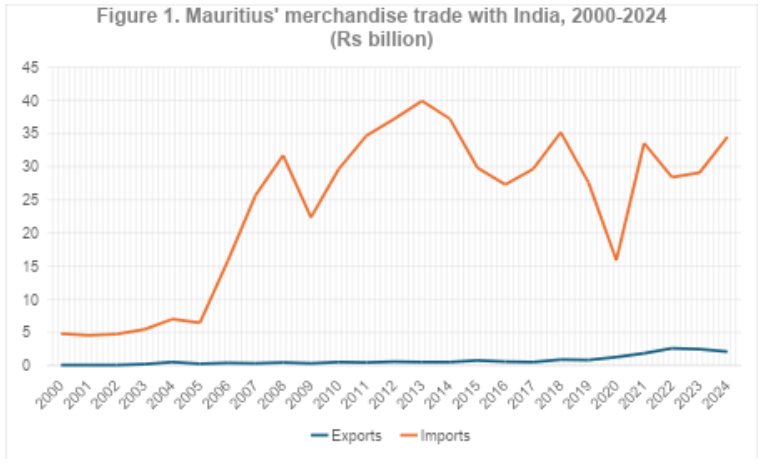
Trade between Mauritius and India is lopsided and totally in India’s favour. Merchandise imports from India increased sharply in the early 2000s to a peak of nearly Rs 40 billion in 2013 (see Figure 1). Imports have, since, hovered around Rs 30 billion, on average, recovering after a massive 42% decline in the pandemic year of 2020. Yet India remains the third largest supplier to the Mauritian market, after China and the UAE. Key imports from India include mineral fuels (accounting for 16% of total imports from India), pharmaceutical products (10%), motor vehicles (10%), cotton (9%), and cereals, notably rice (6%). Petroleum products were, by far, the single biggest import item from India between 2006 and mid-2019 when the supply contract with India’s Mangalore Refinery and Petrochemicals Limited was terminated. While the share of oil in India’s exports to Mauritius has consequently shrunk, mineral fuels still dominate Mauritius’ imports from India.
Conversely, Mauritius’ merchandise exports to India have been flat and negligible since 2000 but have increased slightly to around Rs 2 billion in recent years. This increase in exports is hardly any cause for celebration, though. Scrap metals (iron, aluminium and copper) are Mauritius’ main exports to India, accounting for just over half of total exports to India in 2024. Mauritius also exports some medical and surgical devices, vanilla and clothing to India, but these exports are tiny in value and are eclipsed by scrap metals and paper.
The gap between exports and imports remains glaring by any standard. At its peak in 2013, Mauritius imported 74 times more from India than it exported to the subcontinent. In 2024, this ratio was 16 to 1, still worryingly high. India alone accounts for 14% of Mauritius’ overall trade deficit.
India’s dominance also extends to services trade, an area where Mauritius has historically registered a surplus. Yet, with respect to India, Mauritius shows a deficit, with a tendency to widen in recent years as Mauritius’ exports of accounting and financial services to India have declined.
II. CECPA and its potential impacts
3. Background to the CECPA
Negotiations on the CECPA started back in 2004 but soon slipped into an impasse because of allegations by India that Mauritius was condoning certain shell companies (i.e. inactive companies used as a vehicle for financial manoeuvres, including illicit ones) that purported to do business in India. And then, out of the blue, the Indian Minister of External Affairs was rushed to Mauritius in February 2021 to conclude the long-drawn negotiations and sign the Agreement.
One can speculate about the real motives behind such precipitation. Was it in response to the entry into force of the Mauritius-China FTA on 1 January 2021? It could well be the case – for Mauritius is caught up in a power game between China and India. Both countries have been rolling out tit-for-tat strategies as they vie to maintain economic hegemony over tiny Mauritius. While Mauritius should respond to China’s advances with caution, given the sensitivity around the Chagos issue, it can only revel in the competition for influence between two of its closest partners and the world’s biggest economies.
Or perhaps India has suddenly wakened up to Mauritius’ potential as a platform out of which to engage with Africa, as it trails its arch-rival – China – in the scramble for Africa. As an established member of regional groupings such as SADC, COMESA and IOC, and a party to the African Continental Free Trade Agreement (AfCFTA), trading under which also started on 1 January 2021, Mauritius offers unique advantages to Asian countries seeking to expand trade with Africa.
A more likely reason is geopolitical. Mauritius occupies a coveted position in the Indian Ocean and boasts an extensive EEZ, rich in marine resources and, potentially, offshore oil. Most of the world’s superpowers are vying for control over the Indian Ocean, and several have already established a military or strategic presence in the region. India is allegedly eyeing Agaléga as a potential military base as it seeks to reinforce its a military presence in the Indian Ocean.
4. Salient features of the CECPA
Contrary to modern-day deep integration arrangements, the CECPA remains rather traditional – and shallow – in its scope and objectives. It has a narrow focus on trade in goods and in services. The Agreement does not include a separate chapter on investment other than through Mode 3 (commercial presence) of Trade in Services (chapter 6 of the Agreement), nor does it address issues related to competition, intellectual property rights (IPR), and e-commerce – the so-called “WTO-plus issues”. A ninth chapter – on General Economic Cooperation – was added later in August 2022, and it is unclear if it has been activated.
Trade in goods
Mauritius has a fairly liberal trade regime. In 2023, the trade-weighted average tariff was a mere 1.3%: 3.9% on agricultural goods and 0.7% on industrial products. (These are MFN applied tariffs, that is non-preferential tariffs commonly applied on imports from countries that are not members of a trade agreement.) At 23.5%, the highest MFN applied tariff was on sugar and confectionary. Mauritius has bound duties at 122% for most agricultural products and at 65% for most manufactured goods. These are the ceilings to which tariffs could be raised under exceptional circumstances without violating WTO commitments. In the CECPA, Mauritius has offered further tariff cuts on Indian goods such as spices, tea, plastic products, furniture and automative parts.
India, on the other hand, has one of the world’s most restrictive trade regimes. In 2023, the average trade-weighted tariff stood at 12%, or 65% on agricultural goods and 9% on manufactures. Over 90% of agricultural imports into India attract an MFN applied tariff of more than 25%. The majority of non-agricultural goods feature tariffs in the range of 5% to 10%, but import duties reach 239% on certain items of clothing. India has bound duties at 150% for most agricultural goods and at rates ranging from 40% to 157% for industrial goods.
For any free trade agreement (FTA) to be WTO-compliant, it has to conform to GATT Article 24, among others. This provision requires parties to an FTA to “liberalize substantially all trade”. As far as trade in goods is concerned, this has come to mean that tariffs on at least 90% of imports should be reduced or eliminated. In the CECPA, Mauritius has committed to cut tariffs on 310 products while India would offer preferential market access to Mauritius for 615 products. This includes extensive use of tariff-rate quotas (or TRQs, which allow a pre-determined volume of imports at a preferential tariff but slap out-of-quota volumes with significantly higher tariffs) by both countries. Moreover, the Agreement provides for market access on a rather long list of products (including plastics, aluminium, iron and steel, and articles thereof, and toys) to be negotiated later, without indicating any time frame for such negotiations. No party has revealed the overall magnitude of tariff liberalization, and it is debatable whether it comes anywhere close to the 90% threshold required under GATT Article 24.
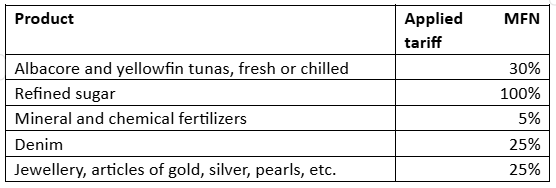
There are several products of export interest to Mauritius on which India offers preferential TRQs. They include fruits (pineapples and lychees), prepared or preserved tuna, speciality sugar, beer, fruit wine, and rum (Table 1). Other products subject to substantial tariff cuts are soap, washing and cleaning agents, travel goods and handbags, watches, clocks, sunglasses and industrial diamonds, and medical instruments. As usual, however, the devil lies in the details. Many products in which Mauritius is reputed to have a comparative advantage are excluded (that is, they continue to be subject to MFN tariffs). Among them are fresh or chilled tuna, refined sugar, mineral or chemical fertilizers, denim, and jewellery (Table 2).
Table 1. Products of export interest to Mauritius covered by CECPA
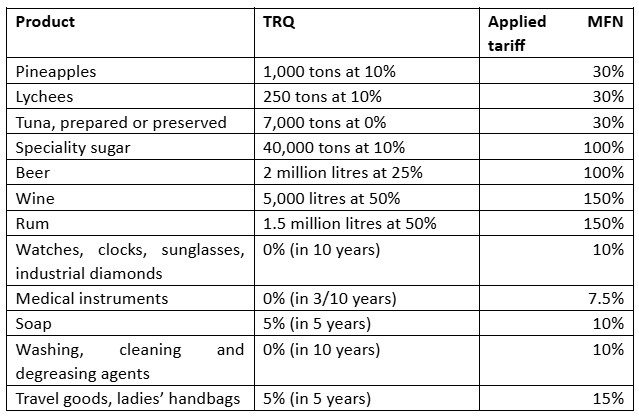
Table 2. Products of export interest to Mauritius excluded in CECPA
The rules of origin (which determine whether an exporting country could claim that a given product was ‘substantially produced’ in its territory for it to qualify for preferential tariffs under a trade agreement) follow international best practices and are quite flexible. They are product-specific and generally require either a change in tariff heading (‘single transformation’) or value addition ranging from 30% (in the case of cotton woven fabrics) to 40% (for pharmaceutical products), or both. The rules of origin allow for bilateral cumulation, that is, if Mauritius uses raw materials or inputs imported from India in the production of a good, it can account for them as if they originated in the country itself for the purposes of determining the value addition.
Trade in services
Both countries have undertaken significant commitments in the services sector. Mauritius will provide improved market access to India in over 120 service subsectors while India has committed to liberalizing some 94 subsectors. The Agreement includes separate annexes on financial services and telecommunication services – a testament to the importance of these subsectors to both countries. There is also an annex on the movement of natural persons, which represents Mode 4 of Trade in Services. For the sake of completeness, note that Mode 1 refers to ‘cross-border supply’ (e.g. call centres), Mode 2, ‘consumption abroad’ (e.g. tourism), and Mode 3 ‘commercial presence’ (e.g. Indian banks operating in Mauritius). The Agreement provides for the mutual recognition of qualifications and experience.
Just as the regime for trade in goods, Mauritius boasts a services sector that is more open to trade than is India’s. Moreover, Mauritius has imposed few restrictions or conditions on Indian service providers and professionals, and where they exist, they are meant mainly as prudential measures, such as those aimed at protecting investors and depositors, and ensuring financial stability, in the case of financial services. Notably, Mauritius has committed to imposing no labour market or economic needs tests, or similar procedures, as conditions for the temporary entry of natural persons (i.e., Indian professionals). Conversely, in its horizontal commitments, India has specified numerous limitations on market access and national treatment. These include numerical quotas in respect of visas for skilled Mauritian professionals, limits on foreign equity participation, and economic needs tests for service providers in the financial sector.
5. Potential impacts
Both Mauritius and India have signed a variety of free trade agreements with individual countries or groupings. FTAs represent an attempt to liberalize trade selectively – bilaterally or regionally – rather than multilaterally, and the motives behind them are usually more political than economic. Not surprisingly, therefore, the economic impacts of the CECPA – on trade, investment and movement of professionals between Mauritius and India – may be rather small and eclipsed by non-economic considerations. The CECPA has now been in operation for about 4 years – a period too short for any meaningful analysis. Such analysis is further complicated by the fact that detailed data on Mauritius-India bilateral investment and services trade is not available.
Goods trade
Notwithstanding the above limitations, examination of merchandise trade between Mauritius and India reveals a slight increase in both imports and exports since 2021 (refer to Figure 1), and the Mauritian authorities confirm that exports to India under the CECPA (that is, exports accompanied by a valid certificate of origin delivered by the MRA) are on the rise. However, only time will tell if this increase represents additional trade or simply exports that were previously on an MFN basis but are now reported under the terms of the Agreement.
The government of Mauritius is upbeat about the CECPA, and its potential to boost Mauritius’ exports of both goods and services into the large yet elusive Indian market. However, such optimism should be taken with a pinch of salt. Take, for example, the prospect of exporting 40,000 tons of speciality sugar to India at an in-quota tariff of 10% (representing a margin of preference of 90%). This raises several questions. First, where will this additional volume come from given that raw/special sugar production has been on a steady downward trend, declining by 40% between 2014 and 2023?
Second, even if the market for speciality sugar exists in India, will Mauritius want to export to India? The Mauritius Sugar Syndicate reports that speciality sugar exports under the CECPA have been “challenged by the price control in place for Indian sugars” (MSS Annual Report 2023-24). This suggests that an export potential may not materialize if the price received for the product is not internationally competitive, or if exports are hindered by other non-tariff barriers.
Finally, is there an effective market for Mauritian special sugar in India? Mauritius has traditionally exported its special sugars to Europe and the US, and Asia has accounted for just 8% of exports in recent years. India is a huge consumer of refined sugar, and keenly protects its domestic sugar industry, with tariffs on sugar imports reaching 100%. Mauritius can only hope to carve out a small niche for its speciality sugar in the traditional Indian market by raising awareness of its brand through an aggressive marketing campaign.
The same can be said of the potential to export substantial quantities of tuna and, especially, beer, wine and rum under the ‘generous’ TRQs offered by India under the CECPA. Exports of Mauritian rum and spirits have increased exponentially since 2006, and the large Indian market looks attractive, in theory. In practice, while the Agreement provides a quota of 1.5 million litres of rum, the applicable tariff of 50% may be prohibitive. Mauritian rum is not cheap to begin with and, so, it is inconceivable that the product will be competitive after adding a 50% tariff to the CIF price. Beer and wine may suffer the same fate. Beyond tariffs and prices, these products must win over Indian consumers accustomed to local varieties. That is the bigger challenge facing Mauritian exporters.
Moreover, the CECPA excludes several products of export interest to Mauritius (see Table 2). Denim and jewellery, in particular, presents good potential, but these products attract MFN tariffs of 25% and 20%, respectively, and India is itself a competitive producer of them, making it difficult for Mauritian exporters to make a dent into the Indian market. Conversely, products like medical instruments, watches, clocks, sunglasses and industrial diamonds, soap and detergents, and travel goods appear as low-hanging fruits. Mauritius has an established comparative advantage in these goods, and is already exporting some medical instruments to India. This is where the Mauritian government and exporters should focus.
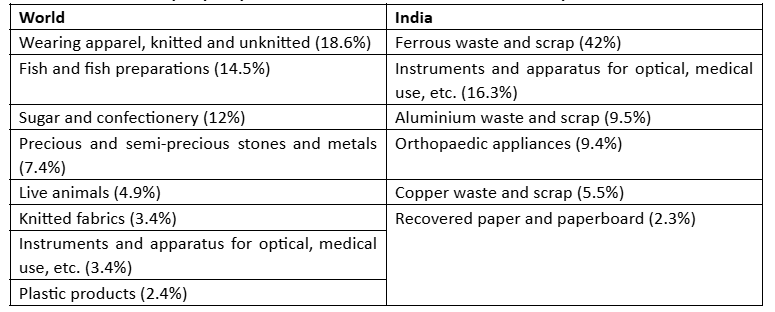
Table 3 shows Mauritius’ top exports to the world and to India in 2023/24. The data suggests a low degree of concordance between Mauritius’ exports to the world compared to India. As noted, Mauritius has mainly exported scrap metals and waste to India in recent years. However, medical instruments, which are among Mauritius’ biggest exports to the world are also an emerging export to India. The CECPA offers duty-free treatment on this product, which could spur its exports to India in the future.
**Table 3. Mauritius’ top export products to the World and to India in 2023/24 **
Services trade
Both Mauritius and India are net exporters of commercial services. Mauritius is an inherently services-oriented economy. Services exports, which are dominated by travel and tourism, accounted for 69% of total exports (of goods and services) in 2023. Given the country’s competitive advantage in the services sector, Mauritius is hopeful that the CECPA will unlock new opportunities for services exports to India.
With a score of 0.29 on the OECD Services Trade Restrictiveness Index (STRI), India’s services trade regime is more restrictive than any OECD countries’, but globally, this is not a bad performance. At the subsector level, financial services and telecommunications feature relatively low STRI, so any market access advantage offered by the CECPA would be limited. Moreover, India is itself a major exporter of telecommunications services globally while Mauritius’ prospects to increase financial services exports to India may have been dented by the amendment to the Double Tax Avoidance Treaty in 2016. In other words, just like trade, the prospects offered by the CECPA in the services domain are likely to be in India’s favour.
One service area where Mauritius can clearly benefit is Mode 4: Movement of natural persons. Mauritius is already host to thousands of Indian workers in the construction and manufacturing sectors. This trend will only accentuate as labour shortages intensify in the years ahead. Hopefully, the Agreement broadens the scope for Indian professionals also to come to work in Mauritius in IT-enabled services, such as software development, fintech and AI.
6. Final word
The impacts of the CECPA on the partners’ economies merit further research. Yet, our analysis so far indicates that the Agreement’s benefits will be rather limited and biased in India’s favour. Mauritius’ exports to India, both of goods and of services, are virtually inexistent. While the CECPA will provide preferential access to a variety of Mauritian products, it appears that the potential to penetrate the Indian market is slim. Thus, in the short term, the CECPA may amplify the already-large trade deficit that Mauritius has vis-à-vis India.
However, over time, the trade relations between Mauritius and India can become more balanced if Mauritius focuses on the few export products that offer quick wins. These include medical instruments, soap and detergents, travel goods and accessories, and industrial diamonds. A targeted marketing stint by the Economic Development Board to promote the Mauritian label in India should, thus, be a priority. Finally, the TRQ for Mauritian rum is unexploitable given the in-quota tariff of 50%. Mauritius should renegotiate this TRQ in a future review of the Agreement.
Mauritius’ scope to export financial and telecommunication services under the CECPA is also limited. Conversely, Mauritius can benefit from Indian investments in modern services and can tap into India’s large pool of professionals where they are most needed.
Ultimately, the CECPA’s developmental impacts on the Mauritian economy are unlikely to come from the areas that this article has focused on, namely trade, whether in goods or in services. They are more likely to arise from technical assistance and economic cooperation, which occupies a full chapter in the Agreement. Mauritius should leverage India’s expertise in biotechnology (breeders’ rights, high-yield seed varieties, pest- and climate-resistant crops, etc.) and sustainable agriculture to enhance crop productivity and food security. The blue economy has been neglected over the past ten years as the Ministry in charge of this sector focused on artisanal fishing. Mauritius can surely benefit from India’s advances in the blue economy sector and, in particular, learn from its Blue Strategy. Technical assistance and staff exchange should help in the diffusion and adoption of best practices between the two friendly nations.
Isn’t it paradoxical that an Agreement that took over 16 years in the making is of such little value to Mauritius? But a bad deal should not be left to get worse. While the CECPA has clear legal provisions in the chapters on trade in goods and trade in services, the language on economic cooperation leaves room for hope. Mauritius should make chapter 9 of the Agreement its prime focus.
Publicité
Publicité
Les plus récents