Publicité
GDP
Why the MSM’s argument does not add up
Par

Partager cet article
GDP
Why the MSM’s argument does not add up
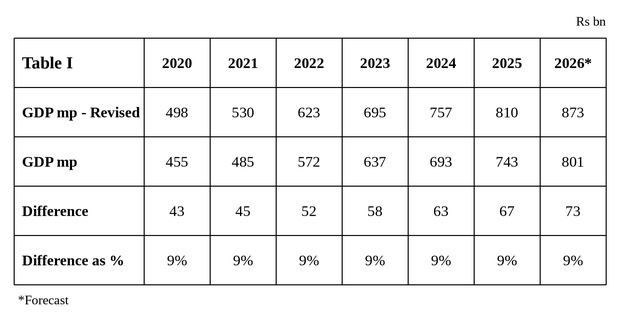
GDP statistics were revised at end September 2026 by Stats Mauritius as part of a periodic exercise carried out every 5-6 years following (i) the conduct of a new Census of Economic Activities in 2023, (ii) the improved coverage of Global business companies (GBC) trade merchanting activities with the help of an IMF technical mission, and (iii) recommendations of the 2025 System of National Accounts.
The previous GDP revision was done in 2022, which raised GDP data for several years by about 4% due to improvements in the estimation process and the coverage of activities. The September 2026 revision increased GDP by about 9% on average.
The former PM and the MSM are claiming that the higher revised GDP estimates show that the GDP reductions made in the State of the Economy (SOE) document issued by Govt in December 2024 were wrong.
It should be pointed out that GDP reductions were made in the December 2024 SOE mainly for the years 2023 and 2024, to reduce the overestimated levels of investment and of GBC services export figures. And Stats Mauritius in its December 2024 publication on the National Accounts endorsed these GDP decreases for 2023 and 2024, while urging for IMF technical support to further improve on GBC data coverage. Following the report of the IMF technical mission in 2025, GBC merchanting activities are now better covered in GDP calculation.
The current September 2026 GDP revision is not related to, or concerned with, the GDP reduction for 2023 and 2024, or the SOE. Instead, it applies to GDP estimates over several years, with a revised GDP series as from 2013, published in its National Accounts September 2026 issue.
It is therefore totally false to assert that the GDP revisions of September 2026 have disproved the GDP reductions for 2023 and 2024 made in SOE and by Stats Mauritius in December 2024. Quite the contrary. In 2023 and 2024, Govt overestimated GDP data by inflating investment and GBC exports of services. The then Minister of Finance even claimed on the eve of 2024 elections that Mauritius was witnessing an economic boom, with real GDP growth rates of 7% in 2023 and 6.5% in 2024.
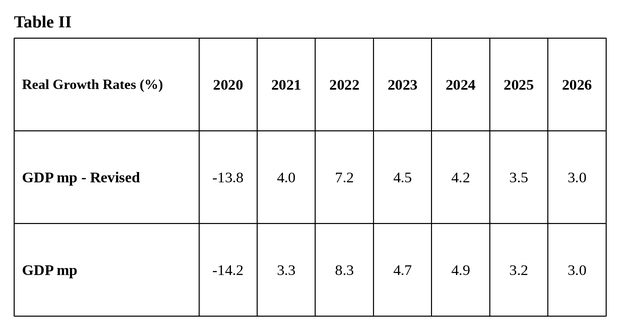
In December 2024, the SOE and Stats Mauritius reduced these real growth rates to 5.6% in 2023 and 5.1% in 2024. The current GDP revision of Stats Mauritius in September 2026 has further reduced the growth rates to 4.5% in 2023 and 4.2% in 2024.
This clearly shows that the SOE and Stats Mauritius were justified in December 2024 in making GDP adjustments to correct for deliberate overestimation of statistical data, and in fact did not go far enough in adjusting GDP real growth rates downwards.
Note on Revision of GDP statistics
GDP statistics have been revised in September 2026, following a new statistical benchmarking exercise that is normally carried out every 5 years. The new GDP data are around 9% higher. (See Table I)
As a result of the broad uniform increase across the GDP series, GDP growth rates have remained mostly unchanged. (See Table II)
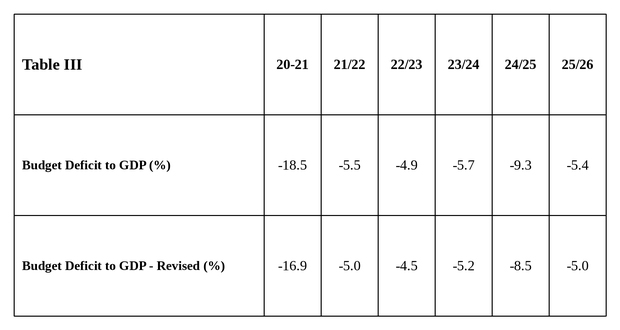
The ratio of the budget deficit to GDP shows a general decline of about half a percentage point. The deficit for 2025-2026 is now at 5% of GDP instead of 5.4%. (See Table III)
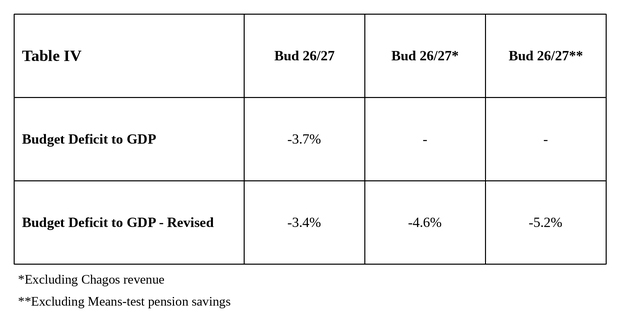
For the current financial year, the 2026-2027 deficit was budgeted at 3.7% of GDP, but now stands at 3.4%. If Chagos revenue does not materialize, the deficit will rise to 4.6% of GDP, and further to 5.2% of GDP without any offsetting fiscal measures for the withdrawal of pension means testing announced in the budget. The budget deficit is likely to lie between 4.5% and 5% in 2026-2027, implying weak fiscal consolidation over the previous year, especially compared with the sizeable fiscal adjustment in 2025-2026. The deficit is here narrowly defined to cover only budgetary operations, without considering the deficit in special funds. (See Table IV)
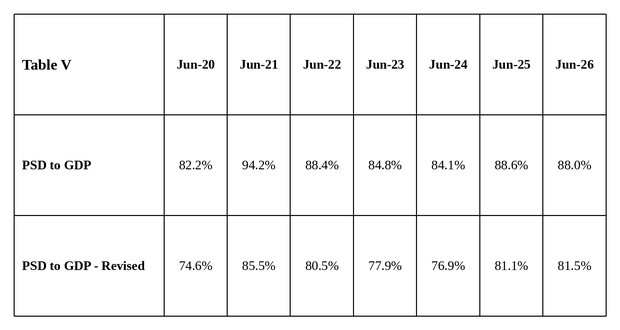
The ratio of public sector debt (PSD) to GDP, excluding any consolidation adjustment, will drop significantly by an average of 7 percentage points. PSD at end June 2026 will decline from 88% to 81.5% of GDP. Without Chagos revenue, the public debt ratio will still be around 80% in June 2027. (See Table V)
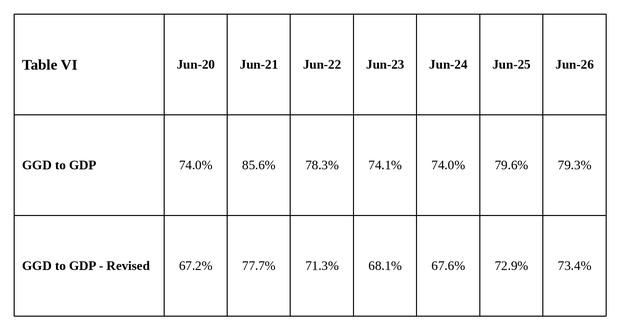
Moody’s focuses on general government debt (GGD) rather than public sector debt, mostly to allow for easier comparison with other countries. GGD will show a decline from 79.3% of GDP to 73.4% in June 2026, and marginally lower to around 73% in June 2027, without Chagos revenue. Despite the decrease in the public debt ratio, Mauritius remains well above the Moody’s mean Govt debt ratio of 58% for Baa-rated peer countries like Mauritius. (See Table VI)
While the GDP revision does help in easing the task of fiscal consolidation, it does not materially change the need for stronger fiscal efforts to improve the deficit and debt ratios further. The global energy crisis is a severe external shock that is compromising growth prospects and adding serious fiscal strain. Mauritius remains a candidate for sovereign credit downgrading, unless more fiscal and monetary tightening measures are adopted.
Publicité
Publicité
Les plus récents