Publicité
In focus
Social integration | Ageing with dignity: A bridge across generations
Par


Partager cet article
In focus
Social integration | Ageing with dignity: A bridge across generations
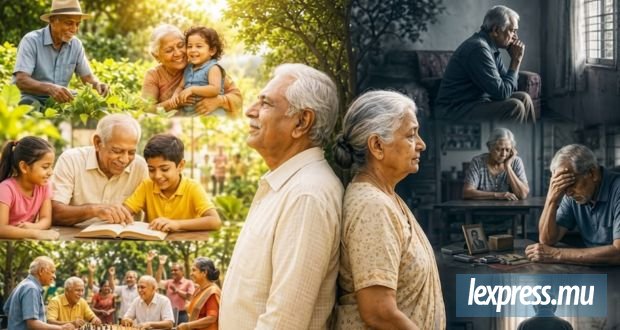
Ageing is no longer a challenge of the future – it is a reality of the present. Mauritians are living longer, birth rates are declining, and family structures are evolving. Discussions on ageing too often focus solely on pensions or dependency. As Mauritius grows older, is there a risk of its growing further apart from the generation meant to carry it forward?
The narrative
October 1 celebrates the International day of older persons to raise awareness about the challenges and opportunities of ageing, and highlight the importance of creating a world where they can live with dignity, independence, and inclusion. Moreover, the official Vatican calendar observes the World day for grandparents and elderly on July 26, aligning with the Feast of Saints Joachim and Anne (Jesus’s grandparents). The theme this year is “I will never forget you”. Coincidence or not, on July 30, the ministry of Health opened its third ‘Acute Care of the Elderly (ACE) Ward’ at Victoria Hospital, offering specialised, personalised treatment for elderly patients, alongside a family meeting room and a new ‘Standard Operating Procedure’ staff guide.
Both events prompted us to highlight the big picture in Mauritius, one of Africa’s fastest-ageing societies, where seniors aged 60+ make up roughly 19-20% of the population (286,500 people). Legally, elderly protection rests on two complementary frameworks. The 2005 Protection of Elderly Persons Act targets abuse against those aged 60+, operating through the Welfare and Elderly Persons’ Protection Unit (EPU). The new Domestic Abuse Bill (No. VIII of 2026), passed on July 10, has extended protection to all family relationships regardless of age, criminalising coercive financial control, psychological abuse, and neglect, and introducing exclusion orders, remote hearings, and private proceedings – sparing seniors prolonged public court battles.
Moreover, civil society representation is quite extensive: over 915 registered Senior Citizens Associations across Mauritius and Rodrigues group roughly 97,000+ members – about a third of all seniors – under the statutory Senior Citizens Council (SCC), which advises government on policy and is affiliated internationally with HelpAge International, IFA and FIAPA. The associations cover advocacy, social integration, health screening, and welfare alerts to the EPU.
However, gaps remain: frail, bedridden or dementia-affected seniors are largely unrepresented by these associations, many of which function more as social clubs than advocacy bodies, and the SCC’s government-funded, ministry-supervised status is seen as limiting its capacity to challenge official policy compared with independent NGOs.
On the other hand, official data for 2023 recorded 1,245 elderly abuse cases: psychological/emotional abuse (621, ~50%), neglect (262, ~21%), financial/ economic abuse (185, ~15%), physical abuse (174, ~14%), and sexual abuse (3). Women represented over 71% of victims across all categories. Authorities believe actual numbers are higher due to underreporting, driven by family stigma, fear of retaliation or economic dependency on caregivers. Press reports regularly document physical assaults by neighbours or family members; exposed care-home neglect has prompted calls from NGO (DIS-MOI) for stricter EPU oversight; and financial coercion by relatives targeting pensions or property seems to be common.
Frail, isolated, overlooked
Advances in healthcare and living conditions have extended life expectancy, but large extended families that once ensured elders were looked after until their final days have now become nuclear ones with new realities and challenges. Behind this demographic shift lies a quieter reality: loneliness. As children of Mauritian baby boomers went abroad – for studies or looking for greener pastures –, ageing parents feel their absence. Even the financial support they send from overseas cannot replace the warmth of their emotional presence.
Family homes once full of life have become silent and even within multigenerational households, older members can feel like observers rather than participants, and decisions are sometimes taken for them without consultation. Feeling excluded can be just as damaging as physical illness. With the fast advent of technology in this century, one can witness an ageing population and a fast-moving younger generation drifting further apart.
Respect for elders, which has always been a pillar in Mauritian culture, is a principle that does not always translate into practice. Expressions such as ‘vie siko’ (old snag) or ‘dinosaur’ casually dismiss older people as incapable, reinforcing the idea that ageing equals decline. An opinion voiced by a young adult may be deemed bold while the same opinion from an older person may be dismissed because of their age. Families, often out of love, may make decisions on their behalf – unintentionally stripping them of their independence.
Longer life expectancy also brings health challenges: diabetes, hypertension, cardiovascular illness, mobility issues, dementia, and Alzheimer’s place growing pressure on families and healthcare services. Family caregivers usually provide invaluable, often unrecognised support, while dependency can expose older persons to financial exploitation, emotional abuse, and neglect, often suffered in silence. Protecting elders from abuse is just as important as providing medical care.
Invaluable contribution
Yet, many Mauritians from all social classes remain active well beyond retirement age and continue to make invaluable contributions to society every single day. They thus ensure that younger generations remain connected to their roots in a rapidly changing world, where this role has never been more important. Within families, they cook, care for grandchildren, and provide stability that allows parents to remain in fulltime work – unpaid care rarely counted in economic statistics, but vital to it.
Retirement does not necessarily mark the end of productivity. Many Mauritians in their late sixties, seventies, and even eighties continue to work because they remain capable, passionate, and committed to contributing. They run small businesses, are ‘pro bono’ professionals, volunteers in NGOs or mentors for younger generations, transmitting values – respect, resilience, compassion, patience – forged through experience that no digital platform or artificial intelligence can replicate. They are living archives, preserving and transmitting ancestral languages, traditions, family recipes, and oral histories that encompass our rainbow nation.
Older, not invisible
Mauritius has long prided itself on family, solidarity, and mutual respect – values now tested by an ageing nation. True progress will be measured not by economic growth alone. Older persons are not simply recipients of care; they are parents, grandparents, workers, caregivers, volunteers, storytellers, and custodians of the nation’s collective memory. The challenge is not simply to celebrate them, once a year on October 1, but to ensure that in daily life, they remain active, respected, included and heard. Because the way a nation treats its elders ultimately says everything about the society it aspires to be.
Publicité
Publicité
Les plus récents