Publicité
Cambridge SC-HSC Examinations
Behind the scenes of a two-month marathon
Par


Partager cet article
Cambridge SC-HSC Examinations
Behind the scenes of a two-month marathon
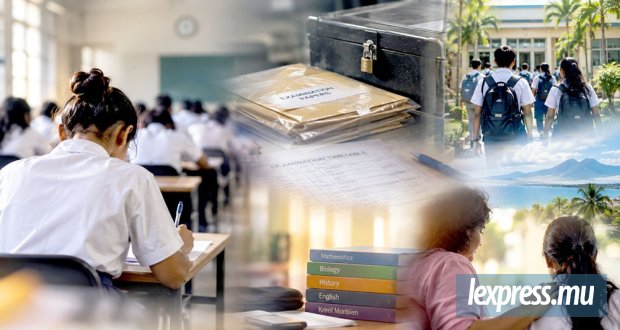
More than 21,000 candidates have started the 2026 Cambridge School Certificate (SC) and Higher School Certificate (HSC) examinations across Mauritius and Rodrigues, an operation that extends far beyond question papers and timetables. While students concentrate on revision, a system is already in motion to ensure that every paper reaches the correct candidate, on time and under strict conditions.
Operational logistics
The first HSC paper was held on Thursday 17 September, followed by an SC paper the next day, launching nearly two months of coordination involving the Mauritius Examinations Syndicate (MES), schools, invigilators, teachers and parents. According to the MES’s latest figures, 8,235 candidates are registered for the HSC and 13,500 for the SC. The scale is significant, but the number of candidates tells only part of the story. Behind each session lies a tightly controlled logistical chain – from securing question papers to seating candidates and enforcing examination protocols.
All written papers are prepared by Cambridge, shipped under strict security, and distributed by the MES to school centres according to precise timetables. While most scripts are marked overseas, a portion is assessed in Mauritius under Cambridge’s supervision. Practical examinations add another layer of complexity: practical subjects such as Food Studies, Art and Design, as well as various science and technical subjects are processed locally by trained teachers, with assessments subsequently ratified by Cambridge examiners to ensure international standards.
Recent measures have further tightened security, including reinforced restrictions on electronic devices and a ban on watches, following malpractice cases recorded during the 2025 sessions. The result is a national operation that extends far beyond the candidates’ sitting – a marathon of coordination, compliance and vigilance.
The governance test
This crucial period of the academic year is a stress test of a school’s governance capacity, ultimately a test of leadership, organisation, and resilience. It reveals the strength of planning, communication, staff morale, and leadership. Operational discipline and educational vision must work together seamlessly. Under intense logistical, human resource, and pedagogical strain, rectors must administer international examinations with zero procedural error while ensuring internal assessments without disruption. They must coordinate with MES supervisors in charge of the examination centres to provide them with secure storage of papers and convert classrooms into examination venues, while ensuring discipline among their candidates. They must likewise reorganise their internal timetables and redeploy support staff to keep daily school life running. As one rector explains, “Once Cambridge exams begin, the entire school shifts into examination mode. We restructure schedules, reassign staff, and ensure strict compliance with MES protocols. Running national exams alongside internal assessments requires daily coordination and absolute precision.”
Human resource pressure intensifies as teachers balance invigilation duties with ongoing teaching. Student anxiety peaks, requiring additional pastoral support. The presence of Quality Assurance teams adds further scrutiny, making operational discipline essential. Another rector captures the emotional weight of the season: “This is an intense time for everyone. Teachers are stretched, students are anxious, and any procedural slip can have serious consequences. My role is to keep the school calm, support the staff, and ensure that both Cambridge and our internal exams run smoothly despite the pressure.”
Two different stakes
For candidates sitting in examination halls, the Cambridge SC and HSC sessions represent far more than a logistical exercise. At SC level, the examination remains a decisive transition point in the Mauritian education system. Results determine whether students can progress to Grade 12 and continue towards the HSC, or consider alternative academic, technical or vocational pathways. The criteria for progression have also evolved. Since 2025, students have been eligible for Grade 12 with a minimum of three credits instead of five.
For 2026, the requirement specifies at least three credits obtained at one sitting, along with a pass in English. The shift has already reshaped the academic stream: after the 2024 SC results, 2,472 candidates with three or four credits could enter Grade 12 under the revised criteria. For this year’s cohort, the SC remains a crucial gateway – no longer defined by the traditional five-credit benchmark.
For HSC candidates, the stakes are distinct. The two-year programme ends with examinations that shape access to higher education in Mauritius and abroad, while determining eligibility for State Scholarships and Laureate status. The broad curriculum is reflected in a timetable covering multiple subjects, including European and Asian languages. The latest addition, Kreol Morisien (KM), introduced at SC level in 2023, is administered locally by the National Examinations Board in partnership with the MES and the University of Mauritius. KM expanded to AS Level and reached A Level status in 2026, with first examinations scheduled for 2027.
Endurance and support
For candidates, classes have ended. With revision leave having replaced the daily routine, students have shifted to individual study schedules, past papers and final reviews. The examination hall is only the visible end point of months of preparation. Outside school, families offer a parallel support system – organising transport, ensuring timetables are correct and helping maintain healthy routines. One mother confides: “Just as other parents, I save my holidays to be beside my kids and discreetly offer the support they need.” Food, rest and emotional stability become part of the strategy, especially as sustained performance over several weeks requires more than academic effort.
The exam session’s length is the toughest challenge and demands endurance. Papers may be tightly grouped or widely spaced, forcing students to constantly adjust their rhythm. A difficult paper may feel like a peak, only for another subject to follow days later. Managing energy, pacing revision and using gaps wisely become essential. An HSC student from Rajkumar Gujadhur State Secondary School shares the emotional weight: “The pressure is definitely there because our family and teachers have high expectations. It can feel overwhelming when we think about how many papers are still ahead.”
To cope, he focuses on manageable steps: “I try to concentrate on one exam at a time.” Support from peers also matters. “We share notes, discuss questions and revise together. Competition exists, but moral support is just as important.” Being surrounded by classmates facing the same long stretch helps maintain balance. Educators often advise treating the session as a sequence – prepare, sit the paper, recover, and move on.
The final stretch
From the outside, Cambridge examinations seem straightforward: students arrive, papers are distributed, answers are written and scripts collected. Behind this simplicity lies a national operation. The MES coordinates the system; schools prepare premises; invigilators enforce rules; parents manage daily logistics; students navigate weeks of pressure. Success depends on all these parts working together. For over 21,000 SC and HSC candidates, the coming weeks will be measured in papers and marks. Once the final script is collected in November, classrooms will be reorganised and everybody will enjoy a much-needed rest while the long wait begins for results expected around the end of January.
Publicité
Publicité
Les plus récents