Publicité
Focus
Louis Cyril Eulalie: A village cobbler challenging the culture of disposal
Par

Partager cet article
Focus
Louis Cyril Eulalie: A village cobbler challenging the culture of disposal
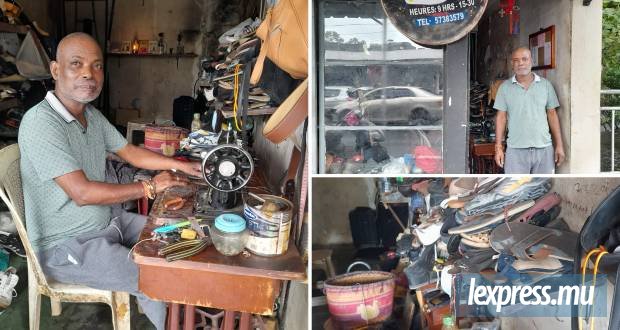
My encounter with Louis Cyril Eulalie this Sunday – he prefers to be called Floris, being better known as such in the village of Bel-Air and around, from Flacq to Mahébourg, to Curepipe and Port-Louis – was just incidental but very enriching. These places are sort of catchment areas for him since he embarked on a profession at the age of 20. He is today 61. I found myself in front of an artisan, nay, an artist, who has found both pleasure and happiness in his profession. Floris is a lone man but surrounded by a clientele that spreads from children to older adults. But what does Floris repair?
Floris has never attended any school except the school of life, having entered the world of work early. He was shovelling sand onto pirogues in the sea around the coastal village of Deux-Frères. The task was physically demanding, with boots, sand, waves and vagaries of the weather impacting on his young age. Prompted by his close ones, Floris joined the workshop of Michel, a famous cobbler in Flacq, who told him the quality of his work should reflect the school from which he had ‘graduated’, the school of late Michel. Today, Floris makes me understand that he always speaks elogiously of Michel, the cobbler of Flacq.
But why is Floris in his workshop on a Sunday? I should have preempted this, in the same way I preempted that Monday is his day off, as for all cobblers. “Li vre ki kordonie pa travay dan lindi?” He gives me his explanation: school children and college students come for repairs, so he attends to the tasks required. On Monday, he stays home, knowing that the students are in their shoes, as good as new, on their way to school. But then, the majority of his regular clients have more time to spare on the weekends. He does not feel the pressure though; he is his own employer and an efficient time manager. We talked while he pushed the stitching awl into the sole of a shoe with a big name so he could pass through the binding thread. He is doing what the forefathers of shoemaking and shoe repairs had done with precision, patience and passion. We had a shared understanding that the shoes ladies do not want to separate from could have a sentimental value, gifted or bought on some special occasion, and men would not find the same models that could cost more or are not available anymore. They all find it hard to get rid of a pair of favourite shoes. Floris tells me the throwaway culture of disposal is being challenged, the more so by the proximity of a cobbler in the village.
Floris is desperate about posterity. He has kept his word with Michel, that of perpetuating a millennium-old tradition of the prominent place a village cobbler occupies in the socioeconomic landscape of a village. For his part, he has found no one as yet to learn from him. He wants to inculcate into whoever wants to learn from him that success comes out of a dint of hard work and that the conditions are favourable, for the village needs the services of a cobbler, as it would need the services of a medical practitioner.
Floris’s shop inside is structured by shelves holding shoes repaired and those on a priority list for repairs. He knows all by heart and from memory: names of owners who have asked him to extend the life of their Sunday best, sports, casual and work shoes and boots.
I have no qualm in saying Floris is a true cobbler.
Publicité
Publicité
Les plus récents