Publicité
Digested week
Health and safety concern | Carbon monoxide poisoning: The invisible home hazard
Par


Partager cet article
Digested week
Health and safety concern | Carbon monoxide poisoning: The invisible home hazard
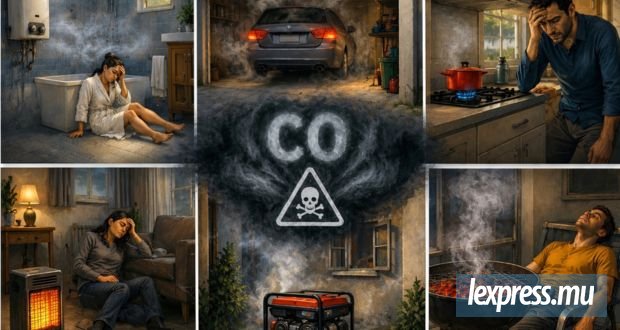
© AI-Generated by Microsoft Copilot.
Public health and safety have been brought into the forefront over the past week after fatal and other incidents renewed concerns over carbon monoxide poisoning and highlighted a troubling reality: this health danger threatening Mauritians today is silent, invisible, but largely preventable.
The narrative
The double tragedy reported at Petit-Verger, Saint-Pierre, on May 29, sent shockwaves across the country. Two professionals were found dead inside a vehicle parked in a closed garage. Forensics led by police pathologist, Dr Sudesh Kumar Gungadin, confirmed the post-mortem cause of death as severe asphyxia due to carbon monoxide (CO) poisoning. Police investigations remain active regarding how the gas built up within the vehicle.
The case quickly reignited concerns over domestic safety and the risks linked to poor ventilation and toxic gas exposure. It also immediately sparked alarm among the public, especially as many Mauritians became aware of how rapidly CO can spread inside enclosed spaces. The gas leaves no visible trace and gives off no smell, making exposure difficult to detect before symptoms appear.
However, this was not the most recent such incident. On Wednesday this week, panic erupted at a primary school in Roche-Terre, in the North, affecting more than 50 students and three staff members. Emergency services were rapidly deployed to the scene. Preliminary investigations suggested the leak could have originated from a nearby house, possibly due to a faulty connection between a gas water heater and a domestic gas cylinder. As of Wednesday night, 13 pupils had been admitted to hospital for observation.
In July 2025, a 16-year-old boy tragically died in Triolet following suspected CO poisoning caused by an unventilated gas water heater. During the same period, two young cousins aged six and 15 were found unconscious inside a sealed bathroom in New-Grove after inhaling toxic fumes linked to a gas appliance. Months later, in November 2025, authorities introduced new safety norms for gas water heaters following repeated warnings about domestic intoxication risks.
A year earlier, in July 2024, 27-yearold Shahana Mamode from Bois-Chéri passed away while taking a shower due to CO buildup from an indoor gas heater installed inside her bathroom. At the time, the incident marked the third bathroom heater-related death recorded within a single week in Mauritius.
The silent killer
Every year, families around the world are harmed or killed by a danger they never saw coming. CO is often referred to as the “silent killer”, because it is impossible to detect without specialised equipment. You cannot see it, smell it, or taste it – but it can kill you within minutes while you are sleeping. This colourless, odourless and tasteless gas produced by the incomplete burning of fuels such as gas, charcoal, kerosene, petrol, diesel, or wood is one of the most insidious threats in any home. In enclosed or poorly ventilated spaces, the gas can rapidly accumulate to deadly concentrations.
In Mauritius, where LPG-powered appliances are a common feature of daily life, the risk is real and largely unrecognised. Bathrooms fitted with gas water heaters, garages, kitchens, and poorly ventilated rooms can become particularly dangerous environments. Medical specialists explain that CO binds to haemoglobin in the blood much faster than oxygen, preventing oxygen from reaching vital organs such as the brain and heart.
The first symptoms can often be misleading. Victims usually experience headaches, dizziness, nausea, fatigue, confusion, or unusual drowsiness. Because these signs resemble those of the flu or exhaustion, many people fail to recognise the danger until it is too late. In severe cases, exposure can lead to unconsciousness, irreversible organ damage, and even death.
Globally, unintentional CO poisoning causes an estimated 41,000 deaths annually, according to an international health study (Wang et al, 2025). However, experts believe the actual number may be significantly higher because many cases are misdiagnosed, never officially identified, or are recorded as unspecified poisoning or cardiac events. Mauritius currently lacks dedicated national statistics on CO poisoning, which further reflects how hidden and underreported the problem remains.
Seasonal risks
The danger increases significantly during winter. As temperatures begin to drop between June and September, many families naturally close bathroom windows, doors, and ventilation openings to keep warm. At the same time, the use of gas geysers, heaters, charcoal burners, and indoor cooking appliances increases. This combination of fuel combustion and poor ventilation creates ideal conditions for CO buildup.
Health authorities have repeatedly urged the public to ensure proper ventilation and regular maintenance of appliances. Dr Fazil Khodabocus, Acting Director of Health Services, recently warned that at least three CO poisoning cases had already been officially recorded since the recent drop in temperatures. Yet, awareness about CO poisoning remains relatively low in Mauritius despite the repeated incidents reported over the years.
Prevention remains relatively simple, straightforward and can be lifesaving. Authorities strongly advise against installing gas heaters inside enclosed bathrooms or operating generators, charcoal stoves, or barbecues indoors. Vehicles should never be left running inside garages, even for short periods. Gas appliances should also be serviced regularly by qualified technicians and always operated in well-ventilated spaces.
The recent events have once again demonstrated how CO can kill within minutes without warning. However it remains largely preventable. Through safer household practices and greater awareness, simple actions can help save lives. If symptoms such as dizziness, nausea, headaches, or unusual fatigue suddenly appear while using gas appliances, immediate medical attention is recommended.
As Mauritius enters the winter season, the message is clear: vigilance, education, and prevention are essential. In the light of the recent events, the authorities could take more proactive measures and launch more public awareness campaigns in the press, on TV and the social media as essential steps towards ensuring that no Mauritian family becomes an invisible statistic.
Publicité
Publicité
Les plus récents