Publicité
Portrait
Ajit Bungloll, the unyielding face of trade union militancy
Par

Partager cet article
Portrait
Ajit Bungloll, the unyielding face of trade union militancy
In a few days, we shall be celebrating Labour Day. Indeed, workers of the world are invited to unite, to stand as one human being recalling that their struggle goes on. The trade union movement in the sugar industry has lost momentum; nay, the fire that kept it burning year in year out has waned somehow but the fighting spirit still prevails. This fire, though reduced to a small area on account of the closure of sugar factories, is jealously kept live. It is against this backdrop that Ajit Bungloll has inherited with his colleagues the fibre essential to maintain an ecosystem for the defence and protection of artisans’ and labourers’ rights.
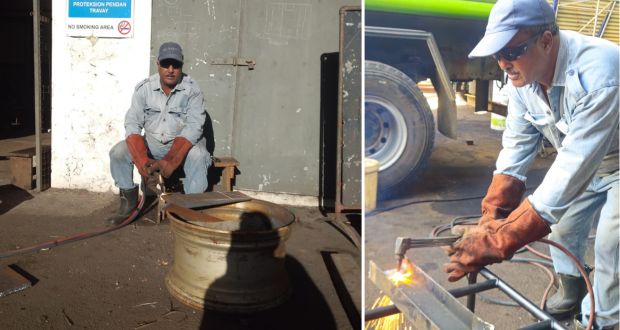
Ajit was born in a family of sugar workers, his father in the factory and his mother in the cane fields. After completing his primary schooling in Britannia and Tyack, he joined Mauritius College in Curepipe. With an astonishing degree of discernment for his age, Ajit chose to train in welding and metal fabrication at the then prestigious Industrial Trade Training Centre. That was in 1982. To date, he has covered 44 years in the job at the Britannia sugar factory. In parallel to learning his job from apprentice to being a qualified artisan, Ajit has rubbed shoulders with his village friends, his seniors, from whom he learnt to debate, speak, breaking barriers to understand more complicated literature of a legal nature.
Further, he sought to know about the trade union movement, dug in its history, thereby discovering Emmanel Anquetil, Pandit Jugdambi, Harryparsad Ramnarain, Rajpalsingh Allgoo, and later on Auguste Follet, Potayya Kuppan, Gopal Bujun, Lutchmun Roy and Devanand Ramjuttun. Ajit had a kind of tryst with destiny when conditions were such that he found himself among the frontline trade unionists defending tooth and nail the rights of artisans of the sugar industry and by extension, those of the labourers’.
The fighting spirit does not suffice, says Ajit. One needs training to understand the dialectical method so as to understand the language, reasoning and stands of the side opposite. Hence, his training at the University of Mauritius for Trade Union Educators in Occupational Health and Safety, Trade Union Administration and Management. One momentous achievement came in the form of the 40 hours a week system in 1994-1995 causing heavy emotions with an acute feeling of the pains endured for years, many workers having passed before that ‘fateful’ turn in the history of the trade union movement in the cane industry.
Ajit is one of the rare workers who has witnessed and participated in the transition post closure of the sugar factory. The welding section has survived obviously to respond to the needs, for example, of the transport unit. Time will come for him to say adieu to his younger fellow workers, remembering with a deep feeling of nostalgia his football team mates, Jean Pierre Bellepeau and Berty Marie of the Britannia Sporting Club. But he will also carry with him loads of arguments, of events and of pictures of the masses, anonymous ones, whom he would have defended to the best of his capacity.
Publicité
Publicité
Les plus récents