Publicité
Portrait
Toon Kallydin: A survivor of Beatlemania
Par

Partager cet article
Portrait
Toon Kallydin: A survivor of Beatlemania
In my adolescent days and youth, we were swept up in an invading culture cutting across all communities in the island. We pulled our bell-bottom trousers, wore shirts with printed flowers, popularly known as chemises à fleurs, and most conspicuously left long hair covering the collar. Beatlemania emerged out of fanaticism ignited by an English rock band in the sixties. The Beatles haircut was omnipresent. Young men sported long hair in the crop fields, factories, bus industry, name it, among local amateur and professional artists.
They had abandoned the habit of having a monthly haircut leaving dressers and barbers grinning seemingly from the doorstep of their ‘salon’. The new fashion sent a shock wave that caused irreparable calamities in the hairdressing profession. Before that, one could count the number of practising hairdressers in a village or urban suburb, mostly middle-aged men having family under their charge. But the tide of change obliged professional hairdressers to give up a battle lost in advance, close shops and change careers to become labourers, masons, lorry helpers, cake sellers...
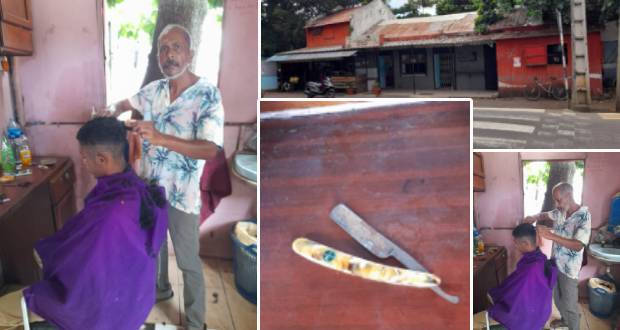
Toon, whom I met in his shop, has been a direct witness to the evolution of hairdressing in his native village of Poste-de-Flacq. He has inherited the profession from his father Bissoon, a longtime respected elderly. Toon was 12 when he joined his father in the very shop he occupies today. Astonishingly the red coloured iron-sheeted structure has resisted the test of time and successive cyclones that have been hitting the country over the half century.
So, the gentleman sitting now waiting his turn for Toon’s pair of scissors is doing exactly what his father had been doing waiting for Toon’s father’s hands. For sure, Toon tells me those who solicit his services have a nostalgia of his father’s time. The furniture comprising his counter, mirrors, chairs and the wooden bench he has inherited will last as long as they are usable. He has kept an old-fashioned razor in a separate drawer, which children feared.
The whetstone (pierre à huile) or commonly spelt ‘piralwil’ and the leather strap, both instruments to sharpen the razor have been lost to memory. This is no impediment as today all barbers use safety blades only once each time to avoid transmission of diseases if ever there is a bruise. Besides he would not keep disinfecting the blade with the same dedicated time after each shaving. Also, Toon reminds me that since the outbreak of HIV-Aids barbers have strict rules to follow in terms of hygiene.
One tends to smile when a client abandons his head and face at the mercy of Toon. He passes a large towel around the upper part of the body without mistake as he eyes me watching. He sprays water on the hair and combs it from front to back which gives enough length to hold the end in his left hand and apply the pair of scissors with his right thumb and index. The gentleman in his hands listens to us docile purporting he is not here. Toon has had no great schooling, but he is a savvy professional earning his livelihood in the shoes of his late father.
In Poste-de-Flacq, Toon tells me he has only one or two female clients although the gentlemen and their sons come as far as the villages of Flacq, Lallmatie, Caroline. His fellow villagers who patronized his father give him all the support he deserves. Toon is a household name after Bissoon. A village heritage from father to son.
Publicité
Publicité
Les plus récents