Publicité
Portrait
Devanand Jimla: the one-and-only village tailor in Rivière-du-Poste
Par

Partager cet article
Portrait
Devanand Jimla: the one-and-only village tailor in Rivière-du-Poste
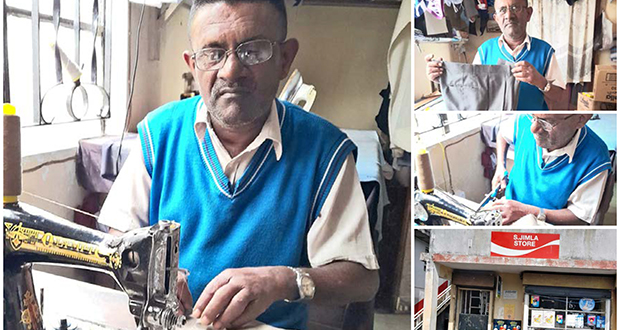
An overwhelming feeling of nostalgia has been overcoming me these past days. Childhood memories came stealthily as I drove by the narrow road that cuts through the village of Rivière-du-Poste from end to end. So, last Thursday morning, I reached my primary school mid-way and cast a glance at the concrete building opposite that replaced a corrugated iron sheet Chinese shop closed many decades ago.
My going through has been gratified by my encounter with the unique tailor who is cutting his way at a time when the ready-to-wear fashion culture is the norm. Devanand took to apprenticeship in Pointe-aux-Piments at his cousin’s, Indur Jemmeela. Indur imparted all his technical knowledge of measuring, tracing, applying the heavy pair of scissors, doing the ‘fofil’ and sewing without any defect or zigzagging on the cloth. The ‘fofil’ operation consisted of manually passing the needle and thread on the cloth folded along a chalked line to hold it straight. The machine needle would repeat the sewing to replace the ‘fofil’, which would be removed, this being the last but one stage before pressing.
Devanand tells me he had no choice but to sit in a tailor’s shop at 11 despite excellent performance in the Standard VI, then known as the Primary School Leaving Certificate examinations. At 65, the markings are still vivid in his memory: English 95, Arithmetic 98, French 96, and Geography 92. He is grateful to Mr. Michel Lenette, a caring teacher, who made the pupils do the papers again as he was so keen to be sure of their performance.
Full-fledged ‘homme de métier’
But the parents, both labourers, could hardly sustain the household with five children. So, the eldest of them all was chosen to leave home and move quarters to Pointe-auxPiments where he would spend almost 31 years. The young Devanand had surely some pangs in the heart but his poupou, father’s sister, provided all the love his own mother would have tendered. Indur left for France and left the tailor’s shop in his responsibility. Hence, a major turning point in his life where he established himself as a full-fledged ‘homme de métier’ (a man with a job). He married.
Our conversation transported Devanand to yonder years of youth, friendship and coastal village events. The names of his close friends of Pointe-aux-Piments trickle down – Deojeet Reedoye, Soobiraj Ramloll, Ramesh Panchoo, Visha Panchoo – the last two, primary school teachers, holding a privileged audience to whom to talk in the tailor’s shop. Today, Devanand has no regrets, the more so as he has returned to his native village to practise his trade. He tailors basically shirts and trousers for his fellow villagers, for people of Mare-Tabac, of New-Grove and sometimes, of Camp-Diable. But this clientele is inexorably fading as the readymade garments are deemed easy to purchase.
Following his instinct of survival, the village tailor has taken to retailing foodstuffs to make ends meet. His patrons obtain a service for which they have no complaints in view of his punctuality. He is on his feet at 04.00, on his toes ready to supply loaves at 05.00, a ritual respected by seller and buyers. In the day Devanand resumes his place at his sewing machine which has never abandoned him on his life journey. My encounter with Devanand has dug out an example of resilience appearing so normal at face value. The resilience is a force to reckon with.
Publicité
Publicité
Les plus récents