Publicité
Electoral reform
Proposals for fair and adequate representation of the people
Par


Partager cet article
Electoral reform
Proposals for fair and adequate representation of the people

There has been a growing consensus that our electoral system should be reviewed. This thoroughly researched paper examines the issues of the existing Best Loser System and the much needed Proportional Representation; it also advocates an overhaul of unequal constituencies that could solve those issues, while achieving constitutional guarantees for adequate representation.
1 LEGAL ISSUES
There are three major issues in the electoral system of the Republic of Mauritius which need to be dealt with.
1 The first one is the issue of the BEST LOSER system (BLS) and its attendant need for candidates standing for election to declare their community affiliation and the practice of using outdated statistics (1972) in implementing it.
2 The introduction of Proportional Representation
3 The third one is the UNEQUAL sizes of the Constituencies.
There has been a legal challenge to the Best Loser system via the Mauritian Supreme Court and also via the United Nation Human Right Committee (UNHRC). The UNHRC has made recommendations to which Mauritius has to abide to. They have questioned the legality of using 1972 census data while implementing BLS and also the way one has to declare one’s community affiliation. This has also been pointed out by the Mauritian Supreme Court, although it has left it to parliament and political parties to resolve the issue.
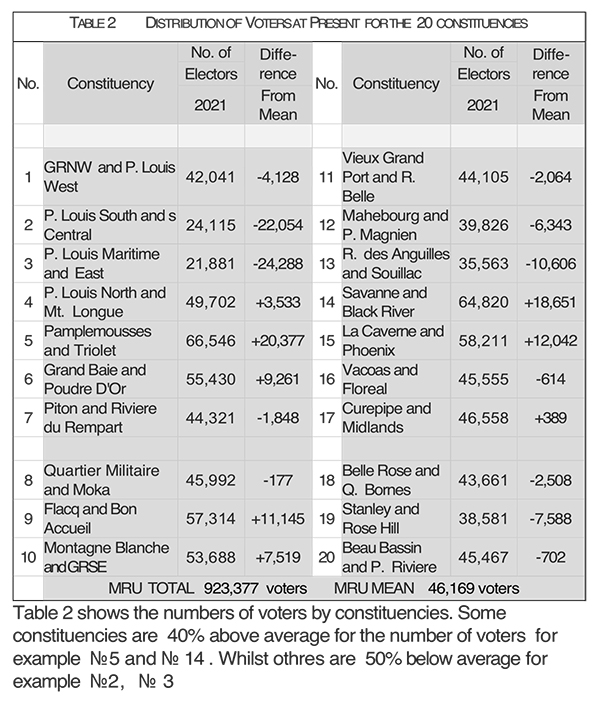
It will not be too long before some political party or individual challenge the issue of UNEQUAL SIZES of the electoral constituencies. The constitution provides that the constituencies should be as equal as possible. Presently one constituency is about 3 times the size of another constituency.
2 NEED FOR CHANGE
The BEST LOSER SYSTEM (BLS) as well as the UNEQUAL SIZES of the different constituencies were initially introduced into our electoral system in the past in order to promote adequate representation of the four categories of the Mauritian population as recognized by the constitution.
Over time and with the emergence of a Mauritian nation, the BLS has quite rightly brought up legal, humanitarian and technical issues, and there is growing consensus and sentiment that it should be reviewed and modified.
Besides the International Covenant on Civil and Political Rights of the United Nations has found that the practice of requiring prospective candidates standing for elections to the National Assembly having to Identify themselves as members of one of the four categories of the Mauritian population, constitute a violation of the rights of candidates who refuse to identify themselves as thus under article 25(b) of the Covenant.
It should here be emphasized that this identification forms the basis of the BLS.
Furthermore there is also a logical need to have constituencies of the same size to ensure fair and equitable representation at elections.
Successive elections have additionally brought to light the urgent need for some form of Proportional Representation (PR)
This document addresses the issues of the BLS, the sizes of the constituencies and PR. It also makes proposals about how we can achieve a more equitable outcome at elections with a fairer Representation of all categories of the population without the need for eventual candidates having to identify themselves as members of specific categories at the initial process.
There is a justified apprehension in a multi racial, multi-cultural country that if the BLS were to be removed and the 20 constituencies in the Island of Mauritius were to be equalized, there will be GROSS under-representation of certain categories of the population as recognized in the constitution and this apprehension is quite understandable.
This document will demonstrate that Equalization of the present 20 constituencies in Mauritius Island will cause more problems in terms of representation.
We need to think outside the box and come with novel ideas.
If we are to increase the total number of constituencies in Mauritius Island from 20 to 24 constituencies, then we can equalize the constituencies quite easily while maintaining adequate representation.
Furthermore we will then be able to modify or eliminate the present BLS.
3 BACKGROUND
There have been quite a few proposals and even commissions looking into the various aspects of the electoral process of Mauritius.
Some looked only at the introduction of Proportional Representation (PR) on its own. Others looked at the Best Loser system on its own and yet others were concerned with how the BLS can be assimilated into a PR system. Others were mainly concerned about the size of the constituencies and how to bring them at par.
As we shall see later these three components are interrelated and we will look at the reasoning behind why matters are the way they are and how we can make changes in a holistic manner.
Mauritius has a Parliamentary system of Government based on the Westminster system of First Past The Post (FPTP). It has 21 Constituencies (20 for the Island of Mauritius and 1 for the Island of Rodrigues) which were initially unequal in size with the 2 constituencies in Port Louis being smaller.
62 members of parliament are directly elected and on top of that there are up to 8 Parliamentary seats being allocated according to the best Loser System (BLS).
The reasons behind the smaller constituencies and the BLS were to enable certain communities which were smaller in size, to be able to elect their members to Parliament.
The allocated seats via the BLS was a compensatory mechanism to achieve overall adequate representation.
Mauritius was a young democracy, fragile and had no experience in Parliamentary democracy. The whole aim of adequate representation was stability and fairness.
Over time, Mauritius has acquired experience in the electoral process. It is felt that a dose of Proportional Representation (PR) would be appropriate, given the fact that on 2 occasions, there were no elected Opposition members in Parliament via the FPTP system and was it not for the small contribution of the BLS, there would have been no Opposition members elected to Parliament.
The BLS itself, though its aims are quite commendable, has raised some issues. It depends upon the candidates declaring their community affiliations in order to be eligible to stand as a candidate in the electoral process. It is also based on data from the 1972 census which is outdated, and hence the legal issue we have to deal with.
The differences in the sizes of the constituencies, though small at the beginning, have grown to an enormous size and therefore there is pressure to deal with this issue.
The aim is towards having equal size constituencies, while maintaining adequate representation. It is worth noting that
1 BLS and the Smaller Constituencies try to assure adequate representation for the different categories of the population .
2 The PR system tries to achieve adequate representation for Political Parties.
It is interesting to note that most elections in Mauritius have been fought on the basis of alliances between different parties in order to guarantee victory at the poll and thus we have evolved into a ‘Consociational’ type of democracy. A "Consociational” system is one whereby a grouping of political parties or pressure groups within a country work together to share power.
4 BEST LOSER SYSTEM
The aim of the BLS has already been mentioned before, that is to ensure adequate representation.
It should however be noted that with the increase of the number of constituencies from 20 to 24 in Mauritius Island, some of the factors leading to under-representation would have been dealt with to some degree. This would eventually make the need for BLS in its present form redundant.
Many pundits have talked about introducing a dose of PR without looking at the major discrepancies in the size of constituencies and how candidates from different communities are fielded presently. We should not have blinkers and should not be under the illusion that the introduction of PR would solve every single issue.
For Electoral Purposes The CONSTITUTION Provides That According To BLS System
1 The “first 4 of the 8 additional seats shall so far as is possible each be allocated to
a The most successful unreturned candidate, if any, who is a member of a party and
b Who belongs to the appropriate community, regardless of which party he belongs to.”
2 For the 4 additional seats.
a If x number of the first 4 seats has been allocated to the most successful party
b And y number of seats have been allocated to parties other than the most successful party
c Then so far as is possible, y number of seats shall “one by one be allocated to
1 The most successful unreturned candidates (if any) belonging both to the most successful party and
2 To the appropriate community
Then if any seat remains vacant, it is allocated to the most successful unreturned candidate (if any) belonging
1 Both to the most successful of the parties that have not received any of the 8 seats
2 To the appropriate community”.*
CERTAIN OBSERVATIONS ON THE BLS
1 There are 8 allocable seats in total. Not all seats were necessarily allocated in the past. Sometimes there were 7 seats allocated or even just 4 seats in some cases. (Pre 1992 Amendment)
2 The BLS takes on board both representation of the categories of the population and of the Political Parties once the list of elected candidates through the FPTP system is known.
3 The winning Party, which will form the Government, always gets 4 seats except if all its candidates are elected or its unreturned candidates are less than 4, in which case it gets the corresponding number.
4 An anomaly has crept in with the case of Rodrigues. Rodrigues had no separate local Political parties initially. Now with the formation of 2 local parties, Rodrigues sometimes gets 2 seats under BLS on top of its 2 elected candidates. Thus it can have double its share of representation at the expense of the opposition parties in Mauritius.
5 There is a misconception that only certain categories of the population are eligible for the allocation of seats. All categories of the population are in fact eligible. It just happens that the main community has more candidates than Its percentage of the whole population would dictate. Members of the main community have also been allocated a parliamentary seat as members of the winning party which always gets up to 4 seats. Thus we have seen Hon Yeerigadoo and Hon Ramdass being allocated seats.
6 The present system of BLS will only work if all candidates declare to which category of the population they belong. This has been an issue as recently some Parties have decided to declare the categories to which their candidates belong to by the drawing of lots.
7 The case of Hon. Sik Yeun is interesting because he declared himself as belonging to the General Population category and was allocated a seat as a member of that category. He is also a member of the Sino-Mauritian population. No Sino Mauritian has ever been awarded a best loser seat until 2014 when Hon Wong was nominated.
8 In fact 95% of Sino-Mauritian are Christian by faith and the Christian community is represented within the General Population category . So what he did was quite understandable because he felt that he is a member of both communities and these communities are not mutually exclusive. This has created an interesting precedent.
9 Some people may look at the BLS with a certain nostalgia. In fact it was through the BLS that certain important characters in Mauritian Politics entered parliament at one time or another. One may recall Sir A R Mohamed who entered parliament through BLS in 1967. Others are Hon. Harold Walter in 1976, Hon. Sir Gaetan Duval in 1991 and 1995, Hon. Xavier Duval in 2000, Hon. Burty David in 2000 and 2005, Hon. Paul Berenger in 1983, Hon. S. Soodun in 1987 and 2005 and Hon. Anwar Husnoo in 2019. In an add-on PR system, these people would also have entered parliament as they would have been high up in the PARTY LIST.
10 One may recall Hon Paul Berenger failing to get elected in Quatre Bornes and also failing to get nominated through the BLS because of the convoluted way the BLS is worked out. On the other hand Hon P. Berenger being the leader of his party would have been at the top of his PARTY LIST and would have entered parliament through the PR system.
11 The way the BLS nominees are worked out is very convoluted and most people do not understand its mechanism. It is very difficult to predict the outcome whereas with PR and its PARTY LIST, one has a good idea of who has a good chance of being nominated.
12 BLS is enshrined in the Constitution and the nomination is made through strict robust mathematical calculation, which albeit being complicated, is not subjected to the whims of the Political Parties.
5 TYPES OF PROPORTIONAL REPRESENTATION PR
There have been a few proposals in the past regarding different modes of Proportional Representation. I will not go through the merit of each and every one of them, which is beyond the scope of this document.
It should be noted that the Golden Standard is a pure straight PR system if fairness is our only consideration.
In Mauritius we already have the FPTP electoral system. Therefore we are talking of an add-on PR system, or mixed member proportional representation. (single vote)
In choosing the type of PR system, apart from fairness, there are other factors that we should consider namely Stability of Government, the history of the electoral system and familiarity of the voters, sizes of constituencies, the number of big and small political parties (leading to splitting of votes and wastage), the ratio of the number of PR seats and FPTP seats, the party list which in some cases should be as long as the sum of the number of FPTP seats and PR seats combined. This will mean that there will be persons who are on the party list but who are not standing as candidates in constituencies. The last one is important in compensatory PR. There are also candidates who are standing at constituency level and who are also on the PR list, so called double candidacies.
The Sachs Commission reviewed in detail the different types of PR that can be applied in Mauritius .
The main PR system used worldwide in a mixed member parliament are broadly:
i The Parallel System of PR which allocates seats based only on percentages of votes obtained by each Party at the election. There is usually a threshold of between 5% to 10 % of votes to be obtained by the party in order to be eligible for PR seats. This system can also change the outcome of FPTP result only if the number of PR seats is much higher than FPTP seats and there are multiple parties.
ii The Compensatory System of PR which takes into account the percentages of votes obtained at the election and the total number of seats obtained via the FPTP and makes adjustments and compensates for any shortcomings in the number of members elected at the First Past The Post System (FPTP). This system is much fairer but can also change the result of the FPTP .
iii There is also the system of SVT (Single Transferable vote) which is quite complicated for the ordinary person to grasp and hence not applicable to Mauritius.
iv In Mauritius recently a system has been proposed called the UVE, the ‘unreturned’ or ‘wasted vote’ system. This system allocates PR seats based only on a pre-selected PORTION of votes called the ‘unreturned votes’ and ignores the total votes each party has scored.
6 THE UVE (UNRETURNED VOTE ELECT) SYSTEM AND ITS ISSUES
This UVE which was put forward by one political party only partially corrects for any discrepancies which the FPTP system introduced as compared to the compensatory PR system.
Certain observations on the UVE system:
1 In the scenario described in a submission describing the UVE system, a party which won 64.16% of votes and obtained 100% of FPTP seats, will on applying the UVE obtain 73.2 % of seats. The upper limit of 73.2% is fixed by the ratio of number of PR seats to the number of FPTP seats. Thus if any party obtains 90% of votes, it will still obtain 73.2% of seats. If there is no threshold of 10%, and a party obtains 99% of votes, it will still be awarded 73.2% of seats which is grossly unfair. ( See Appendix 1) (75% of seats is the number of seats needed for a party to implement its programme in full) (see Appendix 1)
2 The above situation arises because in the UVE system, there is no provision for a person to be on the PR list if he does not stand as a candidate at a constituency level. Therefore if all the candidates on the PR list are elected, then the party has no further eligible candidates.
3 In a scenario such as Mauritius where there are big and small size constituencies in terms of number of voters, the UVE can produce a paradoxical result in a tightly fought election which has led to a tie or near-tie at FPTP level. A party with a smaller total number of votes can win over its competitor after UVE correction. ( see Appendix 2)
4 The UVE uses a preselected portion of the votes, i.e. the unreturned votes instead of total votes. It therefore introduces an inherent bias towards the losing side. It can overcorrect the FPT in favor of the losing side and can thus lead to overhang seats (more seats than the % of votes would dictate). As mentioned above the final result can be absurd.
Suggestions To Improve UVE Proportional Representation System
A In unequal constituencies, it would be better to use the percentages of unreturned votes of the respective parties and aggregate them and then work out the percentage of seats that should be allocated to each party.
B UVE should also include a party list which will have some double candidacies and others standing on the party list only. This is to cater for extreme results such as when one party or coalition scoring very high % of votes. Then this party will still get some seats from the PR list to reflect its actual share. In the end UVE will turn into a truncated parallel PR because it uses only a selected Portion of the votes in its calculations.
All mixed PR systems will have certain shortcomings. The compensatory system of PR (Sachs C) is less likely to overcorrect the FPTP result. If one is concerned about stability, then the parties can form an alliance after the election result rather than before the election. This can be a good basis for stability. The 2019 Election results perhaps shows a new trend in Mauritian Politics with more Parties going alone.
Sometimes people are overly concerned with the 60-0 scenario. One must appreciate that this is usually the result of a coalition of two main parties contesting an election under a joint banner. The opposition in this case lies within the coalition itself. This is borne by the fact that the coalition usually breaks up after a year or two. One cannot just wishfully manufacture an artificial opposition, otherwise one would not be able to have a government of national unity when it is needed.
The compensatory PR system will compensate the losing party according to its % of votes but will not overcompensate. It is worth noting that Compensatory PR approaches straight PR as the number of PR seats increases.
**7 DOES BLS AND PR PROVIDE THE SAME CONSTITUTIONAL GUARANTEES FOR ADEQUATE REPRESENTATION
The BEST LOSER SYSTEM, in spite of its lofty aim, has had a bad press recently. This has been across all communities, even among the General Population and the Muslim Community. This is because we all feel that it is rather inappropriate to require candidates to declare their community affiliations while submitting their candidacies at the General Election.
Recently we have often heard the phrase that the BLS would be subsumed in the PR system. It is a euphemism that the BLS would be abolished but in an oblique way. This is disingenuous and the concerned voters probably do not appreciate this. Many would agree with the abolition of the BLS provided that we find a way to address the issue of adequate representation.
In a proposal for electoral reform which was submitted recently, It was mentioned that in the new proposal there will be no BLS and also it did not contain any constitutional guarantee for adequate representation.
It mentioned that “the responsibility rests with political parties, especially their leaders. And it has to work because of the self-interest of political parties. All the major parties have a long tradition and practice of presenting a balanced slate to appeal to all segments of voters” .
We all know for a fact that all political parties underrepresent the General population in terms of candidates standing at an election, mainly because of electoral expediency. That is the reason that the General Population always gets up to 6 Best Loser MPs.
The driving need to win an election will also compel the leaders of the parties to adopt the same negative practice in drawing up the Party List. Plato observed that Democracy usually degenerates into Clientelism if there is no safeguard in place.
Another Party proposed keeping the BLS and that the nomination of BLS members would be made by the leader of the party. Again this is without constitutional guarantee and moreover it will promote clientelism and power play.
There should be a firm Impartial way of nominating BLS members if we do keep this system.
As the pressure mounts for a change to the BLS, we need to think out of the box in order to provide a solution to this problem.
8 CHARACTERISTICS OF CONSTITUENCIES AND GEOGRAPHICAL AREAS
Section 39 of the Constitution regarding Electoral Constituencies states that there shall be 21 constituencies and accordingly the Island of Mauritius shall be divided into 20 constituencies and Rodrigues shall form 1 constituency.
The 20 constituencies of the Island of Mauritius have been defined by the Mauritius Independence Order 1968 and previously by Mauritius (Electoral Provisions) Regulations 1966.
Mauritius was in 1958, divided into 40 electoral districts.
The Regulations of 1966 established 20 electoral constituencies in Mauritius by pairing the 40 electoral districts which existed before.
Hence we can clearly see that there has been a precedent whereby the number of constituencies has been altered.
THE CONSTITUTION PROVIDES THAT THE ELECTORAL CONSTITUENCIES SHOULD BE AS EQUAL AS POSSIBLE.
Presently the difference in size between the constituencies is really large and this is because the growth in population in the constituencies has not been evenly distributed.


Though this is NOT an official classification, the constituencies of Mauritius can be broadly divided into 6 Geographical Areas.
These are AREAS A, B, C, D, E and F respectively and are based on the boundaries of the 1966 constituencies broadly.
These Areas are separated by mountain ranges, namely the Port Louis-Moka Range, Grand Port Range, Black River Range.
They are also separated by rivers like the GRNW river and in the south by Savanne River.
They can also be broadly characterized as being mostly Rural, Urban or semi Urban.
Direct access between some of these areas are limited e.g. between Moka and Grand Port, and Vacoas and Black River.
Daily Trade, Communal and Administrative facilities are shared within each Area.
These areas have in common the same District Councils, Municipalities, Market Villages and to some extent Transportation.
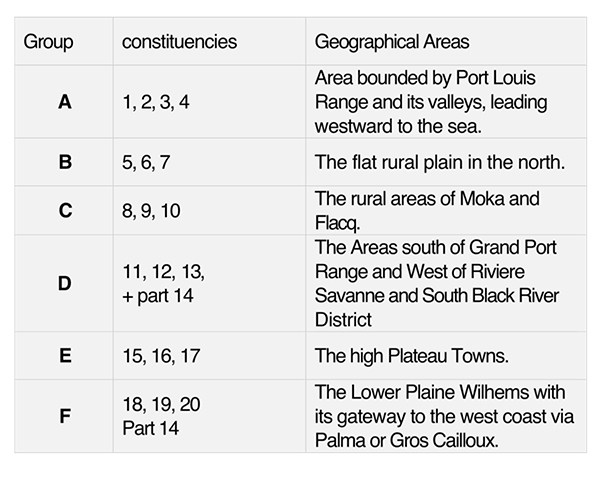
The boundaries of these areas are very much as they were drawn in 1966 with the exception of the valley of Pailles which is now in Group A
The demarcation of these Areas are via natural Boundaries and it will be impossible for Moka-Flacq for instance to physically expand southwards across mountains. Or for that matter to Expand into Urban Areas and lose its specificities.
9 POPULATION GROWTH AND POPULATION SHIFT AMONGST THE CONSTITUENCIES
Over the last 50 years the population of Mauritius has more than doubled. The growth has NOT been uniform across all the Geographical Areas.
Some of these Areas, on top of their inherent local growth, have had an increase in their population due to inter-Area migration.
Other Areas have had a fairly stagnant population size due to their restricted geographical area and the subsequent migration of their population to other Areas.
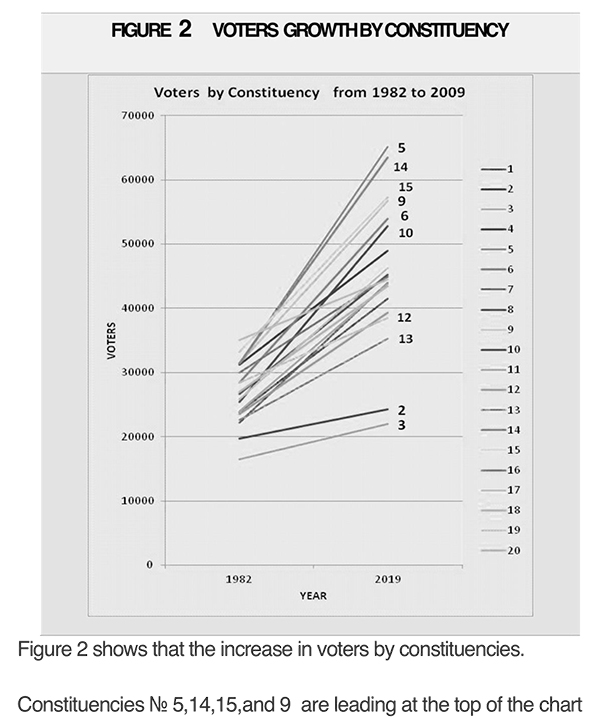
Though the Constitution mentions ‘inhabitants’ per constituency, we will be using the number of ‘Voters’ as a surrogate. The data for Voters is readily available from the Electoral service Commission website and is more up to date.
The population in 4 particular Areas, the 2 Rural B and C and the 2 Urban and semi Urban E and F have had significant increases in their population.
Areas A and D have had much lower overall population growth.
10 THE PROBLEMS WITH EQUALIZING THE PRESENT 20 CONSTITUENCIES
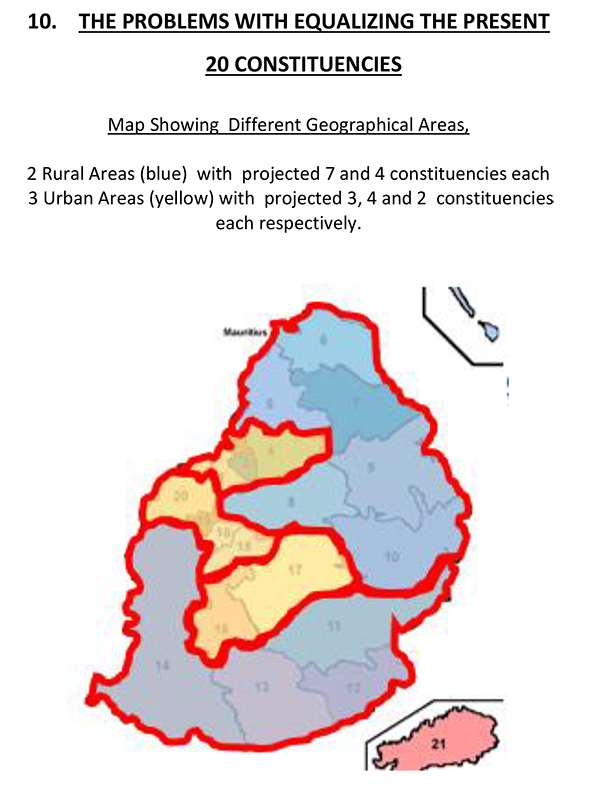
If we were to keep the number of constituencies at 20, we can easily equalize the number of voters amongst them.
The mathematics is really quite simple. We should aim at an average number of voters of nearly 46,000.
The problem is that in trying to solve one issue, we will be creating another one and in fact we will be going counter to the goal of Adequate Representation.
The Urban Areas will have 1 less constituency and in return the rural areas will gain 1 constituency.
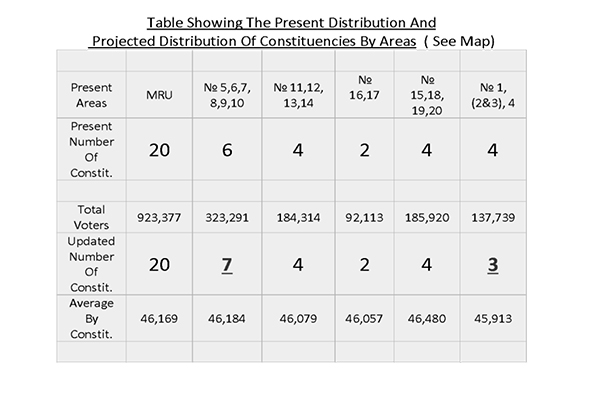

Certain Observations regarding equalizing 20 constituencies
1 The rural areas of Pamplemousses, R. du Rempart, Moka and Flacq presently have 6 constituencies and this will have to be increased to 7 constituencies in total.
2 This exercise will give an average of 46,140 voters per constituency. The extra constituency will straddle across the district of Flacq and R. Du Rempart.
3 Curepipe and Vacoas Floreal will stay the same as they are presently.
4 Black River – Savanne № 14 will have to be equalized with № 13, № 12 and № 11.
5 The constituency of Quatre Bornes will take on part of a WARD from the town of Vacoas-Phoenix namely Ward 3
*6 Quatre Bornes in turn will have to transfer its Ward 4 to Rose-Hill.
7 The most significant change will be in Port Louis which will be reduced to only 3 constituencies from the present number of 4 constituencies.
8 Constituencies №2 and №3 will be merged into one constituency.
This transformation of constituencies №2 and №3 into a single constituency, together with the removal of the BEST LOSER SYSTEM will not be acceptable to quite a few of the constituents and also to some political parties.
Whilst everything possible was done in drafting the original boundaries in order to promote Adequate Representation, this particular change will go in the OPPOSITE DIRECTION AND DECREASE REPRESENTATION.
11 HOW 24 CONSTITUENCIES CAN SOLVE BOTH THE UNEQUAL CONSTITUENCIES ISSUES AND THE BLS ISSUE.
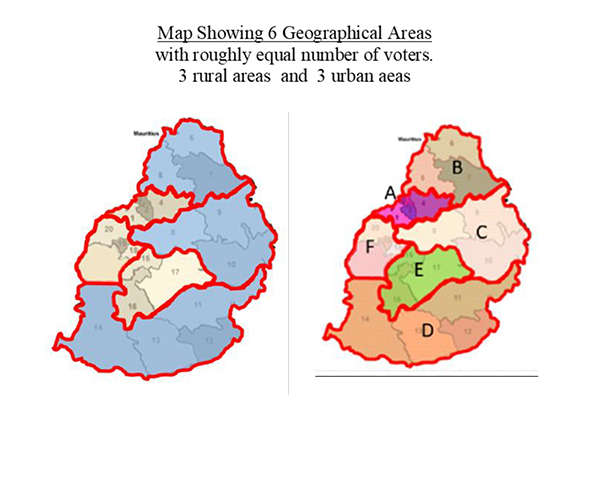
It is nearly impossible for the Electoral Boundaries Commission to work with the same number of constituencies and to come up with a proposition that will remediate the issue of inequality of number of voters per constituency without raising new problems.
The issue of Adequate Representation will have to be addressed and also the geographical characteristic of constituencies has to be preserved.
It is interesting to note that the total number of voters in these 6 Geographical Areas ( A to E) as they stand are roughly similar. The total number of voters in the Rural Areas will be roughly equal to that of Urban and semi-Urban Areas. ( within 2%)
2 of these particular areas, namely (A,D) already have 4 constituencies and the 4 other Areas namely (B,C,E,F) have 3 constituencies each.
The best solution would be the creation of I more constituency in each of these 4 geographical areas B, C, E and F respectively.
In these 4 geographical areas B, C, E and F, there are four constituencies that have a higher number of voters are namely № 5, 9, 14 and 15 and these 4 large constituencies can be split into 2 smaller constituencies each, with certain adjustments being made with the other contiguous constituencies within each respective Geographical Areas as illustrated in Table 4A.
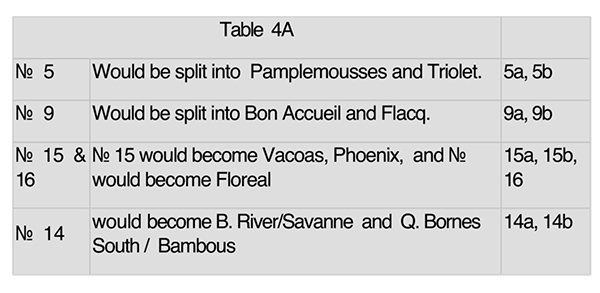
Each geographical area will thus have 4 constituencies each and the final average number of voters per constituency would be very close to each other.
The total number of constituencies would thus be 24 and the mean number of voters per constituency for Mauritius island would be 38,424. The deviation from mean number of voters for each Constituency would be within less than 10 % at a maximum.
This increase in the number of constituencies from 20 to 24 will improve Representation of the population in general.
Furthermore the changes will be local and it will be within the Geographical Area.
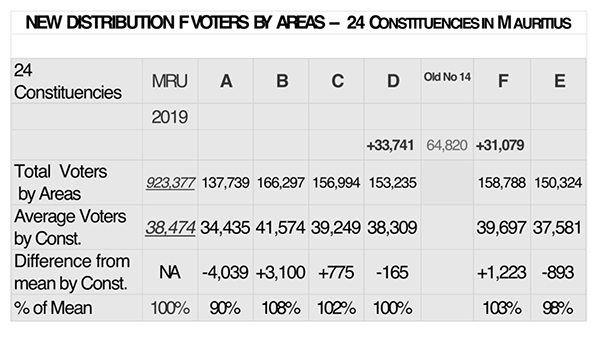
Changes across natural boundaries or across the present boundaries between rural and urban / semi-urban constituencies would be avoided.
In total there will be 12 rural and 12 urban / semi urban. The preservation of the specificities of the smaller constituencies will be achieved and all constituencies will be more or less equal in size.
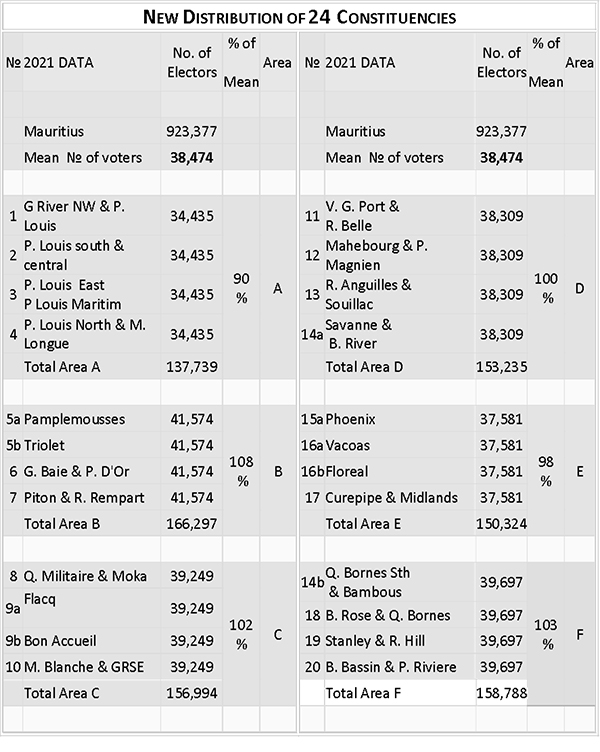
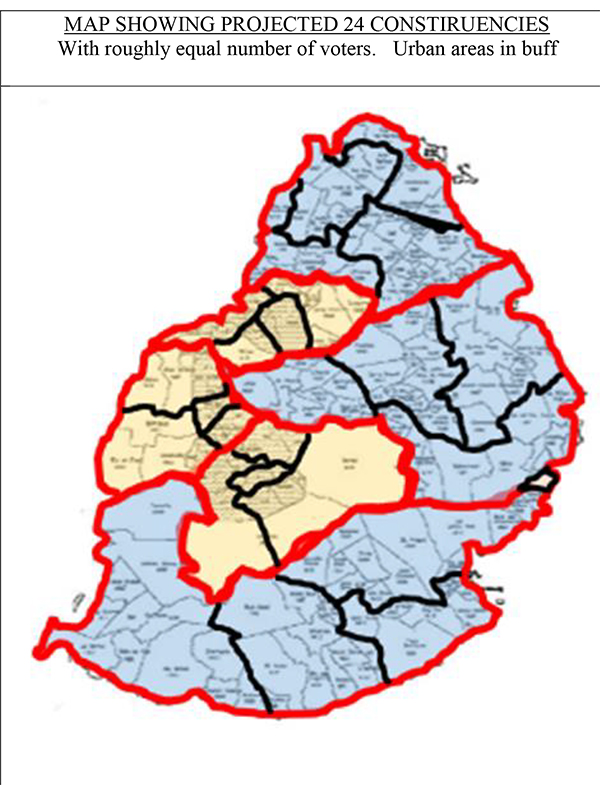
A Few Changes Would Occur Intra-Area In Geographical Area A.
1 It should be noted that Constituency №3, Port Louis East and Port Louis Maritime would become Port Louis East only. The Harbour areas would be detached from №3 and incorporated into Constituencies № 1, whilst Pailles would be detached from №1 and joined to №2
2 Port louis ward 8, Vallee des Prêtes would move from № 4 to №3
3 Part of Roches Bois (half of Port Louis ward 6) will be moved from №3 to №1
4 This will allow for a common border between Constituencies № 1 and № 4 and facilitate exchange of voting areas if need be.
5 The above exercise will also preserve the specificities of these 4 Constituencies.
The Changes affecting the other Geographical Areas are illustrated in the map above.
Further details can be worked out subsequently by the Electoral Boundary Commission.
12 SUMMARY
1 The best way to tackle the issue of adequate Representation is to deal with the problem at source. We need to find a way to field more Candidates from the General Population and other minorities. The Political Parties need to work on a system to include enough candidates from all communities mentioned in the constitution and also from other subgroups which are not mentioned in the constitution.
2 In order to facilitate the above and increase representivity, we will need to
a Increase the number of constituencies from 20 to 24 in Mauritius island
b Equalize the numbers of voters per constituency.
(to within less than 10%). (Presently the difference is nearly 200%). This exercise has been dealt with in great detail in a previous section.
A commonly accepted adage is that; the more constituencies you have, the greater will be the representation of all socio-demographic components.
Increasing the number of constituencies will thus provide a sound constitutional way to increase representation in parliament. This would also be legally robust and furthermore morally correct.
3 After addressing the above issues, we will be left with a BLS that can be modified. As mentioned above one of the problems is in the way we field candidates at the elections because of political expediency. The BLS is here only to correct the outcome of this negative practice. If we address the above issues, then the BLS can be safely abolished.
4 The Party List should have a closed, rank-based list of candidates with some double candidacies (some both at constituency and party level) and also some single candidacy (only party list or only constituency level). The extra names on the party list cater for extreme swings in voting outcome..
5 The compensatory PR system is the most fair system. But if we are concerned with stability, then the coalition between parties can be done after an election rather than before an election. The 2019 election is a good scenario where the compensatory system would have worked very well and would have actually reflected the voters' wishes. Furthermore the Compensatory PR system is a well-tested, robust mathematical model.
6 This document is not about the type of PR we should adopt.
There are wide ranging views on this. In a nutshell, if we are only concerned about the top officials of the party getting into Parliament without any major effect on the FPTP result, then the parallel system (Sachs A) is your choice. On the other hand if fairness is important as well, with the possibility of changing the FPTP result then Sach C is the choice. This is a major debate in itself. Suffice it to say that the system should be robust and transparent, and not break down under any circumstance because this may lead to much wrangling after election result.
We need a good robust foundation for our electoral process with FIRM CONSTITUTIONAL guarantees.
On a separate note, some people may believe that Mauritius is quite a small place and that we should just have one Party list without any constituencies. This can be quite dangerous for Mauritius because it can lead to polarization on a national level and generate tensions amongst partisans.
There will be persons who would point out that the increase in the number of parliamentarians would inevitably lead to an increase in the budget allocated for this purpose.
The Best loser system presently has 8 seats which are allocated. The increase in constituencies by 4 new constituencies will entail an increase of 12 new MPs. If the Best Loser system is abolished, its previous 8 seats can be used and this will leave us with an increase of only 4 additional MPs This is a small price to pay in order to have a fair and just system. In any case, most reform proposals have already envisaged increases to the maximum number of MPs.
Already it is felt that we are spending too much on parliamentarians. We suggest that the proposed reform should be part of a more holistic reform looking at all aspects of the political parties and at the election process. This would also include the role of the Speaker of the House, the issue of gender representatin etc.
13 APPENDIX 1
In a publication regarding the UVE, there is a table detailing the results of the 1982 election .
We will look at 2 scenarios namely
1 one where MMM/PSM did actually score 64.16 % of votes nationally.
2 Another one where it is supposed to score 84.16 % of votes nationally.
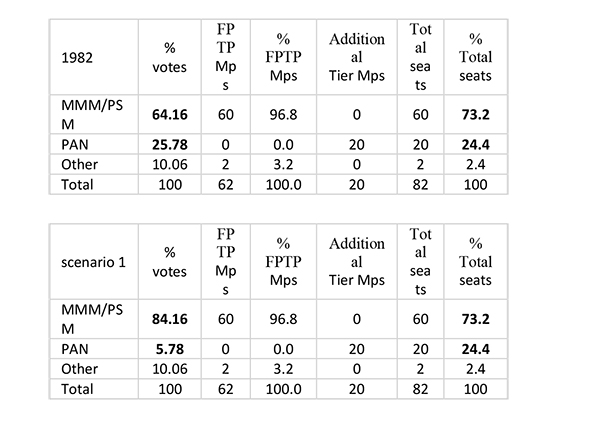
Supposed in the 1982 general election, the MMM/PSM had scored 84.16 % of votes.
With the UVE PR system, the MMM/PSM would still get 60 seats via FPTP but none of the PR MPs.
The PAN with 5.78 % of votes would still get 20 MPs because MMM/PSM has no unreturned candidates.
Thus despite having an overwhelming popular mandate of 84.16 % of votes, it will see its proportion of MPs in the house reduced to 73.2%, which is less than 75%, the number required to implement all of its programmes independently.
On the other hand Parallel PR and Compensatory PR would be more in keeping with common sense and preserve the overwhelming mandate from the electors while the UVE result is really absurd.
It gets worse, PAN with only 10% of votes would still get 20 PR MPs (24.4%) as the MMM/PSM would have no unreturned candidates. By extension if theoretically the number of PR seats is greater than 60, then the PAN would be the winner. That is why the ratio of PR seats to FPTP seats is important in deciding on the system to adopt.
14 APPENDIX 2
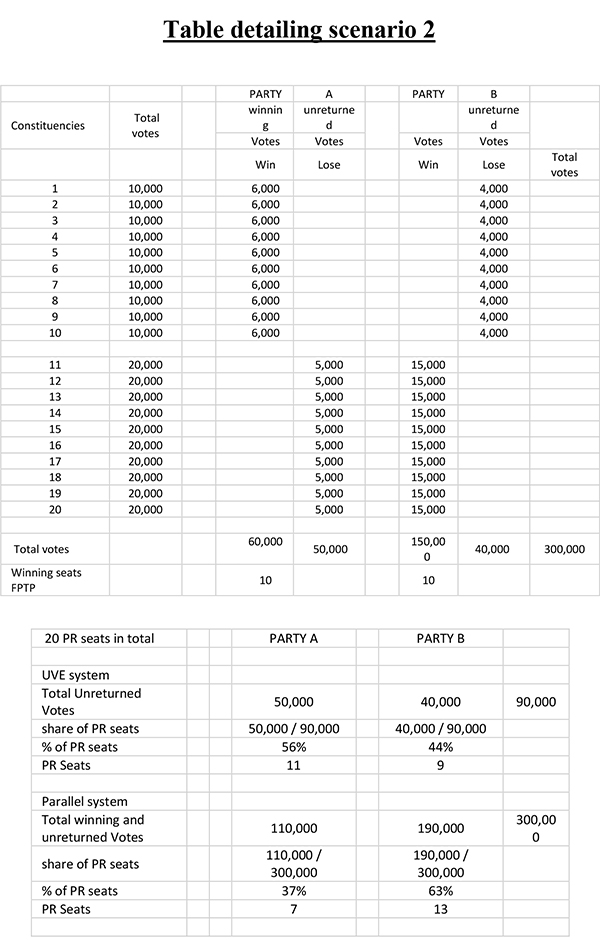
The next scenario involved a tightly fought contest with unequal constituencies.
In the UVE system, the total votes of all the unelected candidates of the parties are considered, provided the parties scored above 10% of national votes. The unreturned votes of each party are aggregated together and each party would then get a share of PR MPs according to their share in the aggregate.
The FPTP results in this scenario shows that both Party A and Party B have equal number of seats according to FPTP SYSTEM.
According to the “UVE“ PR system, Party A will get 11 PR seats and Party B will get 9 PR seats, in spite of the fact that Party B has scored a much higher total number of votes nationally.
With the parallel system Party A will get 7 seats and Party B will get 13 PR seats. This is in keeping with common sense whereas the UVE outcome is nonsensical.
Unequal sizes of the constituencies causes this contradiction while Parallel or Compensatory systems would perform well under any scenario.
Publicité
Publicité
Les plus récents