Publicité
The “slow violence” of plastic
Par

Partager cet article
The “slow violence” of plastic
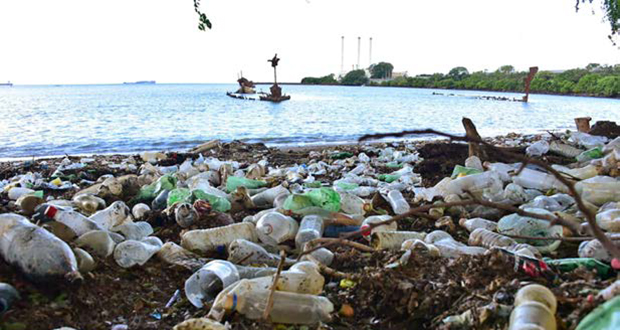
The Environment Protection (Control of Single Use Plastic Products) Regulations of 2020 put forward a clear ban on multiple “non-biodegradable single use plastic products”. However, in the case of key products, this ban is a performance of endless deferral. Indeed, when it comes to plastic trays, cups and bowls used for specific purposes such as the packaging of dairy products, margarine, cooked and pre-cooked food items, the ban was previously extended from January 2021 to January 2022, then to January 2023, then to January 2025, and then to January 2026. On Friday 28 November, Cabinet once again approved the use of these products for a yearlong period beginning on 15 January 2026.
This decision has been controversial. According to the Ministry of the Environment and the Association of Mauritian Manufacturers (AMM), this is a necessary and practical step in the long journey towards reduced plastic usage. A key obstacle cited is the lack of alternative packaging that would respect current food safety norms. According to other stakeholders – a word I use intentionally, for this deferral has major stakes for every single person living in Mauritius – this is not a step forward but backwards: This decision directly contradicts the government’s past rhetoric on the importance of reducing Mauritius’ dependence on plastic, undermines Mauritian credibility on the global stage, and penalizes the businesses which have invested considerable time and resources in the development of plastic alternatives (several of which appear to exist, seemingly unbeknownst to those with decision-making power).
This debate is one rooted in science and policy. It also illuminates the power of language to shape our reality: What do we see as “realistic,” and what do we see as “violent”?
In the current debate, the language of “realism” functions as an excuse for not acting urgently and decisively. That is, although the roadmap for the elimination of these single use plastic products was put forward half a decade ago, those who defend the extension imply that to expect its implementation at this point is unreasonable. This discourse creates a perception of the ban as a long-term goal that can afford to be endlessly deferred, rather than an urgent priority that costs us invaluable capital in terms of environmental and human health with every day that passes.
Banning single-use plastic is simultaneously a long-term goal and an urgent priority. Why a long-term goal? Because when it comes to not just eliminating but also replacing products that have become indispensable to daily existence, no quick fixes are possible. Why an urgent priority? Because although the damage that single-use plastics wreak upon both environmental and human health is gradual and insidious rather than sudden and spectacular, it is nonetheless lethal.
It is easy to lose sight of this lethality. After all, the ways in which single-use plastics poison the planet is a classic example of what environmental humanities scholar Rob Nixon calls “slow violence,” that is, a type of violence that “occurs gradually and out of sight, a violence of delayed destruction that is dispersed across time and space, an attritional violence that is typically not viewed as violence at all.” As opposed to our more sensational imaginaries of violence – a bomb exploding, a human being shooting another, a car running over an animal – slow violence is one that happens so slowly and invisibly that we are never sure it has occurred at all… until it is too late.
In Mauritius, plastic trash often accumulates far from the pristine landscapes that we depend on for tourism, or the familiar places that condition our daily existence. Instead, it ends up in the Mare Chicose landfill, a space that most of us Mauritians are more than happy to pretend does not exist… until we are forced to, such as a little over a year ago when the landfill caught fire and compromised air quality in various parts of the island. Simultaneously, nobody falls dead the moment they eat food or drink water contaminated with microplastics (that often leach into food and beverages from containers). But these plastics circulate deeply within the human body, including in our blood, bones and brain. While the effects of these invisible particles on the human organism have not been fully established by scientific research, we have mounting evidence that they increase risk for endocrine disorders, cognitive decline, fertility issues, and various kinds of cancer.
The ubiquitous presence of single-use microplastics must be seen for what it is: a slow violence that takes place everyday against our bodies and our environment. This violence is so tightly woven into the fabric of everyday life that it would indeed be unrealistic to expect any society to fully dissipate this violence from one day to the next. But it is not at all unreasonable to expect a government to recognize this violence and undertake urgent action rather than endless deferral. In this situation, the discourse of realism cannot be wielded as an excuse for not acting decisively: instead, the fact that the road towards plastic elimination is long and arduous should become all the more reason to get started as soon as possible.
Publicité
Publicité
Les plus récents