Publicité
Blue economy
Lagoon under strain: fishers demand a voice
Par

Partager cet article
Blue economy
Lagoon under strain: fishers demand a voice
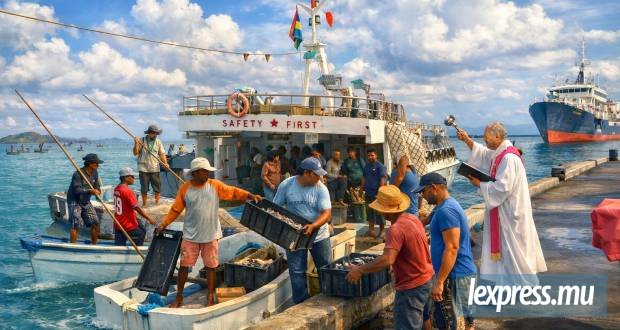
© Ai-generated Illustration by Microsoft Copilot
The message of Sea Sunday, celebrated by Stella Maris (Apostolate of the sea – AoS) on Sunday 12 July, is an opportunity to reflect on the essential role of local fishers and coastal communities, whose work sustains food security and livelihoods; but it also highlights that fishers want recognition as people with dignity, families, hopes, and fears; and consultation on issues affecting them directly in a context of environmental degradation and climate change.
The Narrative
“When the oceans suffer, humanity suffers with them.” Caring for the sea and caring for fishers are inseparable responsibilities. Artisanal fisheries remain a cornerstone of coastal livelihoods in Mauritius, supporting approximately 2,700 registered fishers and an estimated 3,500 people who depend directly on fishing for income. As economic opportunities in coastal regions decline, artisanal fisheries have become even more essential for food security, job creation, and poverty alleviation.
Mauritius’s artisanal and smallscale fishers are represented through a network of syndicates, federations, and village-level cooperatives that defend their economic rights, access to marine resources, and working conditions. The Syndicate of Mauritian Fishers and the Federation of Mauritian Artisanal Fishers act as the main national bodies, negotiating on issues such as fishing rights, foreign fishing agreements, badweather allowances, and technological upgrading. At village level, local cooperatives help fishers manage shared resources, secure equipment, and access training through programmes such as the UNDP Ecofish Project.
At the Ocean Assises held by the Ministry of Blue Economy in October 2025, secretary of Stella Maris (Apostolate of the sea – AoS), Patrick Fortuno, spoke on behalf of Mauritian fishers. He noted that fishermen are often the first witnesses to climate change and the difficulties faced at sea. “Fishermen live daily with the effects of climate change and resource scarcity. They need to be heard and supported in this transition towards sustainable fishing.” He also stressed the need to better value traditional fishing communities’ knowledge. In a document titled “Fishing: A job, a culture, a life: strengthening artisanal fisheries in the blue economy of Mauritius”, he shared the main issues and proposals of the fishing community, which were reiterated in the pre-Budget consultations last June.
Issues and proposals
The fishers’ associations argue that Mauritius cannot achieve a just and sustainable Blue Economy unless artisanal fishers are fully integrated into governance, resource management, and development planning. A central challenge is the ageing fisher population – nearly 40% of registered fishers are aged 60 and above – which threatens long-term continuity in the sector. Although the government has reopened registration, fishers report irregularities, including individuals with no fishing background being registered. They call for transparent, merit-based registration and structured youth recruitment supported by training, certification, and access to modern equipment.
Fishers also express frustration over the lack of meaningful consultation. Despite the Fisheries Act 2023 providing for a Fisheries Advisory Committee, fishers have not been invited to participate in discussions on lagoon surveillance, foreign fishing agreements, coastal development, or regulatory reforms. They argue that these issues are of national importance and demand structured, ongoing consultation through a formal platform involving fisher organizations.
Economic modernization is another priority. Fishers propose the creation of an Artisanal Fisheries Development Fund, financed through fisheries-related revenue such as EU agreements, foreign vessel licensing, and donor contributions, which would support modernization, youth entry, climate resilience, and access to improved gear, boats, engines, and market opportunities. They also call for better coordination among government institutions to reduce bureaucratic obstacles that exclude fishers from existing incentives.
Environmental and safety concerns feature prominently. Fishers report that nautical sports activities – speedboats operating in lagoons – pose serious risks and disrupt fishing activities. They recommend zoning these activities to specific areas. Similarly, amateur and sports fishing, which accounts for over 40% of total catch, creates unfair competition and environmental damage when conducted illegally. Fishers propose designated zones, mandatory reporting of catches, and stricter enforcement.
Climate change is already affecting daily catch, increasing risks at sea, and threatening livelihoods. Fishers call for climate-resilience measures, including preparedness plans, safe onshore storage for boats, slipways, marinas, and dredging of passes to ensure safe movement. They also emphasize upgrading fishlanding stations to improve safety and hygiene.
To relieve pressure on the lagoon, fishers support transitioning toward off-lagoon semiindustrial fisheries, provided they receive financial and technical assistance. They recommend SME registration for fishers, improved loan schemes, and increased deployment of Fish Aggregating Devices (FADs) accessible only to registered fishers. They also support expanding small-scale aquaculture, but insist that fish cages and barachois access be reserved for cooperatives with proven activity, ensuring benefits reach genuine fishers.
Budget measures
The 2026-2027 Budget measures align partially with these demands. The government announced support for expanding the semi-industrial fleet, enabling artisanal fishers to shift toward off-lagoon fishing. It also committed to deploying smart FADs, constructing two new hatcheries at Albion, and opening 28 fish-farming zones through international expressions of interest. Plans for a modern fishing port with improved landing, cold storage, and processing facilities directly address long-standing concerns about postharvest losses. These initiatives are tied to a national goal of tripling fish production from 5,000 to 15,000 tonnes within three years.
However, gaps remain. The Budget does not address fisher concerns about consultation, registration irregularities, enforcement of amateur fishing regulations, or zoning of nautical sports. Nor does it establish the proposed Artisanal Fisheries Development Fund. Fishers therefore urge the ministry to convene a National Artisanal Fisheries Reform Dialogue to develop an implementation roadmap integrating their proposals into the Blue Economy strategy.
Overall, the fishers’ document presents a comprehensive reform agenda grounded in governance, economic modernization, environmental sustainability, and social protection. The Budget measures represent meaningful progress, but fall short of the inclusive, participatory approach fishers consider essential for a fair and sustainable Blue Economy.
Sea Sunday & Stella Maris
Sea Sunday is celebrated every year on the second Sunday of July. Each year the Vatican launches a message to all communities and stakeholders linked by the sea to celebrate this event. This year the message is titled “Beyond cargo and commerce: the human face of the sea”, inspired by the events in the strait of Ormuz where 10,000 seafarers are still stacked. We spoke to Father Jacques-Henri David, who has been the chaplain of Stella Maris (AoS) for 20 years. He explains that the latter plays a crucial pastoral and welfare role for coastal fishers. It delivers direct emergency aid during bad weather or cyclones, collaborates with fisher organisations to advocate for safety gear and fair zoning, and supports community integration through awareness programmes and Sea Sunday celebrations.
Father David, who is fully aware of the acute problems coastal fishermen face – reduction of daily catch, difficult access to credit facilities, digital and financial illiteracy, and impacts of climate change – sees “no effective measures to really boost up artisanal fishing in the Budget 2026-2027. Only Rs 24 M and 48 M are earmarked for the purchase of cannottes and semi-industrial fishing vessels respectively”. The priorities for him should be: capacity building of fishers through digital and financial matters ; new fishing techniques, financial management, soft-term loans for acquisition of fishing vessels, and on-land appropriate facilities for storing and processing of fish.
Publicité
Publicité
Les plus récents