Publicité
From 108 Minutes to Missiles — Trump and a Divided America
Par

Partager cet article
From 108 Minutes to Missiles — Trump and a Divided America
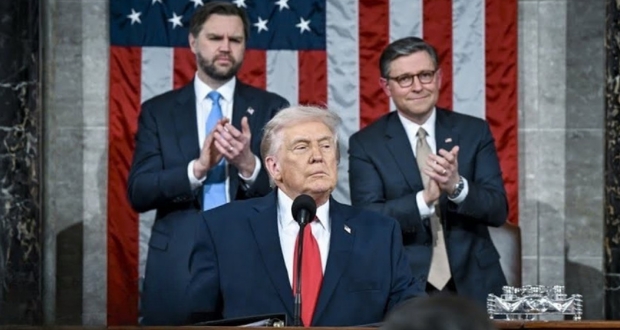
By launching coordinated U.S. and Israeli strikes on Iranian targets without seeking prior congressional authorization, President Donald Trump has shifted from rhetoric to direct confrontation.
The decision marks a decisive escalation. For months, Trump framed Iran as the central external threat to American security, dismissing diplomacy as ineffective and insisting that Tehran’s nuclear ambitions required maximum pressure. Now that pressure has taken the form of military action.
The White House argues that the strikes were limited, targeted and designed to degrade Iran’s nuclear infrastructure. Republican lawmakers largely praised the operation, describing it as a last resort after failed negotiations. But Democrats, joined by Republican Rep. Thomas Massie and Sen. Rand Paul, have raised constitutional objections and are preparing a war powers vote to restrict further military engagement.
The divide reflects more than partisanship. It exposes a structural tension in American governance: the balance between executive authority and congressional oversight in matters of war.
Strategically, Trump appears to believe that calibrated force can coerce Tehran back to the negotiating table. Some foreign policy veterans argue that limited strikes, narrowly focused on nuclear facilities, may contain escalation if both sides signal restraint. That logic draws from previous episodes in which Iran responded proportionately, avoiding full-scale war.
Yet the risks are no longer theoretical.
Iran’s nuclear infrastructure is deeply embedded, and its missile capabilities remain intact. Should Tehran conclude that regime survival is at stake, retaliation could extend beyond Israel to U.S. bases and allies across the Gulf. Asymmetric responses — cyberattacks, proxy operations, regional destabilisation — cannot be discounted.
The strategic ambiguity is striking. The administration maintains that the objective is nuclear containment, not regime change. However, the rhetoric surrounding Tehran’s leadership blurs that distinction. History suggests that air power alone rarely reshapes political systems. Absent a defined end-state, military pressure can generate instability without delivering structural transformation.
Democratic leaders argue that the president is operating without clearly articulated objectives beyond coercion itself. They warn that escalation dynamics, once triggered, can outrun intent. A limited strike can become an open-ended confrontation if deterrence fails or miscalculation occurs.
Trump’s defenders counter that deterrence credibility requires action. Having warned that Iran would face consequences, failing to act could have weakened U.S. leverage not only in the Middle East but globally. In that view, the strike reinforces American resolve and reassures regional partners unsettled by shifting alliances.
This is the paradox at the heart of the current crisis. Neither Washington nor Tehran may desire a broader war. Yet both may believe the other is bluffing. Such strategic signalling resembles a high-stakes game in which misreading intentions carries severe consequences.
Domestic politics compound the uncertainty.
Trump’s presidency has consistently fused governance with performance. From marathon congressional addresses to high-profile foreign policy gestures, the pattern reflects an approach in which spectacle and strategy intertwine. The Iran strike now becomes both a geopolitical move and a defining political test.
For Democrats, the concern extends beyond Iran. It centres on precedent. If major military action can proceed without congressional debate, the constitutional balance tilts decisively toward the executive. The planned war powers vote signals an effort to reassert legislative authority before events accelerate further.
For Republicans aligned with the administration, unity behind the commander in chief is framed as essential during external confrontation. Public disagreement, they argue, risks emboldening adversaries.
Internationally, allies are recalibrating. Gulf states, already navigating delicate relations with Tehran, must assess whether escalation remains containable. European governments, wary of another prolonged Middle East conflict, are urging restraint. Beijing and Moscow will scrutinise Washington’s cohesion and credibility.
What distinguishes this moment from previous episodes is the convergence of factors: heightened regional volatility, domestic political polarisation and a president who has demonstrated a willingness to take risks that defy conventional caution.
Military force can degrade infrastructure. It cannot easily engineer political outcomes. If the objective is solely to impede nuclear advancement, limited strikes may achieve tactical gains. If the objective drifts toward regime transformation, the pathway becomes far less predictable.
The United States now stands at a familiar yet altered threshold — confronting Iran once again, but under conditions shaped by accumulated mistrust and diminished guardrails.
The question is no longer whether Trump would act. He has.
The question is whether this action remains contained — or becomes the opening chapter of a wider conflict neither side fully controls.
Publicité
Publicité
Les plus récents