Publicité
Financial Crimes Commission Bill
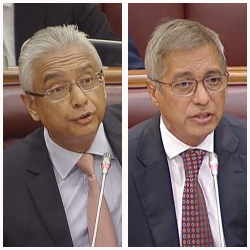
Jugnauth et XLD croisent le fer
Par
Partager cet article
Financial Crimes Commission Bill
Jugnauth et XLD croisent le fer

Speech Financial Crime Commission
Mr Speaker, Sir, the presentation of this Bill today marks a major milestone in our relentless fight against corruption and other financial crimes and bears testimony to our steadfast resolve to eradicate malpractices and irregularities from all aspects of public life and consolidate our national values.
This Bill indeed demonstrates our unflinching commitment and determination to pursue our corruption-free agenda and to continue enhancing the reputation of Mauritius as a clean jurisdiction and consolidate its position as a significant player in the global financial system.
Mr Speaker, Sir, the setting-up of the Financial Crimes Commission (FCC) as an apex body to fight financial crimes in Mauritius first appeared in our Government Programme of 2015-2019. As a matter of fact, on acceding to power in December 2014, the new Government, under the leadership of late Sir Anerood Jugnauth, promised to manage the affairs of the State on the principles of transparency, accountability and exemplary governance. The Government had also promised the nation to free our society from the shackles of widespread corruption, fraud and favouritism that had characterised the two successive mandates of the Labour party-led Government.
We had a clear mandate from the people to clean up the mess left by the previous Government and on the strength of that trust of the people, the Government took a strong commitment to eradicate fraud, corruption, malpractices and irregularities that had plagued all aspects of public life in our country over the preceding nine long years.
On our re-election in 2019, we renewed our commitment to further strengthen our democracy and governance framework by intensifying our fight against fraud and corruption, with zero tolerance of corrupt practices. We also renewed our pledge to introduce appropriate coordination mechanism to ensure inter-agency cooperation to combat economic and financial crimes.
Mr Speaker, Sir, with a view to fulfilling our commitment for the setting-up of a Financial Crimes Commission, a National Committee was set up under the chair of the Financial Secretary to make appropriate recommendations to the Government in that regard. The National Committee was supported by a Technical Working Group comprising representatives from different Ministries, Departments and institutions concerned.
Following extensive consultations, a paper was prepared and submitted by the National Committee outlining its proposals for the setting-up of a Financial Crimes Commission. The Attorney General’s Office was subsequently requested to prepare a draft Bill on the basis of the paper submitted by the National Committee. Once the first draft of the Bill was ready, a second phase of consultation was engaged with all relevant stakeholders, including –
• the Ministry of Finance, Economic Planning and Development;
• the Ministry of Financial Services and Good Governance;
• the Bank of Mauritius;
• the Financial Services Commission;
• the Director of Public Prosecutions;
• the Police Department;
• the ICAC;
• the Mauritius Revenue Authority;
• the Financial Intelligence Unit, and
• the Integrity Reporting Services Agency.
All the submissions received were carefully examined and some of them were retained and the draft Bill was reviewed in the light thereof and thereafter submitted for final approval of Government, before its introduction into the National Assembly.
Mr Speaker, Sir, as the House is aware, financial crimes have drastically changed in recent times as a result of increasing financial globalisation, coupled with the pervasive nature of highly innovative and constantly evolving technology. Illicit assets, derived from the technology-based financial criminal activities, are moved across multiple jurisdictions at the click of a button, thus presenting huge challenges for law enforcement agencies in chasing those criminals and their assets across the globe. Financial crimes, therefore, remain a significant and constantly evolving threat to national security and social stability, with the capacity to undermine our institutions and our democratic values and principles and the rule of law. They constitute a threat in particular to the most vulnerable groups in our society and also jeopardise economic performance and development. Countries, therefore, need to regularly uplift their financial crime framework so as to maintain its effectiveness, and Mauritius is no exception.
Mr Speaker, Sir, in so far as Mauritius is concerned, I must say that, since 2015, the Government has been taking numerous bold and effective measures in order to enhance transparency and accountability and reinforce our overall governance framework. Before delving into the FCC Bill, I think it is fitting for me to remind the House of some of these measures.
Mr Speaker, Sir, as the House is aware, the Eastern and Southern Africa Anti-Money Laundering Group, commonly known by the acronym of ESAAMLG, had released its Mutual Evaluation Report (MER) on Mauritius in 2018, in which it had identified certain strategic shortcomings in our AML/CFT regime. I must say that the deficiencies identified in the MER Report of 2018, were the result of the inaction and lack of foresight of the previous Government and which we inherited in 2014.
I wish to remind that the MER Report of 2008 had already identified several deficiencies, in particular regarding the AML/CFT regulation of the Designated Non-Financial Businesses and Professions, including casinos, real estate agents and legal and accounting professionals.
However, the then Government failed to address those deficiencies. Worse still, in 2012, the FATF reviewed its Recommendations and countries were requested to initiate actions to ensure compliance with the revised Recommendations, which subsequently came to be known as the 40 FATF Recommendations. But again, no action was initiated by the then Government and this resulted in modest ratings for Mauritius in the 2018 MER Report, which in fact rated Mauritius as being compliant with only 14 out of the 40 FATF Recommendations.
In contrast, in 2018, immediately after the release of the 2018 MER Report, the Government embarked on an ambitious exercise to overhaul our AML/CFT framework in order to comply with the FATF standards in terms of both technical compliance and effectiveness, during the one-year observation period from October 2018 to October 2019.
This exercise resulted, among other things, in the adoption and implementation of a comprehensive National AML/CFT Strategy and a National Action Plan. Mauritius was, subsequently, rated as “compliant” or “largely compliant” with 35 out of 40 FATF Recommendations.
In February 2020, the FATF acknowledged the significant progress made by Mauritius since the adoption of its MER, but also noted that some strategic shortcomings remained and Mauritius was required to address those deficiencies within an agreed timeframe.
Mr Speaker, Sir, the Government immediately made a high-level political commitment to work with the FATF to further strengthen the effectiveness of its AML/CFT regime and prioritise the implementation of the FATF Action Plan. At the same time, Mauritius worked closely with the ESAAMLG and also benefited from technical assistance from the latter as well as from UK, France, the EU AML/CFT Global Facility, the German Agency for International Cooperation, the IMF, the UNODC, the World Bank and other international organisations with the aim of strengthening the capacity of our competent authorities and providing relevant guidance in the implementation of their AML/CFT obligations.
I must say that this assistance has been instrumental in addressing the strategic deficiencies identified in the Mauritian AML/CFT regime. In addition, the close collaboration between the competent authorities and the private sector operators was pivotal during this process. Over the course of several FATF Plenary meetings, Mauritius submitted four Progress Reports, detailing the actions it had taken to complete each Action Item.
The House will also recall that, in that same context, the Anti-Money Laundering and Combating the Financing of Terrorism (Miscellaneous Provisions) Act 2020 was passed by the National Assembly on 07 July 2020, through which, 19 pieces of legislation were amended to effectively address evolving risks and further strengthen our overall governance framework. Several other measures were taken to address the deficiencies identified and consolidate our AML/CFT regime.
Mr Speaker, Sir, in October 2021, the FATF concluded that Mauritius would no longer be subject to increased monitoring as the country had made significant progress in strengthening the effectiveness of its AML/CFT regime and had addressed the related technical deficiencies to meet the commitments in its Action Plan.
Consequently, Mauritius was removed from the FATF grey list. In fact, Mauritius managed to exit from the grey list in a record 18 months’ time. Mauritius is now “Compliant” or “Largely Compliant” with all the 40 FATF Recommendations. The FATF and the international community have recognised Mauritius as an improved and effective AML/CFT jurisdiction through measures adopted and well-performing institutions. This removal from the grey list was a much awaited and welcome boost for Mauritius as it not only allowed the country to regain its position among the leaders in the global financial services industry, but also reinforced our position as a leading investment destination, playing a key role in facilitating FDI into the African continent.
Mr Speaker, Sir, soon after Mauritius was removed from the FATF grey list, it was also removed from the UK list of High Risk Third Countries in November 2021. Subsequently, on 07 January 2022, the European Commission also removed Mauritius from its list of high-risk third countries, acknowledging that it no longer presented strategic deficiencies on the basis of the criteria laid down in EU Directive 2015/849.
It is noteworthy that, upon the exit of Mauritius from the EU black list, the EU Commission Delegated Regulation of 07 January 2022, mentioned, and I quote –
“The FATF welcomed significant progress made by Botswana, Ghana and Mauritius in improving its AML/CFT regime and noted that Botswana, Ghana and Mauritius have established the legal and regulatory framework to meet the commitments in their action plans regarding the strategic deficiencies that the FATF had identified. The Commission's analysis concluded that the Bahamas, Botswana, Ghana, Iraq and Mauritius no longer have strategic deficiencies in their AML/CFT regime considering the available information. The Bahamas, Botswana, Ghana, Iraq and Mauritius have strengthened the effectiveness of their AML/CFT regime. These measures are sufficiently comprehensive and meet the necessary requirements to consider that strategic deficiencies identified under article 9 of the Directive (EU) 2015/849 have been removed”.
Mr Speaker, Sir, this remark by the EU is an acknowledgment and recognition of our efforts and commitment to enhance transparency and accountability and fight financial crimes and also of our willingness to fulfill our international obligations.
Mr Speaker, Sir, we have achieved a lot more over the last couple of years –
• We have enacted, amongst others, a comprehensive legislation to regulate virtual assets and initial token offerings, aligned with FATF standards and conducted a risk assessment on virtual assets and service providers;
• We have achieved a “largely compliant” rating for FATF Recommendation 15 on New Technologies;
• Mauritius has joined the top-tier jurisdictions which are “compliant” or “largely compliant” with all the 40 FATF Recommendations;
• We have moved from a recipient of technical assistance to a privileged partner in sharing our experience gained and lessons learned to tackle illicit financial flows. It is a matter of pride for all of us that Mauritian officers have been providing assistance to countries like Mozambique, Kenya, Tunisia, Jordan, Zambia and the Democratic Republic of Congo;
• Mauritius has also participated in prominent regional and international assignments and several of our officers are assuming prestigious roles as ESAAMLG Assessors, Reviewers, and FATF Reviewers, highlighting the country's influence and expertise at both regional and international levels;
• We are actively participating in ESAAMLG Projects, including the development of a toolkit for assessing Money Laundering and Terrorist Financing risks by legal entities, a project on Regional Terrorist Financing Risk Assessment, and a survey on the impact of Fintech products like virtual assets on inclusive financial integrity in the ESAAMLG Region, and
• Mauritius also hosted the international prestigious conference, namely, the Organisation of African, Caribbean and Pacific States Conference in January 2023 and FATF Africa/Middle East Joint Group Meeting in May 2023. These events provided an opportunity for Mauritius to showcase its initiatives in combating Money Laundering and Terrorism Financing in Africa.
Mr Speaker, Sir, the enactment of the Declaration of Assets Act in 2018 was also a major step ahead in consolidating our anti-corruption framework and fulfilling our international obligations under the United Nations Convention against Corruption. As the House is aware, certain information on the declaration filed by Members of the National Assembly and the Rodrigues Regional Assembly and Local Councillors are now made accessible to the public through the website of the Independent Commission against Corruption. Moreover, as from April 2022, the application of the Declaration of Assets Act has been extended to cover every officer of the Departmental grade in the Mauritius Prisons Service, as recommended by the Commission of Inquiry on Drug Trafficking.
The House will also recall that the Statutory Bodies Accounts and Audit Act has been amended such that all statutory bodies are now required to prepare their accounts under the International Public Sector Accounting Standards (IPSAS) Accrual Framework, which is a fair and transparent mode of reporting.
Moreover, Government has introduced the Corporate Governance Scoreboard for Mauritius, which is a major milestone in the journey of governance development for the country.
It is equally noteworthy that, in addition to numerous other anti-corruption measures taken by ICAC, the latter has also been implementing the Public Sector Anti-Corruption Framework to formalise the commitment of public bodies in the fight against corruption and to build up the capacity of public bodies to enhance transparency and accountability. In this context, the conduct of two Corruption Risk Assessments at the level of each Ministry and Department has started in Financial Year 2020-2021 with a view to enhancing transparency and promoting an ethical work culture in the public service. This exercise, which is currently being implemented in all Ministries and Departments, has been extended to Parastatal Bodies and State-owned Enterprises as from Financial Year 2021-2022.
It is also apposite for me to mention that, over the last three years, important amendments have been brought to the Prevention of Corruption Act in order to provide for the following –
• Offences committed by a legal person (in 2020);
• Realisation of assets seized or subject of an attachment order (in 2021);
• Bribery by, or of, foreign public official (in 2022), and
• Non-tax deductibility of bribes (in 2022).
Mr Speaker, Sir, another important measure, which this Government has taken to combat financial crimes more effectively, is the setting-up of a specialised Financial Crimes Division at the level of the Supreme Court and the Intermediate Court, with jurisdiction to hear and determine financial crime offences. The new Division ensures that prosecutions in relation to corruption, money laundering and other financial crime offences are dealt with expeditiously by specialised Judges and Magistrates.
Mr Speaker, Sir, because of its constantly shifting landscape, the fight against financial crimes is a never ending battle. There is therefore a need for us to periodically reassess our current disposition so as to ascertain that it is still fit for purpose. As a matter of fact, there are still some areas of concern in our present financial crime framework which need to be addressed. There is a need, for example, for more coordination and cooperation among the existing law enforcement agencies dealing with financial crimes for better investigations and prosecution outcomes and deliverables. In fact, this is a matter that was highlighted in the report of the Commission of Inquiry on Drug Trafficking, which consequently called for a more holistic approach in the fight against financial crimes for the sake of greater effectiveness. Let me quote the observation made in the Report in relation to the present legal and organisational set-up in the fight against corruption and money laundering. I quote –
“A reading of the various legislation (POCA, ICAC, FIAMLA, Good Governance and Integrity Reporting etc.) reveal that there is an overlapping of functions and the Commission recommends the review of all those legislations so that all of them be grouped under one umbrella with specialized divisions in different fields which would lead to optimising the use of personnel, administrative costs and data collection in a mega data base in compliance with international norms, the more so that many of those commissions have their counterparts in other countries.”
Mr Speaker, Sir, there is also a need to provide our law enforcement agencies with the necessary powers and tools to enable them to investigate fully and effectively the new and complex types of financial crime scams, including financing of drug dealing, and the new breed of criminal enterprises that exist today and bring them promptly before the courts to answer for their misdeeds.
Mr Speaker, Sir, delays in bringing the perpetrators of serious commercial and financial crimes to justice or failure to secure a conviction have potentially harmful consequences, not only for the unfortunate victims, but also for the reputation of our jurisdiction as a whole. Therefore, the focus should now be on effectiveness, that is, on results and outcomes. And this is what Mauritius is going to be assessed upon, by the FATF, in 2027 and this is precisely what we want to achieve through this Bill.
Mr Speaker, Sir, let me now briefly explain the salient features of this Bill. As indicated in the Explanatory Memorandum, the object of the Bill is to provide for the establishment of the Financial Crimes Commission as the apex agency in Mauritius to combat financial crimes, such as corruption offences, money laundering offences, fraud offences, the financing of drug dealing offences and any other ancillary offence connected thereto. This marks a radical shift from a dispersed and disaggregated system to a more holistic approach to combating financial crimes: a strategy which, I must say was endorsed by the ESAAMLG in its 2018 Evaluation Report on Mauritius.
Mr Speaker, Sir, as I stated earlier, the financial crime law enforcement system in Mauritius and its agencies had been the subject of criticisms by the Commission of Inquiry on Drug Trafficking for operating in silos, within a disjointed and dispersed framework, where cooperation was almost inexistent. As an example, investigation on the one hand, and asset forfeiture and recovery on the other hand, are currently being carried out by different agencies and coordination among those agencies has been weak. It is considered that outcome, in terms of investigation and prosecution, could have been better in a centralised and well-coordinated framework. Being given that asset forfeiture and recovery are important components in the chain of investigation, the Financial Crimes Commission will now be empowered to carry out both investigation into financial crimes and asset forfeiture and recovery for a more effective fight against financial crimes.
I must add that, in its post-delisting recommendations, the FATF had indeed advised Mauritius to strengthen its efforts in ensuring that Money Laundering cases are dealt with as a priority and in a timely manner so as to maintain the effectiveness of its regime. In this respect, it was suggested that efforts be made to ensure clearer division of responsibilities between Law Enforcement Agencies in order to avoid overlap during investigations as well as overwhelming files being brought before the Court.
The Bill is, therefore, providing for a new, robust, harmonised, modern and more appropriate structure that will give new strength to, and enhance the effectiveness of, our fight against financial crimes. As such, the Financial Crimes Commission will take over the functions and powers of –
• the Independent Commission Against Corruption under the Prevention of Corruption Act and the Declaration of Assets Act;
• the Asset Recovery and Investigation Division of the Financial Intelligence Unit, under the Asset Recovery Act, and
• the Integrity Reporting Services Agency, under the Good Governance and Integrity Reporting Act.
Accordingly, the Prevention of Corruption Act, the Asset Recovery Act and the Good Governance and Integrity Reporting Act will be repealed and replaced by this new legal framework.
However, the existing provisions of the Prevention of Corruption Act, the Asset Recovery Act and the Good Governance and Integrity Reporting Act are not only being retained, but are also being reinforced in this new legal framework. In addition, the FCC will be the depository of all declarations made under the Declaration of Assets Act, except for the Director-General, Commissioners and officers of the FCC who shall be required to file their declaration of assets with the Mauritius Revenue Authority.
Mr Speaker, Sir, I wish to underline here that the Financial Intelligence Unit will not be integrated in this new umbrella organisation and will continue to operate separately and will focus on its main mandate for which it was established, that is, to gather and disseminate financial intelligence and for suspicious transactions to be reported to it.
Mr Speaker, Sir, another noteworthy change that is being proposed is in relation to the definition of “Relative” in the Interpretation Clause. In fact, with a view to preventing offences with regard to conflict of interest, the definition of “relative”, in relation to a person, has been enlarged to include, inter alia –
(a) the son or daughter of either the brother or sister of that person or the spouse, and
(b) the brother or sister of either the mother or father of that person or the spouse.
Clause 5 of the Bill makes provision for the setting-up of different Divisions within the Commission, as follows –
(i) an Investigation Division, comprising the Financial Crimes Investigation Unit and the Financing of Drug Dealing Investigation Unit;
(ii) an Asset Recovery and Management Division, comprising the Asset Recovery Unit, the Declaration of Assets Unit and the Unexplained Wealth Unit;
(iii) an Education and Preventive Division;
(iv) a Legal Division, and
(v) such other Divisions as the Commission may, with the approval of the Minister, set up.
Except for the Legal Division, every other Division will be headed by a Director. The Legal Division will be headed by a Chief Legal Adviser.
Clause 6 defines the powers and functions of the FCC. In the discharge of its functions under the new law, the Commission will be responsible, inter alia, for –
(a) detecting and investigating into any offence under the Act, including offences related to the financing of drug dealing;
(b) conducting investigations regarding asset recovery and for recovering and managing assets which are proceeds or instrumentalities, including terrorist properties, of offences under the Act;
(c) detecting and investigating into offences under the Declaration of Assets Act;
(d) detecting and investigating into unexplained wealth;
(e) preventing and educating the public against financial crimes;
(f) prosecuting any offence under this Act and any offence under the Declaration of Assets Act, and
(g) doing such other things as may be necessary to fight financial crimes.
Mr Speaker, Sir, Clause 7 of the Bill sets out the composition of the Commission and the manner by which Commissioners are to be appointed. The Commission will consist of the Director-General as Chairperson and four other Commissioners. The Commissioners shall be appointed by the President of the Republic on the advice of the Prime Minister, tendered after consultation with the Leader of the Opposition.
Clause 10 provides that the Director-General shall also be appointed by the President acting in accordance with the advice of the Prime Minister, tendered after the Prime Minister has consulted the Leader of the Opposition.
Mr Speaker, Sir, it is to be noted that, under the existing Prevention of Corruption Act, the Director-General and the Board Members of the ICAC are appointed by the Prime Minister, after consultation with the Leader of the Opposition. The House will recall that this mode of appointment was introduced in 2006 when the then Appointment Committee was abolished. Although there may not be anything wrong per se with this single-branch mode of appointment through the Appointment Committee, which, by the way, is recognised and accepted internationally, it has unfortunately given rise to unjustified criticisms about alleged perception of political interference and lack of independence.
The Bill is, therefore, proposing to align the mode of appointment of the Commissioners and of the Director-General of the FCC with other comparable constitutional and statutory positions, such as the chairperson and members of the National Human Rights Commission, the chairperson and members of the Equal Opportunities Commission, the chairperson and members of the Competition Commission, amongst others.
Moreover, as the House is aware, under the existing PoCA, the Board of the ICAC is chaired by the Director-General. Likewise, in regard to the Financial Crimes Commission, the Bill provides that the Commission shall be chaired by the Director-General. It is considered that this arrangement will enable greater operational efficiency and effectiveness, which will now be a key performance indicator, and we therefore propose to maintain this arrangement in view of the specific nature of the investigatory and prosecutorial powers and functions of the FCC.
Mr Speaker, Sir, it is also noteworthy that, in order to safeguard the independence of the Director-General of the FCC, the Bill is maintaining the same security of tenure that the Director-General of the ICAC now enjoys under the PoCA. The procedure for the termination of appointment of the Director-General of the FCC is, therefore, being maintained as in section 23 of PoCA, which vests the power of termination in the Parliamentary Committee and also provides for an elaborate due process, in compliance with the rules of natural justice.
Mr Speaker, Sir, Part III of the Bill provides, amongst others, for corruption offences and money laundering offences. Most of the provisions of this part are a reproduction of the existing PoCA. However, this Part III also provides for the following new offences –
(a) Bribery for procuring withdrawal of tenders – Clause 28;
(b) Corruption in relation to sporting events – Clause 35;
(c) Fraud offences – Clauses 39-44, and
(d) Financing drug dealing offences – Clause 45.
Clause 28 is criminalising the offer, or acceptance, by any person, of a gratification for the withdrawal of a tender or for refraining from submitting a tender in relation to any contract with a public body.
In relation to sporting events, Clause 35 is criminalising the acceptance or offer of a gratification for influencing the run of play or outcome of any sport event.
Regarding Fraud offences, the Bill is criminalising, inter alia, the following –
• Fraud by false pretend representation;
• Fraud by failing to disclose information;
• Making or supplying articles for use in fraud;
• Fraud by abuse of position, and
• Electronic fraud.
Clause 45 is criminalising the financing of, or deriving a profit or commission from, specified drug dealing activities.
Mr Speaker, Sir, Part IV of the Bill provides for the detection and investigation of financial crimes and other offences. Clause 62 specifies the circumstances in which the Commission can direct its officers to arrest a person. I must point out here that the Commission will have less, not more, powers of arrest than the ICAC presently has under section 53 of the PoCA. In fact, powers of arrest, except for the limited situations specified in Clause 62, will continue to rest with the Commissioner of Police.
Mr Speaker, Sir, with a view to enhancing the effectiveness of investigations and prosecutions of financial crimes by the FCC, Clause 63 of the Bill is empowering the Commission to request any financial institution to provide such customer information, including details of financial transactions. In regard to the difficulty of obtaining information in the course of an investigation, I would like to mention here the observations made by the Commission of Inquiry on Drugs Trafficking, which were as follows, and I quote –
“The Commission is also concerned with the low number of cases in relation to money laundering dealt with by ICAC and successfully prosecuted.
The Commission is fully alive to the difficulty in obtaining information thus the necessity of reviewing the methodology of investigation for in the absence of credible information from which can be distilled intelligence, the chance of successful prosecution will no doubt be low compared to the huge costs which had to be invested in personnel and equipment.”
Mr Speaker, Sir, I must underline however that this power under Clause 63 is subject to judicial check, as an Order from the Judge in Chambers will be required before exercising this power. Moreover, this power is not meant for general application. It can only be exercised where the Commission has reasonable grounds to suspect that –
• any property in the possession, or under the control, of a person is proceeds, an instrumentality or a terrorist property;
• the customer information is likely to be of substantial value to an application made under this Act, or an investigation being carried out, by the Commission, and
• it is in the public interest that the customer information be provided.
I also wish to underline the fact that the ICAC is vested with similar powers, to obtain financial information, under section 64(9) of the Banking Act.
For similar reason, Clause 65 is empowering the Commission to apply to a Judge in Chambers for a Telecommunication Order ordering any public operator to intercept, withhold or disclose to the Commission any information for the purpose of an investigation. Here also, it is to be noted that the ICAC is presently vested with similar power under section 32(6) of the Information and Communication Technologies Act.
Moreover, with a view to preventing and detecting financial crimes offences, Clause 66 of the Bill is empowering the FCC to make use, under judicial control, of Special Investigative Techniques, comprising, inter alia, intrusive surveillance and equipment interception, for the purpose of gathering intelligence or evidence. Such tools and techniques are considered to be essential if we are to enhance the effectiveness of our fight against financial crimes especially in this digital era.
Mr Speaker, Sir, Part V of the Bill provides for criminal and civil-based asset recovery and Part VI deals with unexplained wealth.
Regarding asset recovery, according to the FATF Best Practices Paper on “Confiscation (Recommendations 4 and 38) and A Framework For Ongoing Work on Asset Recovery”, countries should, at the domestic level, implement mechanisms to co-ordinate asset tracing and financial investigations with a view to ensuring that such efforts are not impeded by regionalised or fragmented systems, or competing local priorities.
Our existing asset recovery framework faces challenges stemming from its fragmented structure, leading to procedural complexities and implementation issues. Recognising the imperative for a more streamlined and effective approach, the FCC Bill is proposing a transformative solution in the form of a singular and comprehensive legal framework. The unified approach embodied in the Bill addresses the shortcomings of the current system by creating a single institution empowered to handle both civil and criminal aspects of asset seizure, freezing and confiscation and dealing with unexplained wealth. This unified legislation will not only resolve operational challenges but also ensure a more robust mechanism for combating financial crimes, whilst ensuring economic use of resources.
In regard to asset management, the United Nations Office on Drugs and Crime has, in its 2021 Feasibility Report on “Asset Management Capacity and Needs To Track, Monitor, and Administer Frozen and Recovered Assets” in Mauritius, recommended, amongst others, the setting-up of an Asset Management Office to centrally manage seized assets as currently no agency has the overall mandate to manage all seized and confiscated assets in Mauritius.
In this respect, Clause 5 (1)(b) of the FCC Bill provides for an establishment of an Asset Recovery and Management Division, consisting of three integral units, namely, the Asset Recovery Unit, the Declaration of Assets Unit, and the Unexplained Wealth Unit. These units collectively hold distinct yet interconnected responsibilities.
They will be charged with the crucial task of recovering and managing assets, including those identified as proceeds or instrumentalities of offences committed under the Act or any other relevant enactment, including terrorist properties. Together, these units form a comprehensive framework within the Asset Recovery and Management Division, aligning with the FCC's overarching goal of enhancing our capabilities to combat financial crimes effectively.
Mr Speaker, Sir, Part VII of the Bill makes provision for the protection of, and assistance to, informers and witnesses, in line with international best practices for protection of whistle-blowers. Clause 123, in fact, provides that the identity of an informer and the information imparted shall be secret between the Commission and the informer and all matters relating to such information shall be privileged and shall not be disclosed in any proceedings before any Court, Tribunal or any other authority. Moreover, informers and witnesses are protected against civil or criminal liability. Clause 125 is also introducing a Witness Protection Scheme to assist “Endangered Persons”.
Mr Speaker, Sir, the independence and accountability of the FCC are two sine qua non conditions to reinforce public trust, legitimacy and credibility of the Commission. In order to ensure greater effectiveness, the adoption of a consolidated and holistic institutional set-up should guarantee the independence of the institutions together with a strong accountability mechanism regarding the different aspects of its work. Any risk of abuse of power, perceived or real, can be eliminated by incorporating a strong checks and balances and proper oversight and accountability. Accordingly, it was felt that, while it is important to ensure the independence of the institution, appropriate accountability and oversight mechanisms should be established to create the right balance. As a matter of fact, the UNODC advocates both internal and external accountability mechanisms to prevent any abuse of power by anti-corruption agencies.
Mr Speaker, Sir, the House will recall that the Prevention of Corruption Act 2002 had established a Committee, which was called the Operations Review Committee, whose remit was, precisely, to receive or call for reports from the then Commissioner and advise the ICAC on complaints received and on status of investigations. However, for one reason or another, the Committee was scrapped in 2006 again, thus creating a gap in the accountability mechanism of the ICAC. We are today plugging that gap by reinstating the Operations Review Committee, in line with the requirements of the OECD.
Accordingly, Part VIII of the Bill (Clauses 126 to 128) is making provision for an Operations Review Committee as an independent oversight mechanism that will advise the Commission on the number and the manner in which the following are, inter alia, dealt with –
a) complaints of any offence under this Act made to the Commission;
b) investigations being carried out by the Commission and which have lasted more than 12 months;
c) the exercise by the Commission of its investigatory powers;
d) all cases where suspects have been provisionally charged for more than 12 months, and
e) investigations which the Commission has completed and discontinued.
The Operations Review Committee will consist of –
• a chairperson, who shall be a retired Judge of the Supreme Court or a law practitioner of at least 10 years’ standing;
• a deputy chairperson;
• three other members, and
• the Director General, the Director of the Investigation Division, the Director of the Asset Recovery and Management Division, and the Chief Legal Adviser, who shall be ex-officio members with no right to vote.
Mr Speaker, Sir, the Operations Review Committee will be empowered to call for and receive any information, documents or report from the Director General in the discharge of its functions.
Moreover, in order to guarantee their independence, the members of the Operations Review Committee, other than the ex-officio members, shall be appointed by the President, acting in accordance with the advice of the Prime Minister, tendered after consultation with the Leader of the Opposition.
Mr Speaker, Sir, Part IX of the Bill (Clauses 129 to 131) is providing for a Parliamentary Committee to monitor and review the general manner in which the FCC will discharge its functions and exercise its powers under the Act, other than matters falling within the purview of the Operations Review Committee. In fact, the Bill is maintaining the provisions regarding the powers and functions of the Parliamentary Committee as contained in the present Prevention of Corruption Act.
Part X of the Bill provides for coordination and cooperation among law enforcement agencies and partnership between public and private sector in combating financial crimes.
In fact, Clause 132 of the Bill is making provision for the setting up of a National Coordination Committee, which will, inter alia, coordinate criminal enquiries with law enforcement authorities in relation to parallel and complex cases, and assist in overcoming any challenges in order to ensure effective disposal of such enquiries. The National Coordination Committee will consist of –
• the Director General, as Chairperson;
• the Solicitor General or his representative;
• the Director of Public Prosecutions or his representative;
• the Commissioner of Police or his representative;
• the Director General of the Mauritius Revenue Authority or his representative;
• the Governor of the Bank of Mauritius or his representative;
• the Chief Executive of the Financial Services Commission or his representative;
• the Chief Executive of the Gambling Regulatory Authority or his representative, and
• the Director of the Financial Intelligence Unit or his representative.
Clause 135 on the other hand makes provision for the setting up of a Public-Private Task Force, which will be responsible to develop and promote cooperation between the public and private sector in combating financial crimes, amongst others. Apart from the representatives of the relevant public institutions, the Task Force will also comprise a representative of Business Mauritius, a representative of the Mauritius Banker’s Association, a relevant insurance company and three other members from the private sector.
Part XI of the Bill deals with offences and penalties applicable for breaches of the Act and compounding of offences, which is a new provision.
Mr Speaker, Sir, it is to be noted that Clause 142 of the Bill is vesting the FCC with the power to institute criminal proceedings, as it may consider appropriate, for any offence under the Act or the Declaration of Assets Act. It is considered that an enforcement and investigative agency like the FCC should indeed be vested with the power to institute criminal proceedings and conduct, and has carriage of, its own prosecution independently, as there is a need to deal with financial crime cases with celerity and avoid any undue delay which can compromise their successful outcome. There are different factors which argue in favour of an investigative agency having its own independent prosecution mandate and power. Let me explain.
Mr Speaker, Sir, the FCC will be investigating financial crimes. It will have a full-fledged legal division which will follow and advise the investigations throughout.
This is called a prosecution-led investigation which is recognised and recommended by international organisations such as the FATF in order to ensure that all aspects of an investigation, namely legal, procedural, evidential and completeness are respected. Such prosecution-led approach in investigations is likely to render the investigation and any eventual prosecution more effective.
If the Legal Division of the FCC has followed an investigation and has tendered legal advice to the investigation division throughout an investigation process and has also tendered legal advice at the end of an investigation, after it has considered all evidence in the file, there might not be a need for another lawyer to reconsider or to re-advise the file. This will amount to duplication of work and effort and will result in delay.
Once an investigation will be completed and will have benefitted from legal scrutiny throughout, it will be tabled before the Commission, which will comprise the Director General and four other Commissioners, who will be high calibre professionals and who will consider whether to institute criminal proceedings against a particular suspect, by way of majority decision, and this based on legal advice and an investigation which has been under the scrutiny of a legal adviser of the Legal Division.
The composition of the Commission and the powers and functions of the Operations Review Committee, which I mentioned earlier, constitute the in-built checks and balances that would ensure fairness in the decision-making process whether or not to institute a criminal proceeding against a suspect.
It is worth recalling that, following the exit of Mauritius from its grey list, the FATF highly recommended to ensure effectiveness in a sustainable manner. This is precisely what we are seeking to achieve. I mentioned earlier the setting up of the Financial Crime Division at the level of the courts, which was a consequence of the FATF International Co-operation Review Group process. Strengthening the financial crime scrutiny process and system is part of the effort to ensure effectiveness in the system. With the coming of the next mutual evaluation in 2027, Mauritius has to be ready to demonstrate sustainability and effectiveness in its system.
Mr Speaker, Sir, what is being proposed in Clause 142 is not new at all. Several Statutory Authorities in Mauritius are already vested with prosecutorial powers, for example section 4(2) of the Food Act empowers an “authorised Officer” to conduct an inquiry and swear information and conduct prosecution before a Magistrate in respect of any offence under the Act or regulations made under the Act. There is no mention in the Act, or in any other legislation, of any mandatory consent of the DPP for initiating such prosecution.
It is to be noted that the constitutional powers of the DPP are not being affected at all. The DPP will retain his powers under section 72(3) (b) and (c) of the Constitution and can, therefore, take over and continue or discontinue, at any stage, any such criminal proceedings instituted by the FCC. Where he decides to discontinue any such proceedings, he may give reasons as he may deem fit for such discontinuance. However, an aggrieved party may apply to the Supreme Court for a Judicial Review of his decision.
Mr Speaker, Sir, Clause 150 of the Bill is vesting the Commission with the power to compound any offence committed by any person under the FCC Act or the Declaration of Assets Act.
Clause 160 of the Bill makes provision for the Director General, the Commissioners, all officers of the Commission and members of the Operations Review Committee to file a declaration of their assets and liabilities with the Director General of the Mauritius Revenue Authority, including those of their spouse and minor children. The Declaration of Assets Act is being amended accordingly.
Clause 166 of the Bill makes provisions for consequential amendments to 19 laws so as to align them with the proposed new legislation.
Clause 167 of the Bill deals with the staffing of the Commission, including the transfer/retirement/re-employment of officers of the Independent Commission Against Corruption, the Asset Recovery Investigation Division and the Integrity Reporting Services Agency during the transition period.
Clause 168 (Savings and Transitional Provisions) provides that any proceedings, whether judicial or extra-judicial and any investigation or inquiry started by the Independent Commission Against Corruption, the Asset Recovery Investigation Division, the Integrity Reporting Services Agency and pending on the commencement of the new legislation to be taken over and continued by the Financial Crimes Commission.
In addition, any prosecution instituted under the Prevention of Corruption Act and under Part III of the Financial Intelligence and Anti-Money Laundering Act shall continue under these enactments as if they have not been repealed.
It is also to be noted that the Bill is amending the Declaration of Assets Act to provide for gold coins, virtual assets, work of art exceeding 500,000 rupees in value, as well as waqf properties, to be declared.
Mr Speaker, Sir, the finalisation of this Bill has been a complex and arduous task, involving considerable amount of work over an extended period of time and consultations with major stakeholders.
There are, however, some minor amendments which I will propose at Committee Stage of the Bill, including the following –
• in Clause 2, in the definition of “repealed enactments”, in paragraph (b), where “section 166(8)(b)” should rather be read as “section 166(9)(b)”;
• in Clause 126(4)(c), where “Commissioner” will be deleted and replaced by the term “member”.
All the proposed amendments will be circulated shortly.
Mr Speaker, Sir, as I stated in my opening remarks, financial crimes have changed drastically in nature over the past years mainly due to globalisation of business activities coupled with rapid advances in technological innovations. Since 2015, the Government has taken numerous initiatives to respond to the new realities and exigencies. However, financial crimes remain a complex and ever-evolving phenomenon and traditional financial crime investigative methodologies are no longer adequate to meet contemporary financial criminal activities. Therefore, countries inevitably have to undertake regular risks assessment in order to address emerging vulnerabilities and ensure that their anti-corruption framework remains relevant and fit for purpose. This is precisely what the Government has done and our response is embodied in the Bill we are presenting before the House today.
Mr Speaker, Sir, through this Bill, the Government is not only sending a clear message that it is determined to prevent and combat corruption and other financial crimes and to protect our society from their corrosive and destructive effects but is also reaffirming our unequivocal subscription to the core values of democracy, justice, ethics, honesty, accountability and transparency.
The new anti-corruption framework proposed in the Bill is grounded in a modern, pragmatic and holistic set-up, favouring better synergy among the different agencies, greater agility and greater effectiveness in the fight against financial crimes. We are convinced that the proposed framework addresses to a significant extent the deficiencies in the current set-up and can effectively respond to the existing and upcoming challenges.
With these words, Mr Speaker, Sir, I commend the Bill to the House.
Mr Speaker Sir,
Democracy
-
This nation, the whole opposition, inside and outside of Parliament are profoundly attached to democracy and the democratic values thanks to which this nation has prospered since independence.
-
These democratic values are enshrined in our Constitution and our laws generally…be it the letter or the spirit of the law.
-
These democratic principles have guaranteed our basic freedoms..freedom of expression, protection from arbitrary arrest, protection from persecution.
-
These have not only afforded our citizens a more pleasant way of life but has also brought us much needed economic development by attracting foreign direct investment for instance.
-
Our strong, unflinching attachment to democracy, the rule of law, separation of powers and above all independence of institutions dictate that we must oppose by all political and legal means, this Bill that we find dangerous not only for the fight against corruption but also dangerous for our democracy and civil liberties.
Tribute
-
At the start i wish to pay tribute to our present DPP and also to the past incumbent. Both of them have earned widespread respect across our nation for the manner in which they have carried out their constitutional duties and above their sense of independence and fair play.
-
At a time when we are debating a bill that makes an unprecedented attack on the DPP’s powers and prerogatives.
I will proceed in stages, leaving a number of the finer legal issues to my colleague lawyers.
-
How much power over ordinary citizens should be given to a mere political nominee.
-
Judges, Magistrates, the CP, the DPP all wield considerable power…they are all appointed by independent bodies…Judicial and Legal Service Commission, Disciplined Forces Commission etc..
-
Not the DG of the Financial Crime Commission. No at all.
-
Neither appointed by JLSC . Nor is his salary set by Pay Research Bureau.
-
No competitive process either.
-
He is in fact chosen by the PM, appointed formally by President, as letter box, who has no say in the matter.
-
After supposed consultation with Loto. This is just a farce.
-
Invariably. A letter. A brief CV. No…proceed. Yes…proceed. More info…still proceed. Need to meet for itw…still proceed.
-
For renewal. Same attitude…no assessment provided. No itw allowed. No justification sent.
-
Cases where non PRB…no idea of salary and remuneration…Rs100,000 or a Rs1m. You will not get same calibre. Horses for courses.
-
It is nothing but an eyewash.
-
The case in point is…Current DG . Assessment of his performance since 2015. By all accounts very very poor. What does the Commission think. What do his colleagues think?
-
In fact the current salary of the DG has never been disclosed officially. Un officialy we know its Rs675,000, not Rs650,000 as i previously thought. No details of perks and other benefits…maybe housing allowance, overseas travel. Official car and driver, security officers etc..
-
Compare this salary of Rs675,000 to the mere Rs163,250 for the CP. 4 times more. CP commands 15,945 men and women. The DG 158.
-
The Chief Justice Rs219,500 plus 30%…Rs283,000. More than twice.
-
A judge Rs194,805. 3.5 times more.
-
A huge salary, attached to a person selected by the PM, salary decided in secrecy by the PM, no security of tenure…and renewable contract….Asking for trouble. No way for that person ta act independently. Subservient.
-
Appointment….consult LOTO…in name only…Sacking…no involvement of LOTO.
-
In fact why has the salary of DG been kept secret. When asked in Parliament…to go to the Parliamentary Cttee. On 4th May, i thus proceeded to appoint Hin Bodha. Since 4th May, the Cttee has not been convened even once, although under S…of POCA, convened once a month. Has not sat for the last 8 months.
-
Real aberration as role of PC under S59 of POCA is to monitor the ICAC.
-
The bill gives enormous power to the DG. Unheard of. Power to investigate. Power to discontinue. Power to prosecute. Power to carry out extensive surveillance. Power of arrest. All to a political nominee…without necessary checks and balances.
-
Unheard of…political nominee…so much power, including power of arrest.
-
Power of arrest…already under POCA…but FCC deals with twice as many offences as POCA and Financial Intelligence and Anti Money Laundering Act…16 offences. Now 33. Including private sector corruption, sporting events, fraud, electronic fraud . Good. Also Financing of drug dealing. Good. Odd that does not also cover Financing of Terrorism. Good.
-
Vast number of offences…pose a great danger to civil liberties without appropriate checks and balances.
-
Law officers of FCC …employees…ODPP….public officers. Junior colleagues of DPP. Far more independence.
-
Appointment by Judicial and Legal Services Commission.
Deal with the question of constitutionality
-
I will give my opinion…consult eminent lawyers.
-
Section 58 gives the power to the Commission to prosecute accused parties.
-
With the proviso that in accordance with S72 of our Constitution, the DPP may discontinue or take over the prosecution.
-
However S72, gives the constitutional duty to the « DPP to institute and undertake criminal proceedings before any court of law »
-
The DPP has the constitutional duty to decide whether someone should be prosecuted, after the investigation by enquiring agencies.
-
That is why under POCA, all files, even discontinued files were sent to DPP after the further investigation stage. S 47(6) of POCA reads as follows « After receipt of the opinion of the Commission, the DG shall submit a report to DPP which shall include: a) all material and information and statements b) a description of the evidence and c) the recommendations of the Commission. After consideration of the report the DPP advises on whether to prosecute or not.
-
It is the opinion of eminent lawyers that the current bill, robs the DPP of the power to prosecute or not, where cases are discontinued by FCC, without having to seek the views of DPP.
-
In other words, DPP has constitutional duty to prosecute after investigation. Discontinuation of investigations, solely by FCC, seeks to illegally amend the Constitution by preventing DPP to perform his work.
-
FCC bill pretends to respect the Provisions of our constitution…not the case.
-
The FCC recognises the right of DPP to discontinue…but no provision for files, statements , evidence and reports to be submitted….severely hampered .
-
Is he supposed to fo by what he reads in the press! To decide whether to discontinue.
-
Will take a lot of courage…without file to discontinue.
-
With recourse specifically stated for judicial review of his decision at the Supreme Court.
-
Wheras, deux poids deux mesures…Commission discontinues…no recourse. No disclosure. Very very biased. Aggrieved party…no recourse.
-
The Govt of the day, through the DG, can give completely protection against prosecution to any one it so wishes.
-
A real aberration.
-
What if all other investigative agencies were to be given the same powers…CID, Police in general, Fisheries, Gardes Forestiers etc etc…
-
ODPP…would become a vase a fleur…unconstitutionality of it all.
Parliamentary Cttee.
-
Has not sat for the last 8 months. Under POCA.
-
Even before.grave doubts about its effectiveness…opposition members resigned.
-
In May 2023, I appointed, NB, opposition would have a watching brief.
-
And in particular to obtain information on terms and conditions
-
No sitting was ever convened. Why!
-
Nothing in current law or the bill..to sanction the Chairperson…who fails to convene without reasonable excuse.
-
Now once every 3 months.
-
PC has fairly vague powers…repeat of POCA.
-
PC virtually unchanged. No effect whatsoever. Not sat for last 7 months.
-
Even when it sat…no effective work.
-
Merely looking at financial estimates and reports. No guidelines were ever issued. under S61(d). Since 2002. No reports to Parliament under Section 61(f). No Guidelines whatsoever. Since 22 years.
-
Same clauses, are virtually copy pasted in FCC Bill. Except…report to Parliament..out.
-
Same composition 5/4. Govt
-
Could have adopted as PAC…5/4…but Opposition chairman…works much better.
-
PM has total control. Chairperson designated by PM.
-
In effect the PC as it is proposed…purely party political lines…emanation of the PM himself.
-
The PC does not receive any reports from the Operations Review Cttee. How can it decide whether disciplinary action to be envisaged against DG
Operations Review Cttee
-
Again an emanation of the PM.
-
Should be appointed by CJ.
-
Empowered to advise…number of things.
-
No meetings called…no sanction
-
Advice totally ignored..,no recourse…no sanction, all ultra secret.
-
On the ORC…will sit…the DG, the director Investigation Division, the Director of Asset Recovery, Chief Legal Adviser…5 persons…not vote.
-
And 5 other members appointed by PM.
-
On such terms and conditions.
-
Cannot interfere in day to day operations.
-
Overview only…
S 66….Surveillance…means the continual act of monitoring, observing, or listening to a person, his movements, conversations, or other activities and communications, from a public place , with the likely result of obtaining private information about that person or another person.
Dictionary : Continual: where the same action is repeated frequently.
The Commission, of its own accord, may place any person in Mauritius under frequent and repeated surveillance…followed, spied upon, listened to…public place. For as long as he wishes.
Political appointee.
Intrusive Surveillance…private…same otherwise. Judge in chambers.
Imperative that permission given by Judge ex parte…time barred. Not more than 30 days.
Equipment interception…also time barred. Legalising piracy and hacking.
Judge specify…which techniques…depending on gravity.
My opinion…may be acceptable for drug financing…totally inappropriate for other offences.
Mr Speaker Sir,
On 20th December 2016, the now infamous Prosecution Commission bill was scheduled to be presented in Parliament, together with a bill to amend the Constitution of Mauritius
The PMSD preferred to resign, en masse, because we considered that two bills, dans la forme et dans le fond, did not satisfy the benchmarks of democracy, separation of powers, had not been sufficiently debated and analysed and was being presented in great haste at a time when the nation’s attention was focussed on end of year festivities. Above all it represented a danger to the independence of our justice system.
7 years later…12 December …similar events are unfolding…again in the middle of end of year festivities….
Same modus operandi….
In many ways…as far as financial crime cincerned…the FCC …even more dangerous.
It is clear…the position of DG…tailor made for actual incumbent of ICAC.
The performance of ICAC .., since he took over.
Recent PNQ…with regard to crimes under POCA…as opposed to Money laundering offences…easier…13 convictions…most of which …absolutely minor offences.
Whilst since 2016…a whole string of scandals have rocked the nation…not a single one having been successfully investigated.
Even fairly straightforward ones ..Mulnupiravir…where MoH bought 1 million tablets…at a substantially inflated price…of Rs79…from a local supplier after having bought 800,000 tablets the day before at Rs70 less. Rs70m. That local supplier had been given special permission to import. Simple and straightforward. All actors are local. Yet 2 years down the line…nothing has happened and no one prosecuted.
There are absolutely dozens upon dozens of such cases…Pack and Blister, bid rigging at STC Kistnen JE, Alvarro Sobrinho etc etc etc…
International Ranking
Since 2012…43/180 countries….lost 14 places . Down to 57.
Mo Ibrahim Index. 2022. Mauritius obtains its lowest score ever.
AfroBarometer… » More than 7/10 mauritians say the level of corruption has increased somewhat or a lot over the past year. 2023.
The fight against corruption…has been a losing battle for this government.
In power since 2015…dusmal dismal record.
Changes in the law may well be necessary, after 22 years.
Range of offences.
Direct attack on civil liberties….bypassing checks and balances in the Constitution.
Device to settle scores with political opponents and the independent media.
Device to offer protection to anyone govt so wishes to protect.
Evil Precedent
Publicité
Publicité
Les plus récents