Publicité

Dr Idrice Goomany: Hero and Patriot

A few days ago, a wellknown politician uttered the words “jihad” in a futile context that needs no further ink to be wasted here. It was not surprising to hear this word freely being used as a scare tactic, aimlessly, as a dangerous and potentdistortion of true and in actual fact non-violent Islamic principles. It was laughable to me, as it was such an incredibly and poorly designed political shot that generated “tapages” instead of value.
If one cares to research, “jihad” in fact connects at so many ontological levels with the Hindu concept of “atmaivabhut” (spirit in man, battle inside not outside). Both Islam and Hinduism repeat that only a philosophy which affirms that they are rooted in the universal spiritual nature of things can give depth and fervor to moral life, courage and confidence in moral difficulties. Idrice Goomany was a towering example of such a person, and such a life.
In a very well maintained enclosure within Club Med, a hotel located in the northern part of the island, a popular French resort mostly frequented by French nationals. One least expects to find outside, there sitting serenely and unphased by the usual cacaphony of crows up above, a small memorial enclosure, mostly avoided by all staff and visitors, dedicated to Idrice Goomany. The Mauritian Patriot who had died in 1889 at the tender age of 40 around the whereabouts of the hotel, which then held the old immigrant quarantine area of Pointe-aux-Canonniers.
A doctor in the times of colonization, one reads that he was one of the first Mauritians to make the daring adventurous trip to Glasgow Scotland to earn a medical degree, despite the obstacles imposed by a racist colonial regime, aiming to further placate and continue the oppression of the locals. His parents, Ameer Goomany and Rosie Marguerite Cesar, had to endure years of sky high costs to support their son.
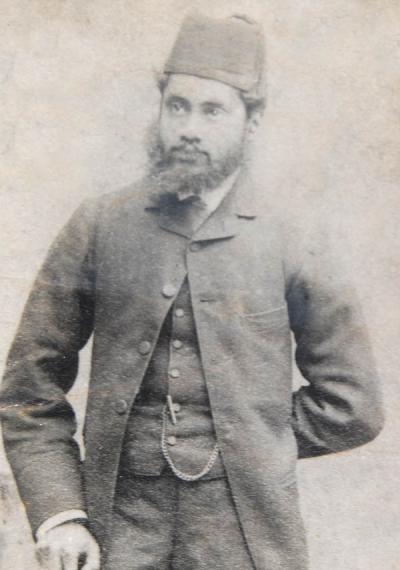
In my mind, I still see the handsome face of Idrice, with his long beard and wearing a Turkish salwar, feeling alienated in a foreign world, travelling in third class to save costs, missing his parents, but carrying in his mind and soul the hunger of those natural born intellectuals who exist to disrupt their comforts, as they search of a higher purview in life.
National Hero
He completed his specialization in surgery in Edinburgh, and had, in between, the time to fall madly in love with a French woman as he passed through Paris. Despite the serious look of a Sufi master lost in the contemplation of the divine, Idrice seemed a man hungry to taste the beauty of the world, as he searched for himself. He was to my mind the prototype of the now successful erudite Mauritians of today. One feels the glow of his idealism in his search for knowledge, in an impossibly racist misogynic world, to taste the ephemeral beauty, to experience the fresh appeal of love, but, above all, to eventually return to Mauritius to serve.
What holds one in awe is to learn that instead of coming back like most doctors, to recoup in kind the efforts they would have put in the years of toiling, Idrice chose the difficult job of serving the then government in the most complexes of problems, which was dealing with incoming waves of immigrant population, scarred by ill health and disease. It would be similar today to going to a cholera infested zone to help those affected.
Without delay, he volunteered to run the immigration hold center without great logistical support from the government, a sorry contrast to the well-equipped clubs and resorts of the colonial executive establishment. He had to pull together what he had in hand, the lack of support from the then colonial regime, and the very dismal state of the medical facility.
Idrice threw away pride, lifted his sleeves and sacrificed himself for the immigrants stepping out of these “cargoes” of death. These same people landed with bruised faces, having slept in their own faeces and urine, through a four-month journey.
After many months of supreme human efforts, Idrice himself sadly perished at the centre, after himself contracting cholera, to the tragic dismay of all the communities, white and non-white. His own parents and brothers who had put all their savings on call to make of him a man of letters were shattered. Gone too early.
Known today as a national hero, one cannot help but murmur these few lines of Rumi, on the 128 years on the death anniversary on the 29th July 1889, of Idrice Goomany: “Be drunk with Love, for Love is all that exists. If they ask what Love is, say: the sacrifice of will.”
Publicité
Publicité
Les plus récents