Publicité
Avoiding stagflation: A Budget analysis
Par

Partager cet article
Avoiding stagflation: A Budget analysis
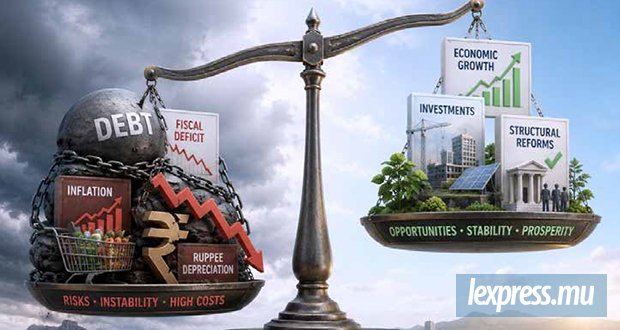
A new Government came to power in November 2024 with an overwhelming mandate to implement an ambitious programme of fundamental changes to improve the living standards and well-being of the population. However, the task proved more challenging than anticipated, as the true state of the economy revealed deep structural issues, confirming earlier concerns by independent economic analysts. The country was indeed saddled with an unsustainable fiscal deficit, a heavy debt burden, a widening external imbalance, a weakened rupee and constrained availability of foreign exchange.
2025-2026 Budget outcome
In response, the Government’s first 2025-2026 Budget set out to restore fiscal discipline. Encouraging progress has been achieved, as the budget deficit fell significantly by Rs20 bn, from Rs66 bn to Rs46 bn, equivalent to a reduction from 9.3% to 6% of GDP. If the expected revenue of Rs10 bn from the Chagos deal had been received, the deficit would have dropped below the budgeted figure of 4.9% of GDP. Moody’s commends the 2025-2026 Budget outcome as a “strong fiscal adjustment to stabilise debt to GDP”. Despite the decline in the deficit, the public debt level remains high, at an estimated 87.8% of GDP in June 2026, slightly lower than in June 2025, but still higher than in June 2023 and June 2024.
Fiscal improvement relied mainly on increased taxation rather than expenditure cuts. The tax measures, including the Fair Share Contribution, yielded mixed results. Tax revenue increased by only Rs16 bn, falling short of the budgeted Rs25 bn, while overall spending declined only slightly. A rise of Rs5 bn in interest payments offset savings from the pension reform measure and from cuts in CSG allowances and other expenditures. Capital spending remained depressed.
2026-2027 Budget estimates
The 2026-2027 Budget seeks to cut the deficit further by Rs15 bn to Rs31 bn, or 3.7% of GDP, by boosting revenue more than expenditure. Tax revenue is budgeted to increase by Rs19 bn, with new tax measures on individual and corporate income and profits, higher excise duties, and a higher corporate climate responsibility levy. Other additional revenue of Rs12 bn includes receipts of Rs10.6 bn from the Chagos deal.
In contrast to the spending restraint shown earlier, total expenditure is expected to increase by Rs16 bn next year. Capital spending is expected to double, and current spending to rise, due to the full implementation of the Pay Research Bureau salary award for Government employees , highers pending on goods and services, and mounting interest payments.
A budgeted, then withdrawn, pension reform measure sought to replace the universal Basic Retirement Pension (BRP) system with an incometested State Age Pension (SAP) from January 2027. As a result, BRP/SAP payments would have declined by some Rs3 bn in 2026-2027, and further by Rs6 bn in 2027-2028. The potential savings from this pension reform are roughly estimated at around Rs12 bn over the next two fiscal years. The Government has announced postBudget measures to review taxes and expenditures and make up for the foregone pension savings.
Achieving the 2026-2027 deficit target will rest largely on the UK’s ratification of the Chagos Agreement, currently beset by a great deal of uncertainty. Pending receipt, our development partners, credit rating agencies, the IMF, the World Bank and other international institutions will assess the country’s fiscal stance without accounting for Chagos revenue. Excluding Chagos-related revenue, the deficit will be around 5% of GDP in 2026-2027 and could be even higher if the loss in pension savings is not matched by increased revenue or reduced spending.
Deficit control
Although it appears that the Government is still pursuing fiscal consolidation by reducing the deficit from 6% of GDP to 5%, this is not really the case. The Government once again resorted to a long-standing practice of window-dressing the budget deficit through the use of transfers to special funds. In 2026-2027, special funds will undertake off-budget expenditures of Rs11 bn, higher than in 2025-2026, but partly financed by earlier budget transfers to these funds. Special funds display a surplus of Rs2 bn in 2025-2026 (0.2% of GDP), followed by a deficit of Rs5 bn in 2026-2027 (0.6% of GDP).
The true fiscal position is better reflected by consolidating the budget and special funds, in line with the IMF methodology used in its annual country reports. The State of the Economy Report of December 2024 exposed previous “trimming and cooking of data” and recommended such consolidation “in order to have a complete picture of the fiscal situation”. On this basis, the consolidated budget deficit will remain unchanged at around 5.7% of GDP in both 2025-2026 and 2026-2027, indicating the lack of progress in fiscal deficit reduction.
The absence of overall fiscal adjustment is clear in Government borrowing requirements, which amount to Rs47 bn in both 2025-2026 and 2026-2027, excluding Chagos revenue. Government borrowing requirements include Government loans and equity injections in public sector bodies, which will be higher by Rs6 bn in 2026-2027. These financial outlays are considered investments and not expenditures in computing the fiscal deficit but are disguised expenditures to cover the operational costs and losses of Metro Express, Airport Holdings, Wastewater Management Authority, Central Water Authority, Maubank Holdings and other state-owned bodies.
As mentioned in the last Report of the Director of Audit, previous Government investments of Rs61 bn have yielded zero return since acquisition, and a total of Rs21 bn of Government investments in Maubank Holdings and the National Property Fund was written off in June 2025. This is another stark reminder of the huge public cost of the Bramer Bank/BAI closure. The Government disregarded the recommendation of the Director of Audit for the setting-up of an Asset Management Unit to ensure effective oversight and management of Government investments.
Debt burden
Public sector debt is budgeted to decline by about 2 percentage points to 85.6% of GDP by June 2027, but by only 1 percentage point to 86.8%, excluding Chagos revenue. Moreover, the debt ratio would remain unchanged by June 2027 if the GDP deflator increase in 2026-2027 were less than projected. Even the small projected improvement in the debt burden is partly attributable to higher inflation, rather than genuine fiscal consolidation.
As rightly stated in the Budget, despite a downward trend, our debt level is still significantly higher than that of our peer countries and continues to be closely monitored by the rating agencies. It is widely recognised that persistently large deficits causing debt to stabilise at high levels would likely lead to a rating downgrade.
The Public Debt Management Act (PDMA) was amended in mid-2025 to prescribe a new fiscal anchor, namely a public-sector debt-to-GDP target of 75% by end-June 2030. The failure to implement pension reform and any further delays in securing Chagos revenue will derail efforts to meet the public-sector debt projection of 79.8% of GDP by June 2029. The achievement of the fiscal target under the PDMA is thus shrouded in considerable doubt.
Moreover, the Budget has not provided any update on plans for a Fiscal Responsibility Act to ensure that fiscal policies are governed by sound fiscal rules and guidelines. The Government pays no heed to the Director of Audit’s recommendation for the setting-up of a Fiscal Council or a Parliamentary Committee acting as a Fiscal Council.
The difficulty in tackling public debt arises mainly from the high level of Government spending, which will stay at around 32% of GDP in 2026- 2027, well above the average of 25% prevailing in pre-Covid years, and still higher than the 30% post-Covid average. Social spending accounts for 30% of total Government expenditure, while employee compensation represents a further 18%. Together, these two items make up around half of overall spending, and interest payments add another 11%.
Rising public debt is driving up debt-servicing costs, with interest payments expected to exceed Rs30 bn in 2026-2027. For the first time, the country is spending more this year on interest payments than on education. Capital spending remains constrained by high social spending and debt servicing, stagnating at very low levels of less than 5% of total expenditure, and less than 2% of GDP.
The harsh but unavoidable conclusion is that the current degree of fiscal adjustment is not sufficient to bring down the public debt ratio appreciably and ward off the risk of a credit rating downgrade. The Government must demonstrate a more credible and sustained fiscal effort to put the debt trajectory on a clear declining path.
Growth prospects
The drive for fiscal sustainability should be accompanied by policies for stronger economic expansion. A real growth rate ranging from 2.3% to 3.0% in 2026 is projected, depending on how the Iran conflict evolves. Although the IMF and the Bank of Mauritius are now forecasting slightly lower GDP growth at 2.8%, it seems more likely that growth will decline further towards 2.3%, closer to the worst-case scenario of Statistics Mauritius.
A major challenge to fiscal consolidation lies in the decline in investment, exports and GDP growth. Total investment, in real terms, contracted by 3% last year and is expected to register marginal growth this year. Private investment, accounting for over 80% of total investment, fell by 2.8% in real terms in 2025 and is expected to drop further by 1.7% in 2026. Public investment also recorded negative real growth of 4.4% last year.
Exports of goods, in real terms, fell by 1.5% in 2025, following a sharp contraction in 2023. Real value added in export-oriented enterprises and in the seafood sector showed negative growth in 2025, as in the preceding two years. With the uncertainty surrounding AGOA renewal and the recent UK tuna tariff liberalisation, the scope for positive real growth in the goods export sector in 2026 is bleak.
The Budget forecasts GDP to rise to 3.5% in the next fiscal year and further to 4% annually in the following two years. Instead, the troubled outlook for investment and exports, combined with slower real consumption growth, signals dim prospects for a strong GDP revival in the near term. In view of an ageing and shrinking population, and constrained labour availability, Mauritius may be driven into a new economic phase characterised by low GDP growth.
To avert such a pessimistic growth scenario, the 2026-2027 Budget offers new avenues for development in the blue economy, renewable energy, AI, digitalisation and other high-tech activities. Translating these opportunities into tangible investments will depend critically on the Government’s capacity for effective policy implementation and project execution. A major Budget omission is the complete neglect of the development potential offered by the biotechnology and life sciences sector.
The previous Budget underscored the critical need for public-sector restructuring and reforms to raise overall productivity and growth. However, the 2026-2027 Budget omits to report on last year’s announcement of a Public Reforms Bill to strengthen governance, transparency and accountability across public institutions, and on the settingup of proposed Reform and Innovation Units in all ministries and departments.
There is also no word on progress on the previously announced Public Bodies Financial Sustainability Programme, or the planned “reorganisation to reduce inefficiencies, cut waste and rationalise parastatals to address the issue of inefficiency and generate budgetary savings”. Instead, the 2026- 2027 Budget now proposes to set up “A Steering Committee on Public Sector Efficiency to identify areas of duplication, inefficiency and wastage”. Without decisive action on these repeated Budget statements, the Budget’s potential for boosting investment and growth is likely to remain largely unrealised in practice.
Inflation risks
Failure to rein in the fiscal imbalance will have serious adverse consequences, translating into a higher external deficit, a weaker rupee and higher inflation. This was clear under the previous Government. The fiscal deficit increased from 3% of GDP in 2018-2019, the year preceding Covid, to 6% of GDP in 2023-2024. Over the same period, between 2019 and 2024, the current account deficit also widened from 3% to 6% of GDP, the rupee fell by 27%, and prices went up by 30%. Resorting to money printing to finance Government spending further worsened the situation, resulting in double-digit inflation.
Inflationary pressures remain a major concern, driven by structural imbalances, currency depreciation and rising global prices. Despite an additional budgetary earmarking of Rs2 billion for the Price Stabilisation Fund to subsidise a broader range of selected consumer goods, the erosion of purchasing power caused by rising prices continues to fuel significant public discontent.
The US–Iran war and the resulting energy crisis have pushed up fuel and electricity prices, with knock-on effects on the cost of other goods and ser vices. The Bank of Mauritius projects average headline inflation to rise to around 5.5% in 2026, and notes that core inflation, which excludes controlled items, has remained persistently high, currently at 6.4%. The increase in the key interest rate by 25 basis points to 4.75% was specifically aimed at containing mounting inflationary pressures.
The recent depreciation of the rupee is also feeding into higher inflation, having started before the Iran war. The rupee dropped by close to 30% between 2019 and 2024. Although it stabilised in 2025, the rupee has already weakened by around 5% against both the US dollar and the euro since the start of the year. Rupee weakness reflects a chronic forex shortage, stemming directly from the large external imbalance. Exports are not growing, while imports continue to rise, especially due to a higher fuel bill.
The goods deficit, on an f.o.b. basis, remains high, at around a quarter of GDP, or about US$4 bn. Services show a surplus of over US$2 bn, largely from tourism and the global business sector. The current account deficit, which has been widening again since 2024, is now expected to rise further to 7.5% of GDP, in the absence of Chagos income.
The persistent shortage of foreign currency and continued rupee weakness follow from the economy’s twin imbalances, namely a wide fiscal deficit and a large external deficit. Further downward pressure on the rupee will fuel higher import costs and drive inflation up. Unless the fiscal deficit is further reduced and exports are revived, the country will face a cycle of currency depreciation and high inflation.
n Pension targeting More than one-third of Government spending is on social benefits, with old-age pensions accounting for a major share. Social benefits soared from Rs32 bn in 2018-2019, or 6% of GDP, to an estimated Rs83 bn, or over 10% of GDP, this year. BRP and related payments represent over 8% of GDP. An ageing population and a growing old-age dependency ratio are putting unfair pressure on the younger generation to bear a heavier tax burden. In the pursuit of fiscal adjustment, the growth of spending on old-age pensions must inevitably be contained. Pension reform started last year with a gradual increase in the BRP eligibility age from 60 to 65 years and was pursued in the 2026-2027 Budget by the introduction of income meanstesting for BRP, among other measures. Income targeting of BRP, renamed SAP, was meant to replace universal BRP payments from January 2027, but has now been abandoned. Despite the delayed start of the new National Pensions and Provident Fund beyond July 2027, it is hoped that other announced pension reforms will proceed as intended. Several concerns have been raised regarding the design of the means-testing measure. A first issue relates to (i) the relatively low monthly income-threshold level of Rs14,000 for full pension eligibility, currently representing half of median monthly employment income, and (ii) the level of Rs50,000 for non-eligibility, which is less than twice full median income.
Another perceived flaw is the failure to gradually lower the income threshold for pension non-eligibility over time, to allow pensions for higher-income earners to be phased out over several years instead of being stopped suddenly. A more balanced approach could have included a gradual phasing by age cohorts as well as over time.
Fairness considerations suggest that income-based means-testing for pension eligibility should be complemented by asset testing, ensuring that interest and dividend income are also taken into account. A confounding feature of the reform is the entitlement of persons under 65 years of age, who are already gainfully employed, to receive BRP on purported compassionate grounds.
Pension reform is inherently complex and highly sensitive, but broad public consensus can ultimately be reached on most of these core issues. The Government should stay committed to fiscal adjustment by building the public’s understanding and support for necessary pension reforms.
Conclusion
Mauritius is at significant risk of entering a stagflationary period, marked by sluggish growth and sustained inflation. Current fiscal and other policies appear inadequate to lower public debt levels meaningfully, or to stimulate stronger economic activity.
To avert this outcome, the country will need stricter fiscal discipline, comprehensive structural reforms, enhanced governance and more effective policy implementation. Ultimately, achieving economic stability and renewed growth will hinge on credible and decisive leadership. Now more than ever, the appointment o f a full-fledged and dedicated Minister of Finance is imperative.
Publicité
Publicité
Les plus récents