Publicité
The Mauritius story, 1638- 2026
A people and their choices
Par

Partager cet article
The Mauritius story, 1638- 2026
A people and their choices
Introduction : Mauritius has spent nearly six decades defying the predictions made about its bleak future by Nobel economist James Meade in 1961. The second part of this six-part series of essays – to be published in the following days – explains that the Mauritian miracle did not happen in a vacuum, but in a specific international environment almost perfectly designed to reward small states with political stability and institutional quality.
• From colonial inheritance to the threshold of the fifth wave (Part 1&6)
PART I
The people before the nation
• Mauritius to 1968
The island that would become Mauritius was uninhabited until human beings brought it deliberately into their world, first as a waystation, then as an experiment, and finally as one of history’s most improbable attempts to build a multiracial democracy from the ruins of a plantation economy. Understanding how it arrived at independence in 1968 is not merely historical context. It is the explanation for the institutional inheritance that made every subsequent transformation possible, and for the social tensions that have constrained it.
> The colonial foundation and its institutional legacy
The Dutch arrived in 1598, named the island after Prince Maurice of Nassau, and extracted what they could: ebony, dodo, and provisions for East India Company ships. They abandoned the colony in 1710, leaving behind deer, pigs, and rats. France arrived in 1715 and stayed. Under the name Île de France, the island became a significant node in the French imperial economy as a provisioning base on the India route and a sugar producer whose entire labour force was enslaved. French writers described Mauritius as “the Star and Key of the Indian Ocean”, a description that captured its strategic significance as the most important maritime hub of the age. That hub status would last until the opening of the Suez Canal in 1869.
Britain captured the island in 1810 and held it at the Treaty of Paris in 1814 with a promise that has shaped Mauritian political history ever since. that French laws, the French language, and the social rights of the colonists would be preserved. This legal continuity of French civil law surviving alongside English common law, both languages alongside Kreol Morisyen, and the Franco-Mauritian planter class retaining economic dominance long after it lost political power is one of the structuring facts of modern Mauritius.
It is also the origin of Mauritius’s single most valuable institutional asset. The common law inheritance and specifically its application to commercial contracts is what made the economic miracle possible. When Hong Kong and Taiwanese garment manufacturers chose where to locate their EPZ investments in the early 1970s, they were making a bet on whether a contract signed in Mauritius would be honoured. Many African governments introduced broadly similar export-processing frameworks during the same period.
What was unusual in Mauritius was not the policy but the institutional environment within which it operated:
a. A judiciary genuinely independent of the executive;
b. A commercial law framework recognisable to international investors;
c. A civil service capable of administering the regime consistently rather than capturing it for personal or political benefit.
Institutional economics distinguishes between policies and policy credibility. A ten-year tax holiday announced by a government operating within a stable legal framework is worth more than the same holiday announced in an environment where renegotiation is always possible. The common law inheritance provided exactly that credibility.
> Slavery, indenture, and the making of a plural society
The abolition of slavery in 1835 freed approximately 70,000 to 76,000 enslaved people. Compensation was paid to the slave owners, not the enslaved. The freed population found themselves legally free in an economy with no place for them except as agricultural labourers on the same estates that had enslaved them. Many refused. The sugar industry faced a labour crisis.
Between 1834 and the early 1900s, approximately 450,000 Indians arrived in Mauritius as indentured labourers under a system the colonial authorities called the New System of Labour and the people who endured it called a new kind of slavery.

By 1901, Indo-Mauritians constituted approximately 69% of the island’s population. The community imported as cheap labour had become, by sheer demographic weight, the majority community of the island. The political implications of this demographic fact would take another half-century to work themselves out, but the foundation of modern Mauritian political life with its communal arithmetic, its coalition imperatives, its consociational instincts was laid by the end of the nineteenth century.
> The sugar economy and its social architecture
For most of the period between 1835 and 1968, sugar occupied 90% of cultivable land, accounted for the overwhelming majority of export earnings, and structured the social hierarchy of the island with a clarity that formal legal arrangements could not have achieved. The Franco-Mauritian planter families owned the large estates. Hindu and Muslim Indo-Mauritians moved from field labour toward small cane cultivation and eventually toward the professions. The Creole community occupied an ambiguous middle position. The small Chinese community dominated retail trade in ways that made it commercially influential beyond its numerical size. This hierarchy was reproduced through the education system with considerable fidelity. A handful of elite secondary schools fed a small class toward professional careers and political leadership. The majority received limited formal education and remained within the agricultural economy. Literacy rates at independence were low; economic mobility was structurally constrained.
> The welfare state before the economy; the coalition politics that made it
What distinguished Mauritius from the beginning, and what external analysts consistently underestimated, was the early and genuine investment in social infrastructure. Free primary education was established in 1957, more than a decade before independence. Universal free healthcare meant the island’s hospitals were open to every Mauritian regardless of ability to pay. The non-contributory basic pension, established in 1958, was available to every Mauritian over 60 regardless of employment history. These social investments were the hidden foundation of the economic miracle that was about to begin. When the EPZ revolution required a literate, trainable female workforce, Mauritius had one. The welfare state was not a drain on the economy. It was the precondition of the economy that followed. But the mechanism by which these investments were sustained is as important as the investments themselves. Mauritius has never been governed by a single-party majority in the normal sense. The ethnic and communal arithmetic of the constituency system, combined with the Best Loser mechanism designed to ensure community representation, means that governing coalitions are invariably broad, multiparty, and cross-communal. In the short term, this is costly. Coalition governments are slower to act and more constrained in their policy choices. In the long term, it has produced something more valuable than speed, the cross-party consensus on economic fundamentals that allowed structural reforms to survive changes of government. The EPZ framework established under Labour was expanded by the MSM. The social welfare architecture established in the 1950s has been maintained and extended by every government that has held office.
What appears to be a weakness, the slowness, the compromise, the need for consensus, is the source of the institutional strength. A government that must build cross-party agreement before acting is a government that, when it does act, is implementing policies with a broader base of social legitimacy than a single-party government can typically claim.
It was also, as part V argues, the origin of the fiscal challenge that now threatens the economy it made possible. The pension system calibrated for a population with a total fertility rate of 5.8 and a median age of 20 cannot be sustained unchanged for a population with a fertility rate of 1.32 and a median age of 38. That arithmetic was not visible in 1958. It is inescapable now.
> Independence and the demographic trap
The 1968 independence came with a warning from James Meade, whose 1961 report had concluded that Mauritius was caught in a Malthusian trap. The population had grown from 419,000 in 1944 to 826,000 in 1968, a near-doubling in twenty-four years. At those rates of growth, no plausible rate of economic expansion could generate sufficient employment and income growth to improve living standards. What Meade could not foresee was the speed with which Mauritian fertility rates would collapse as women entered the formal labour force. The EPZ revolution of the 1970s was not merely an employment programme. It was a demographic intervention of the first order. By 2024, the total fertility rate had fallen to 1.32, below Japan, below Italy, far below replacement. The island warned it would be crushed by its population became, within a generation, an island worried it would not have enough people.
******
PART II
The art of the impossible
• Four waves of reinvention, 1968–2020
In the fifty-eight years since independence, Mauritius has built four distinct economic pillars from the rubble of four successive crises. The mechanism has been identical each time. A shock destroys the existing model. Political urgency enables structural reform that peacetime complacency would have blocked. And the reform creates the conditions for a new economic pillar that outlasts the crisis that produced it.
This is the most important single fact about Mauritius that the island has not fully told itself. It is not merely that Mauritius has been resilient. Many countries survive crises without being transformed by them. It is that Mauritius has consistently metabolised its crises, converting economic threat into structural opportunity with a consistency that cannot be attributed to luck. Understanding how it did so requires understanding the institutional substrate that made each transformation possible.
Every pillar Mauritius has ever built was born in a crisis that seemed, at the time, like evidence of irreversible decline.
> The first wave: the EPZ revolution (1970–1977)
The starting point was simple and desperate: 20% unemployment, a single-crop agricultural economy, no mineral resources, no domestic market, and no regional precedent for the kind of industrial transformation required. The Export Processing Zones (EPZ) Act of 1970 was the answer. Its political design was as sophisticated as its economics. The government did not attempt to dismantle the existing sugar economy and the powerful Franco-Mauritian interests that depended on it. It created a parallel track made of a separate, export-oriented manufacturing regime with its own rules. Companies in the EPZ received duty-free importation of all inputs, ten-year tax holidays, and full repatriation rights. Crucially, they did not threaten the sugar estates, the import-substitution industrialists, or the existing civil service. The EPZ was a new space, not a redistribution of an old one.
Investors were found through promotion missions to Hong Kong and Taiwan, where garment manufacturers were facing tightening export quotas under the MultiFibre Arrangement. Mauritius, as an ACP country with unused quota allocations, was the solution to their problem. By the late 1980s, EPZ employment had reached approximately 110,000 and unemployment had fallen from 20% to 3–5%.
Why did the EPZ work in Mauritius when broadly similar policies produced rent-extraction or superficial assembly in comparable African economies? The dualtrack design mattered enormously. By creating a new space rather than redistributing from an old one, it avoided the fatal confrontations that derailed structural reform elsewhere. But the deeper answer is institutional. The investors from Hong Kong and Taiwan needed to be able to enforce their contracts, trust the regulatory environment, and rely on a civil service capable of administering the regime consistently rather than corruptly. Many African governments announced the same EPZ policies as Mauritius in the 1970s. What was different was not the announcement but the institutional architecture that made the announcement credible.
> The second wave: The IMF adjustment that built tourism (1979–1986)
By 1979, the balance-of-payments deficit stood at $111 million, the fiscal deficit at 10% of GDP, inflation at 24%, and unemployment had risen toward 17%. Between 1979 and 1986, Mauritius entered three IMF Stand-By Arrangements and two World Bank Structural Adjustment Loans. Devaluation, fiscal consolidation, wage restraint, and liberalisation were applied in Mauritius at precisely the moment they were producing social devastation across sub-Saharan Africa. In Mauritius they were applied differently, not because the economic prescriptions differed, but because the institutional context did. The coalition political culture created crossparty consensus on economic fundamentals. The government retained the authority to sequence reforms rather than submitting to an externally imposed timeline. Trade union institutions had sufficient legitimacy to negotiate wage restraint rather than resist it in the streets. One World Bank assessment described the implementation as having a “smooth and human-faced” quality absent from comparable programmes elsewhere. This was not technocratic competence. It was political institutional design.
The rupee devaluation simultaneously made Mauritius dramatically more affordable for European tourists. Rather than pursuing mass-market volume tourism, the government made a deliberate choice to position at the premium end: five-star hotels, direct European routes, a national brand built on natural beauty, safety, and cultural richness. By the late 1980s, the current account had swung from a 15% of GDP deficit to a 5% surplus, inflation had fallen below 1%, unemployment to 2.5%, and GDP was growing at close to 10% per year.
> The third wave: financial services and the India DTAA (1990s–2007)
The third pillar arrived not from a single dramatic crisis but from the recognition that the first two pillars were approaching their natural limits. The Multi-Fibre Arrangement ended in 2005. The sugar protocol was being progressively eroded. Both pillars faced structural threat from the very liberalisation of the trade preferences that had made them possible.
The foundation of the response was the 1983 double taxation avoidance agreement with India, which allowed foreign investors to route capital into India through Mauritius while paying tax only in Mauritius. By the early 2000s, Mauritius was the single largest source of FDI into India, accounting at various points for 35–40% of total FDI inflows into a country of 1.2 billion people. What made the DTAA route work was not only the tax advantage. It was the genuine legal certainty, stable regulatory environment, and structural protections for investors that the Mauritian institutional framework provided. Renegotiating the DTAA in 2016, removing its most advantageous provisions, was the managed diminishment of the third pillar’s most powerful engine. The sector can grow further, but it must grow on foundations of genuine regulatory quality and authentic substance rather than treaty arbitrage.

> The fourth wave: surviving the global financial crisis (2008–2009)
The 2008 global financial crisis was the first major external shock that Mauritius did not convert into a new economic pillar. It survived the shock rather than metabolising it and survival was a genuine achievement.
The Bank of Mauritius’s prudential conservatism, a regulatory culture that had maintained conservative banking standards throughout the pre-crisis boom, meant that Mauritian banks had limited exposure to the structured credit instruments that destroyed institutions across Europe and North America. Mauritius recorded positive GDP growth in every year of the GFC period, recovering to 4.2% growth by 2011. The diversification achieved through the first three waves had itself become a form of shock absorber. Resilience was not a policy choice. It was the cumulative product of fifty years of structural diversification.
The GFC also offered a cautionary institutional episode that deserves more attention than it typically receives. The Bank of Mauritius’s performance in 2008–09 was built on a decade of sustained investment in prudential supervision capacity and genuine independence from political interference. That independence is not self-maintaining. The 2020 FATF grey-listing, resolved by October 2021, demonstrated what happens when the sustained investment in institutional quality is withdrawn, even for a relatively short period. The root cause of the grey-listing was not a single regulatory failure but a political environment in which the financial services sector’s commercial interests had been allowed to weaken the regulatory standards on which that sector’s credibility depended. The estimated 6–10% loss of financial services revenue during the grey-listing period, an industry estimate, not official statistics, and to be treated accordingly, is the price of institutional neglect. Institutional quality is not self-maintaining. It requires sustained political and resource investment. When that investment lapses, the consequences transmit rapidly and painfully through the economic and demographic dimensions.
> The pattern and its implications
The structural pattern across all four waves is consistent enough to be stated as a thesis. Every major pillar of the Mauritian economy was built during or immediately after a crisis that threatened the existing model, by a government with the institutional capacity: the credible legal system, the coalition political culture, the competent civil service, to implement the required reforms while comparable economies failed to do so.
The implication for the present moment is that the current external shock is not a deviation from the Mauritian story. It is the Mauritian story. There is one critical caveat. The four previous waves all had a structural advantage that the fifth wave does not; a young, growing, and increasingly educated population that could be directed toward new economic activities as the old ones declined. The fifth wave must be built as the workforce shrinks, as the old-age dependency ratio rises, and as the fiscal pressure from ageing increases the difficulty of the public investments that transformation requires.
******
PART III
The world that made Mauritius, and how it is breaking
The economic miracle of Mauritius did not happen in a vacuum. It happened in a specific international environment almost perfectly designed to reward the combination of small size, political stability, and institutional quality that Mauritius possessed. That world is ending. What replaces it will be both more dangerous and more opportunity-rich for a well-positioned small island state. Understanding this transition is the precondition for understanding what the fifth wave must build.
> The architecture of advantage
Three structural advantages powered the Mauritius miracle, and all three are now substantially gone. The first was the African, Caribbean, and Pacific sugar protocol, guaranteeing preferential access to European markets at prices two to three times world market levels from 1975 to 2007. The second was the Multi-Fibre Arrangement, allocating export quotas to developing-country producers and making Mauritius attractive to Hong Kong and Taiwanese garment manufacturers in ways that would have been impossible in a genuinely free market for textiles. The third was the India double taxation treaty, a bilateral instrument that made Mauritius the primary routing point for Foreign Direct Investment into a country of 1.2 billion people for over two decades. Each was the product of careful positioning within the postwar international order. Each ended because the order that produced it changed.
What replaced the preferential architecture was a world of formal non-discrimination, Organisation for Economic Co-operation and Development substance requirements, and BEPS-driven constraints on the regulatory arbitrage that had powered financial services growth. The Financial Action Task Force grey-listing of 2020 demonstrated how quickly institutional credibility can be damaged in this environment and how slowly it is rebuilt. What Mauritius must now compete on is not preference, but merit; that is genuine regulatory quality, authentic legal certainty, and real economic substance.
> From multilateral to multipolar: threat and opportunity
What is replacing the post-war order is not chaos. It is multipolarity. The G7’s share of global Gross Domestic Product (GDP) has fallen from roughly two-thirds in the mid-1990s to under half today. BRICS+ nations represent over 37% of global GDP at purchasing power parity. The Global South of over 130 nations representing three-fifths of global population is pursuing multi-alignment, seeking to maximise benefits from all major powers rather than committing to any single bloc.
For Mauritius, this is simultaneously threatening and opportune. The threat is clear. Open, import-dependent economies with limited fiscal space are acutely vulnerable to external shocks in a world of contested rules and unpredictable large-power behaviour. The opportunity is equally clear. In the post-war unipolar world, the premium for small-state alignment went entirely to states aligned with American preferences. In the emerging multipolar world, small states that are trusted by all sides, that offer genuine legal and institutional quality, that maintain authentic nonalignment, and that can serve as bridges between competing power blocs, command a premium they could never have achieved when there was only one power worth pleasing.
The post-war order gave small states with good institutions a structural advantage. The emerging order gives the same states a different but potentially larger advantage if they can position themselves as genuinely indispensable bridges between competing power blocs.
One dimension of the multipolar transition deserves explicit attention: the China relationship. The multi-alignment argument requires Mauritius to be trusted by India and China simultaneously, which is an increasingly demanding requirement as those two powers’ strategic competition intensifies in the Indian Ocean region. Honest analysis cannot resolve this tension. What the history of successful small-state diplomacy suggests is that authentic multi-alignment, maintained through genuine usefulness to both sides rather than empty declarations of neutrality is achievable, but it requires a professional diplomatic service with the analytical depth to track the relationship continuously and position Mauritius’s interests with precision. The institution-building implication is taken up in Part VI.
> The Hormuz moment: conditional windfall
The disruption to the Strait of Hormuz since early 2026 has rerouted global shipping to the Cape of Good Hope, bringing every major container line directly past Port-Louis for the first time since the Suez Canal opened in 1869. The effects for Mauritius are threefold: a cost-push shock on energy imports (90% of primary energy is imported); disrupted aviation connectivity through Middle Eastern hubs with real consequences for tourism; and a geographic opportunity of historic proportions.
This opportunity must be characterised carefully. The Hormuz disruption is a temporary windfall with permanent institutional potential, not a permanent structural shift. The question is not whether the Cape Route will always be the primary Asia-Europe corridor. It may not be. But whether the institutions built to capture today’s windfall will retain value when the route eventually changes again. Infrastructure without institutions is the Venetian mistake, as Part IV explores. The case for port investment rests on building durable regulatory, professional, and maritime services capacity, not on a geopolitical bet.
> The institutional quality imperative
The transition from a preference-based to a merit-based international environment has a precise institutional implication that it is worth stating explicitly. In the post-war world, the structural preferences, which were the sugar protocol, the MFA, the DTAA, generated economic returns almost regardless of institutional quality. The preferences were generous enough to survive significant governance deficits. In the emerging world, there are no such preferences. The returns flow to genuine institutional quality: independent judiciary, credible regulation, authentic rule of law, and the predictability that international investors require before committing long-horizon capital.
This means that institutional quality is no longer merely a development aspiration for Mauritius. It is the primary competitive asset. Anything that erodes it, like political pressure on judicial appointments, regulatory capture by incumbent financial services interests, the subordination of monetary policy to short-term fiscal convenience erodes the foundation of everything the fifth wave requires. Protecting and deepening institutional quality is not separate from the economic strategy. It is the economic strategy.
******
PART IV
Lessons from small states
• What history teaches about survival and sovereignty
Mauritius is not the first small state to find itself caught between larger powers in a world of competing interests. History offers a series of instructive parallels. None is perfect, historical analogies never are, and the causal arguments they support require care. But used as lenses rather than blueprints, they illuminate the conditions under which small-state strategies succeed and fail, and the institutional requirements that survival imposes.
> Ragusa (Dubrovnik): the closest parallel
The Republic of Ragusa sustained its independence for 450 years between 1358 and 1808, surrounded by powers that could have absorbed it at any moment. These were the Ottoman Empire to the east, Venice to the north, the Habsburg Empire to the west. It survived not through military power, as it had virtually none but through institutional quality, economic indispensability, and the systematic cultivation of relationships with all competing powers simultaneously.
Ragusa paid tribute to the Ottoman Empire while maintaining diplomatic relations with every Christian power. It traded with everyone and took sides with no one. Its ambassadors were among the most skilled in early modern Europe, tracking great-power relationships with extraordinary precision and positioning Ragusa as useful to each power without being threatening to any. Its merchants were trusted in Istanbul, Rome, Madrid, and Vienna simultaneously, because everyone understood that Ragusa’s neutrality was genuine rather than tactical.
Ragusa understood something most small states have forgotten. The goal of small-state diplomacy is not to align with the winning side. It is to make yourself so useful to all sides that none of them can afford to be your enemy.
The institutional quality of the Republic was equally remarkable. Ragusa maintained a republican government more stable and more resistant to corruption than virtually any other political system of its era. It operated the first quarantine system in Europe, implemented in 1377, protecting its commercial life from the plague epidemics that periodically devastated competitors. Institutional quality was not a luxury Ragusa maintained despite its small size. It was the survival mechanism that its small size made necessary.
The causal argument deserves precision. It is not certain that Ragusa’s longevity was caused by its multi-alignment strategy rather than being correlated with it. But the historical record is consistent with a causal reading. The moments when Ragusa’s independence was most threatened were precisely the moments when its neutrality became difficult to maintain, and survival came when it re-established its usefulness to all sides. The lesson is instructive rather than conclusive.
> Singapore: the developmental state model
Singapore in 1965 was a small island with no natural resources, a multi-ethnic population with potentially explosive communal tensions, and an uncertain economic future. Like Mauritius, it became one of the most prosperous small states in the world within five decades. Singapore’s method was distinctive and demanding, a meritocratic civil service recruitment on a scale that absorbed much of the country’s most talented human capital into public service; active industrial policy that identified priority sectors and built supporting institutions; a political management of communal tensions that was simultaneously dirigiste in its methods and effective in its outcomes.
The transferable lesson is narrower and more important than the overall model. A small state with no natural resources has no choice but to treat human capital as its primary resource, and treating it as such means investing in it with a consistency and seriousness that resource-endowed countries can afford to avoid. Singapore also offers a specific warning for the immigration proposals in Part VI. Singapore achieved its demographic management under conditions of political constraint not available to a genuine multiparty democracy. Any immigration strategy for Mauritius must be designed for a democratic political environment, not transplanted from Singapore’s more constrained context.
> Venice: the cautionary tale
Venice’s decline began when the Portuguese discovery of the sea route to India in 1498 removed the geographical advantage on which its trading position depended. The Eastern trade that had made Venice indispensable no longer required the overland routes that passed through Venetian control. The city adapted, but never with the urgency or completeness that the structural shift required. Its institutional rigidity, the same quality that had made it stable, made it slow to respond to a changed environment. By the seventeenth century it was a minor power; by the eighteenth, a tourist attraction.
The Venetian lesson is directly relevant to the Hormuz opportunity. Geographic advantage is real and significant, but it is not permanent. Mauritius must invest in port and maritime infrastructure in ways that build institutional capacity in regulatory quality, professional services, and maritime law that will retain value even if the Cape Route’s prominence diminishes. Infrastructure without institutions is the Venetian mistake.
> The pattern across cases
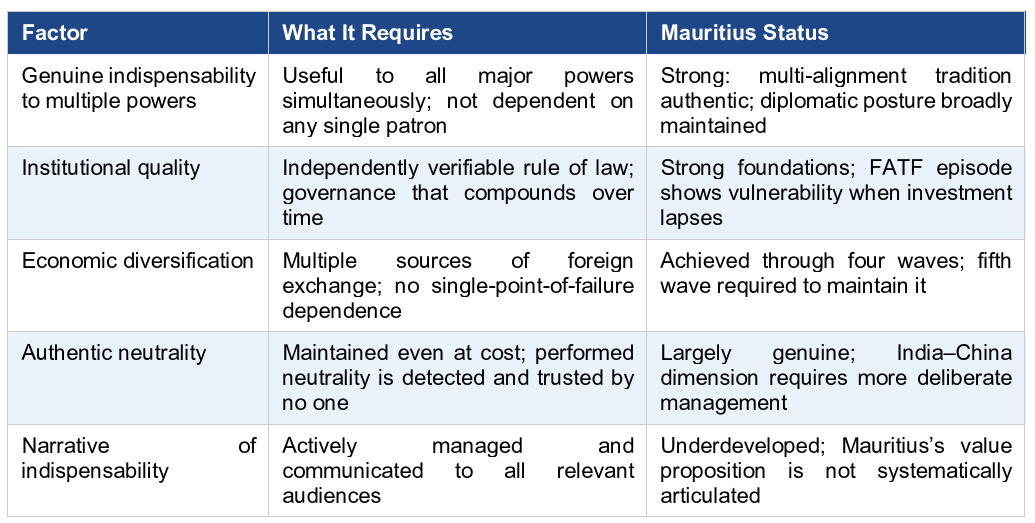
Comparing Ragusa, Singapore, Venice, the Netherlands, Switzerland, Luxembourg, and Hong Kong produces a consistent set of factors that predict small-state survival and prosperity across very different historical periods and geographical contexts.
Mauritius meets most of these criteria. The institutional quality is real, the diversification is genuine, the geographic position is advantageous, and the tradition of multi-alignment is authentic. The question is whether the institutions required to maintain these advantages are being built at the speed and with the seriousness that the current moment demands.
> What the historical pattern requires Mauritius to build
The comparative case points with unusual consistency toward three institutional requirements. The first is a professional career foreign service. Authentic multi-alignment is not a political declaration. It is the product of sustained, sophisticated diplomatic engagement conducted by professionals who understand the interests and sensitivities of each interlocutor well enough to position Mauritius as genuinely useful to all of them simultaneously. The current practice of staffing ambassadorial positions partly through political appointment cannot deliver this. The capacity must be built and maintained over decades, not improvised for each diplomatic challenge.
The second is a dispute resolution and arbitration centre in Port-Louis capable of becoming the default venue for Africafocused commercial disputes. The Ragusa parallel is instructive: the Republic’s legal codes were among the most sophisticated in the Mediterranean world, not as an end in itself but because legal quality was the product it sold to trading partners who needed certainty. Mauritius has the judicial foundation made up of the Privy Council appellate link, the Supreme Court’s commercial division, the common law inheritance to make this achievable. The gap is specialist commercial law capacity and the bilateral agreements with African jurisdictions that would make Port-Louis the natural venue for their commercial disputes.
The third is the maintenance and deepening of the institutional quality that is Mauritius’s primary competitive asset in a meritbased international environment. The small-state historical record is unambiguous on this point. Institutional quality is not a luxury that small states maintain in addition to their economic strategies. It is the economic strategy. Everything else follows from it or depends upon it.
******
PART V
The quiet crisis
• Population, ageing, and the productivity trap
Every crisis that has transformed Mauritius in the past has had one essential political feature. It was visible. Oil prices quadrupled; you noticed. The balance of payments collapsed; the International Monetary Fund (IMF) arrived. These crises were loud. They created the political urgency that unlocked structural reform that peacetime complacency would have blocked. The crisis Mauritius faces now is different. It is quiet. It is arriving slowly, without drama, and with almost no political constituency for the structural response it requires. The demographic transition now underway is the most consequential structural shift in the island’s modern history. It is more consequential than any of the economic shocks that preceded it, because those shocks were external and they passed. The demographic shift is internal, self-generated, and will not pass. It will compound.
The numbers
In 1968, Mauritius had a total fertility rate of approximately 5.8 children per woman. By 2024, that rate had fallen to 1.32, far below the replacement level of 2.1, far below France (1.84), below the United Kingdom (1.63), and approaching the lowest rates in the developed world. The demographic momentum built into a population that already exists determines the structural shape of the 2040 population. The children who will be of working age in 2040 are already born. The people who will be over 60 in 2040 are already alive.

The old-age dependency ratio, the number of people over 60 per 100 working-age adults, stood at 12 per 100 in 1968. It stands at approximately 35 per 100 today and is projected to reach 60 or more per 100 by 2040. A workforce simultaneously shrinking in absolute numbers, ageing in composition, and declining in the ratio of workers to dependants cannot sustain the pension and healthcare commitments made for a demographic structure that no longer exists.
> Why this crisis resists the mechanisms that resolved previous ones
The demographic crisis differs from every previous external shock in three structurally important ways. First, it has no dramatic moment. The oil shock arrived on a specific date. The balance-of-payments crisis of 1979 reached a specific threshold that triggered IMF intervention. The demographic shift accumulates silently, one fewer birth at a time, one emigrating graduate at a time, one person turning 60 at a time. There is no single day on which the problem becomes undeniable, and therefore no single day on which the political urgency is maximally concentrated.
Second, the solutions are politically costly in ways not offset by immediate visible benefits. Raising the pension qualifying age means telling voters who have worked for forty years that the plan has changed. Managed immigration as a response to labour force decline means integrating communities whose cultural differences generate political friction before their economic contributions become visible.
Third, the costs of inaction compound slowly and then suddenly. The pension system’s fiscal mathematics are manageable today, uncomfortable in five years, and unsustainable in fifteen. By the time the moment of fiscal crisis arrives, the reform options will be far more painful than they are today.
The institutional lens explains why the crisis is slow in a way that the demographic lens alone cannot. The current beneficiaries of the Basic Retirement Pension are an organised, motivated, and fully enfranchised political constituency. The future workers who will fund a demographically unsustainable pension system are either not yet born, too young to vote, or too diffuse in their interests to organise effectively against the concentrated interests of current retirees. This is not a Mauritian failure. It is a structural feature of democratic institutions everywhere, the asymmetric representation of present voters over future voters in electoral systems.
The institutional response is well-understood: independent fiscal institutions with statutory mandates to publish binding assessments that insert long-horizon analysis into the political process. New Zealand’s Retirement Commissioner, Sweden’s Pensions Agency, and the UK’s Office for Budget Responsibility all address exactly this structural bias. Such institutions generally produce better quality public debate about pension sustainability; they do not automatically produce pension reform. They make reform politically harder to avoid, not politically costless. Mauritius does not yet have this institutional architecture.
> The pension system: the fiscal mathematics of generosity
The Basic Retirement Pension, the non-contributory universal pension established in 1950, and available to every Mauritian over the qualifying age, is among the most generous welfare provisions in sub-Saharan Africa and one of the most politically sacrosanct elements of Mauritian social policy. It is also, in its current form, on an unsustainable trajectory.
The BRP’s cost has doubled since 2019. As the proportion of the population over 60 rises from 18.7% today toward a projected 26% by 2040, the fiscal burden will increase inexorably, not because the system has been poorly designed, but because it was designed for a demographic structure that no longer exists. The arithmetic is not political. It is mathematical.
The options are known: raising the qualifying age, introducing a contributory element, means testing the universal provision, increasing labour force participation to widen the contributory base. The 2024 government raised the pension qualifying age from 60 to 65, the first substantive step, and one that was not well received. It is a first step, not a solution. Closing the full fiscal gap requires the full package: a contributory element, a means-tested universal provision, and a systematic effort to raise labour force participation rates. This series does not pretend to have resolved the political sequencing of these reforms. What it argues is that an independent Fiscal Commission with a statutory mandate to publish binding actuarial assessments on a fixed schedule would make these decisions politically harder to avoid, though not politically costless.
> The brain drain and its compounding
Approximately 3,500 Mauritians emigrate every year. This figure deserves disaggregation that the available data does not fully support. The 3,500 figure is derived from emigration statistics that do not perfectly distinguish by skill level and do not adequately account for return migration. What the data does support is the directional concern. A significant proportion of those who leave are educated, the net flow is persistently outward, and the pace appears to have increased in recent years. Principal destination countries are Australia, Canada, France, and the United Kingdom.
The brain drain is self-compounding. When skilled Mauritians leave, the quality of public services and private sector institutions diminishes slightly. That diminishment makes Mauritius slightly less attractive to the skilled people who remain. Some of them also leave. The diaspora that this creates is not purely a loss. Mauritians abroad maintain strong connections, send remittances, and represent potential returnees. Managing this diaspora as a strategic resource rather than lamenting the outflows is one of the underutilised tools available to a National Population Strategy.
> The productivity trap
The demographic challenge cannot be separated from the productivity challenge because they are causally connected. A shrinking workforce can produce a growing economy only if each worker is producing more. Mauritius’s productivity performance has been poor.
Capital productivity growth is reported by several analyses to have averaged close to zero annually across the decade 2014-2024. This figure requires a methodological caveat. Total factor productivity measurement in a service dominated small open economy is genuinely contested, and different methodological choices produce meaningfully different estimates. What is less contested is the compositional problem. Private investment during this period was heavily concentrated in real estate and construction. These activities do not produce the tradeable output or the productivity improvements that compound over time. They absorb capital that could otherwise have funded the knowledge economy investments that productivity-led growth requires.
The productivity trap and the demographic trap reinforce each other. Low productivity means low real wages. Low real wages make emigration of skilled workers more likely. Emigrating skilled workers reduce the human capital available for productivity-enhancing activities. Lower human capital reduces the capacity for productivity improvement. Breaking this loop is the central economic challenge of the next decade.
Capital misallocation into real estate is not primarily a market failure in the conventional sense. It is the rational behaviour of private capital in the absence of a credible public signal about where the economy is going next. When governments invest credibly in specific sectors, in training institutions, regulatory frameworks, infrastructure, and diplomatic agreements, they create conditions in which private capital moves into adjacent capability-rich activities. The real estate concentration in Mauritius is the predictable consequence of the absence of clear public direction. Correcting it requires that public direction, not moral exhortation to the private sector.
> The drug epidemic and what it signals
This series would be incomplete without a dimension of social stress that the economic aggregates largely conceal. Mauritius has a drug epidemic that, by some estimates, affects approximately 7.4% of the population. This figure’s methodology is not fully transparent, and it should be treated as indicative rather than precise.
The drug epidemic matters to this analysis not primarily as a health crisis, though it is certainly that, but as a symptom of the distributional failure that headline Gross Domestic Product numbers obscure. The EPZ revolution of the 1970s created formal sector employment that transformed the life choices of a generation of women and directly accelerated the fertility transition. The subsequent economic waves have been less successful at creating formal sector employment for the segments of the male population most at risk. The epidemic is concentrated in precisely those communities and age groups where formal sector inclusion is lowest. An economic strategy that produces aggregate growth without addressing this distributional failure is not succeeding by any meaningful measure, even if the macroeconomic statistics look satisfactory.
******
PART VI
The Fifth Wave (I)
What Mauritius Must Build Next
Every argument in the preceding five essays converges on a single point: Mauritius is at an inflection moment more consequential than any since independence. The post-war preferences that powered the first four waves are gone. The demographic foundations that made the previous waves possible are weakening. The world order within which Mauritius has operated for fifty years is being restructured in ways that are simultaneously threatening and opportunity-rich.
This final essay proposes what the fifth wave must contain and what it must build on. These proposals are offered as judgements derived from the preceding analysis, not as uniquely correct conclusions. A different analyst using the same three-lens framework might prioritise differently, and those branching points are identified explicitly. The choice of whether to act, and in what sequence, belongs to Mauritius.
> What the Fifth Wave Cannot Be
The fifth wave cannot be a refinement of the fourth. The financial services sector is not exhausted, but its structural growth engine of the tax and regulatory arbitrage that the India DTAA and the offshore architecture provided, is gone. The sector can and should grow, but on foundations of genuine regulatory quality, authentic substance, and the value of the African gateway position rather than tax arbitrage.
The fifth wave cannot be based primarily on tourism, which faces structural headwinds from environmental degradation of the reef and coastal systems, from air connectivity disruption through Middle Eastern hubs, and from the social consequences of a tourism-dependent economy in which prosperity is geographically and socially concentrated.
And the fifth wave cannot be built without simultaneously addressing the demographic productivity trap. A transformation strategy that ignores the fact that the workforce it depends on is shrinking, ageing, and emigrating is not a strategy. It is a wish.
> The Economic Framework: Complexity, Industrial Policy, and Better Measurement
Three bodies of economic thinking inform the forward-looking proposals. Complexity economics, developed by Cesar Hidalgo, Ricardo Hausmann, and collaborators, provides the most useful analytical lens. Its central insight is that the wealth of nations is determined by the complexity of productive knowledge: the breadth and sophistication of the capabilities that exist within an economy, and the degree to which those capabilities can be combined to produce new products and services. An economy can only move into activities that are close, in capability terms, to what it already does.
The four waves of Mauritian economic transformation are a textbook demonstration of this logic. EPZ manufacturing built capabilities, like project management, quality control, international logistics, service delivery discipline, that were not sugar-planting capabilities. They were the foundation on which tourism could be built, because managing an international hotel requires precisely those skills. Financial services required the contract enforcement, legal sophistication, and international business literacy that tourism and EPZ manufacturing had developed. Each pillar was adjacent to the one before it.
The implication for the fifth wave is specific. The maritime economy comprising of port services, bunkering, transshipment, maritime legal services is adjacent to both the financial services sector and the geographic asset of the Cape Route corridor. Climate finance is adjacent to the existing IFC capability. The startup jurisdiction is adjacent to the rule-of-law environment and the African gateway financial services architecture. These adjacencies are not random. They are the sectors that the capability base Mauritius has already built makes reachable.
The industrial policy renaissance provides the intellectual justification for the state’s role in directing investment toward these sectors. The empirical case that selective government intervention succeeds when it is disciplined, when there are clear performance criteria, when support is time-limited and conditional on performance, when the state has the institutional capacity to exit failing programmes, is now overwhelming. The discipline question is, in the end, an institutional question. Mauritius has the institutional foundations to run industrial policy well. The question is whether it will deploy them.
A Mauritius Prosperity Index — a composite measure tracking distributional, social, and environmental outcomes alongside GDP — completes the framework. This is not an argument against growth. Mauritius needs growth to fund the pension system, service the public debt, and invest in the institutions the fifth wave requires. But GDP growth is a measure of output, not of welfare. A government accountable only for GDP has no institutional incentive to address the brain drain, the drug epidemic, the distributional concentration of tourism wealth, or the environmental degradation of the reef system. A government accountable for a broader scorecard does.
GDP is the speedometer. The Mauritius Prosperity Index is the fuel gauge, the oil pressure, and the temperature. You need all of them to know whether the journey is going well.
> Proposition One: The Indian Ocean Hub State
Mauritius’s most durable competitive advantage is its position: geographic, institutional, and diplomatic, at the intersection of the Indian Ocean, Africa, and the international financial system. This is not a sector. It is a strategic posture. Singapore understood this and built institutions around it. Luxembourg understood it in the European context. Ireland understood it in the Atlantic context. Mauritius has the same structural opportunity, genuinely unique in the Indian Ocean, and has not yet fully built the institutions that would make it structurally irreplaceable rather than merely advantageously positioned.
Building those institutions means four things.
A unified financial regulator, a Mauritius Monetary and Financial Authority, combining the functions of the Bank of Mauritius and the Financial Services Commission under a single MAS equivalent mandate to resolve the dual-regulator architecture that currently triggers adverse classification by international institutional investors. The institutional merger will encounter entrenched bureaucratic resistance in both existing institutions, and overcoming it requires deliberate coalition-building. It also requires that the governor appointment process be fully insulated from political interference. The credibility of the unified regulator will be assessed partly by reference to the process that appoints its leadership.
Port and maritime services infrastructure that makes Port Louis the indispensable hub for the Cape Route corridor with bunkering capacity, transshipment facilities, and the maritime professional services ecosystem that generates durable value even if the route eventually shifts.
A Port Louis arbitration and dispute resolution centre as the default venue for Africa-focused commercial disputes, requiring genuine judicial independence and specialist commercial law capacity.
And a diplomatic posture of genuine multi-alignment, including more deliberate management of the India–China dimension, that makes Mauritius trusted by all the major powers in the Indian Ocean region simultaneously, maintained by a professional career foreign service rather than a partly patronage-based diplomatic corps.
> Proposition Two: Population as Strategic Resource
Mauritius has treated its population primarily as a domestic welfare concern. This framing is incomplete and increasingly inadequate. Population is also, and in the current moment primarily, a strategic economic resource. The question of who lives and works in Mauritius, at what skill levels, in what demographic profile, with what cultural and linguistic capabilities, is a foundational question of economic strategy.
A National Population Strategy of setting explicit targets not just for birth rates but for the managed composition of the population through immigration, diaspora activation, and skills attraction is not a radical proposal. Singapore has had explicit population targets for decades. Luxembourg, which has maintained its prosperity through deliberate demographic management, has a population that is nearly 50% foreign-born. The question is not whether Mauritius should manage its demographic future deliberately. The question is whether it will.
The managed immigration component is politically the most sensitive and intellectually the most important. Mauritius needs, over the next decade, to attract and retain skilled workers in maritime services, financial technology, healthcare, and education that the domestic workforce cannot supply at sufficient scale. This requires a genuine, generous, and rapid immigration system for skilled workers; a welcoming social environment that does not treat skilled immigrants as a threat to communal identity; and a pathway to residency and citizenship that makes permanent settlement attractive.
The political economy is genuinely difficult in ways this series does not fully resolve. The communal arithmetic described in Part I of the ethnic and demographic structure of the constituency system, the Best Loser mechanism, the deep communal roots of political identity makes large-scale managed immigration politically sensitive in ways that the Singapore comparison cannot fully illuminate. Singapore achieved its demographic management under conditions of political constraint not available to a genuine multiparty democracy. Any realistic immigration strategy for Mauritius must be designed for a democratic political environment: building the political coalition for reform explicitly, communicating the economic case clearly, and sequencing the integration of immigrant communities so that visible economic contribution precedes political friction. This series cannot design that coalition-building strategy. What it can say is that the economic case is strong enough that the political difficulty is worth engaging rather than avoiding.
The diaspora dimension deserves equal emphasis. The approximately 3,500 Mauritians who leave each year are not simply a loss. Diaspora networks in Australia, Canada, France, and the United Kingdom represent both a pool of potential returnees and a network of economic relationships, investment, skills transfer, market access that a deliberate engagement strategy could mobilise. This is an underutilised tool requiring modest institutional investment and carrying none of the political sensitivity of managed immigration.
******
PART VI
The fifth wave (II)
• What Mauritius must build next
Proposition three: productivity through mission-economy investment
The productivity trap cannot be broken by the private sector alone, because the investments required in educational quality, research infrastructure, digital public infrastructure, and the regulatory frameworks for emerging technologies have returns that are too diffuse and too long-dated for private investors operating under commercial time horizons.
The specific missions are five.
Zero Grade 3 illiteracy by 2029, as the foundation of a workforce capable of participating in the knowledge economy.
A National University for Science and Technology that produces the engineers, data scientists, and environmental specialists that the Indian Ocean hub economy requires.
A Mauritius Innovation Authority with a genuine mandate to develop five sectors identified as natural competitive advantages: maritime sciences, financial technology, climate finance, digital infrastructure, and knowledge-intensive agri-food. A 60% renewable energy target by 2029 that reduces energy import dependence from its current 90% level and creates a domestic clean energy sector. And the Mauritius Prosperity Index.
> The Mauritius Innovation Authority: consolidation, not creation
The Mauritius Innovation Authority (MIA) requires particular attention because it is the proposal most likely to be misread and most likely to fail if misread. The MIA is not a new institution to be built from scratch and placed alongside the existing landscape of research and innovation bodies. It is a consolidation and elevation of what already exists. Framing it otherwise would be both analytically dishonest and politically self-defeating: it would immediately generate the bureaucratic resistance of every existing institution that perceived itself as a competitor or a target for absorption.
Mauritius already has a significant, if fragmented, research and innovation infrastructure. The University of Mauritius and the University of Technology Mauritius conduct academic research across multiple disciplines. The Mauritius Research and Innovation Council coordinates public research funding and manages the national research agenda. The Agricultural Research and Extension Unit undertakes applied research in agri-food. The Mauritius Oceanography Institute conducts marine science research relevant to both the blue economy and climate resilience. The National Computer Board drives digital infrastructure and ICT policy. Sector-specific bodies within the Economic Development Board support investment attraction in priority sectors. The Mauritius Standards Bureau manages quality and certification frameworks. And various parastatal bodies maintain technical capacity in energy, environment, and health.
The problem is not the absence of research capacity. The problem is fragmentation, duplication, and the absence of a strategic mandate that connects research outputs to economic transformation objectives. Each body operates within its own ministerial reporting line, with its own budget allocation, its own human resources constraints, and its own definition of success. There is no institution with the authority, the cross-sectoral mandate, or the resources to say: these are the five capability areas where Mauritius must build world-class research and innovation capacity over the next decade, and everything else is subordinated to that mission.
The question is not whether Mauritius has research capacity. It does. The question is whether that capacity is organised, funded, and directed in a way that converts research outputs into economic transformation. Currently, it is not.
The MIA is therefore best understood as an apex coordinating institution, a body with a statutory mandate, independent governance, and adequate funding that sits above the existing research landscape and directs it toward the five priority sectors. The existing institutions are not dissolved. They continue to operate, retain their specialist expertise, and in many cases retain their operational independence in their respective domains. What changes is that their strategic priorities, their funding allocations for applied research in the five sectors, and their external partnership and commercialisation activities are coordinated through the MIA rather than managed independently through separate ministerial channels.
The governance model that best fits this purpose is one in which the MIA board brings together the heads of the relevant research institutions, representatives of the private sector in each of the five priority areas, the relevant line ministries, and independent international experts in the sectors concerned. The MIA secretariat is small. It is a coordination and strategy function, not a large bureaucracy and its chief executive is appointed through a process insulated from political patronage, because the credibility of the institution with international research partners and private sector investors depends on the quality and independence of its leadership.
The funding model combines a core public allocation which gives the MIA the stability to make multi-year research commitments with competitive grant mechanisms open to the existing research institutions, universities, and private sector innovators working in the five priority sectors. The competitive element is essential. It creates the performance incentives that a purely allocated funding model does not, and it allows the MIA to direct resources toward the highest quality proposals rather than distributing them according to institutional seniority or political relationships.
The political economy of this consolidation deserves candour. Every institution that currently operates independently will have reasons to resist coordination. Ministerial fiefdoms will resist the transfer of strategic direction to a cross-cutting body. Research leaders will worry about loss of autonomy. Budget holders will resist the pooling of resources even if the total allocation increases. These resistances are predictable, legitimate in their own terms, and surmountable only if the political decision to establish the MIA is made at a sufficiently senior level, the Prime Minister’s Office rather than a single line ministry, and if the consolidation is framed consistently as an elevation of the existing research community’s collective ambition rather than a restructuring that threatens individual institutions. The EPZ precedent from Part II is relevant here: the government did not dismantle the sugar economy to create the manufacturing sector. It created a new space alongside the existing one, with new rules and new incentives. The MIA does the same for research and innovation. It creates a new strategic apex without requiring the immediate dismantling of the institutions that sit beneath it.
The AI dimension warrants specific attention. Mauritius is unlikely to be a significant developer of AI systems in the foreseeable future. But it is entirely possible to be a sophisticated and early adopter using AI tools in financial services, regulatory technology, education, healthcare, and public administration in ways that compress the productivity gap with larger economies. The specific risk is the automation of service-sector activities of back-office financial processing, routine legal and accounting services that currently employ significant numbers of educated Mauritians in well-paid formal sector jobs. Managing this risk requires investment in the higher value activities that AI augments rather than replaces like complex financial structuring, regulatory expertise, relationship-intensive advisory services. It is, once again, fundamentally an institutional challenge dressed in economic clothing.
The fiscal question this series cannot avoid
The proposals – elaborated in “The fifth wave (I)” – require honest engagement with a question the preceding essays have skirted: where does the money come from?
The proposals do not all have the same fiscal profile. The unified financial regulator is primarily an institutional reorganisation that should not require large net new spending. The arbitration centre requires modest infrastructure and significant judicial investment but generates revenueonce established. The diaspora engagement strategy is low-cost. Port infrastructure requires apublic-private financing structure. The more fiscally demanding proposals like the NationalUniversity, the Innovation Authority, the energy transition, the educational missions compete directly with the pension and healthcare spending that the demographic transition is expanding. There is no way to avoid the trade-off between investing in the productivity-generating activities that fund future social spending and maintaining the social spending commitments that current voters have earned. The sequencing of pension reform is therefore not separate from theinvestment agenda. It is its fiscal precondition. Governments that defer pension reform whileannouncing investment programmes are making an implicit fiscal bet that growth will close the gap before the arithmetic forces the issue. That bet has historically been lost more often than ithas been won.
The fiscal space: a country under pressure and what the sea owes it
The fiscal challenge facing Mauritius in 2026 operates on two distinct timescales that must not be conflated. The first is immediate: the Middle East crisis has simultaneously compressed foreign exchange earnings, driven up import costs, and disrupted the aviation connectivity on which thetourism economy depends. The second is structural: the demographic transition is expandingpension and healthcare commitments while shrinking the working-age tax base. Understandingboth timescales and the difference between them is the precondition for an honest publicconversation about how the government funds the fifth wave.
Tourism contributes approximately 20–25% of GDP and is the primary source of foreignexchange earnings for an economy that imports 90% of its primary energy and a significant share of its food. Disruption to Middle Eastern aviation hubs has reduced European visitor arrivals atprecisely the moment when fuel and food import costs have risen sharply. The result is asimultaneous compression of foreign exchange inflows and expansion of import costs, a currentaccount squeeze that limits the government’s room for manoeuvre and increases the urgency ofdiversifying both the revenue base and the sources of foreign exchange. This is not a temporaryinconvenience. It is a structural reminder that an economy dependent on a single dominant sectorand a single dominant import corridor is fragile in ways that the aggregate growth statistics do not reveal.
The fiscal response to the Middle East crisis cannot be to defer the investment agenda. It must be to accelerate the diversification that makes Mauritius less vulnerable to the next external shock and to unlock the revenue that the island’s own sovereign assets have always been capable of generating.
> The maritime windfall: capturing what geography has given
The Cape Route rerouting has dramatically increased port traffic, bunkering demand, and thevalue of Port-Louis as a transshipment hub. Concession fees, port dues, bunkering levies, andmaritime services licensing represent a new and growing revenue stream that did not exist in thepre-Hormuz fiscal baseline. Capturing a fair share of this windfall through transparent fee structures rather than allowing it to be absorbed by incumbent port operators through negotiatedexclusivity is both fiscally significant and institutionally straightforward. The risk to avoid is theVenetian one, allowing private commercial interests to capture a public geographic windfall ratherthan ensuring the revenue flows to the public account.
> The blue economy: what the sea already owes Mauritius
The most important and most underappreciated fiscal argument in this series concerns the 2.3 million square kilometres Exclusive Economic Zone that Mauritius owns but has never fullycharged for. This is not an abstract point about international maritime law. It is a concretequestion about sovereign assets and who captures the value from them.
Mauritius currently grants foreign fishing fleets access to some of the most tuna-rich waters inthe Indian Ocean under agreements, most significantly the EU fisheries agreement, that do notreflect the full commercial value of the resource being extracted. The access fees are modestrelative to the catch value. The royalty structures are minimal. The monitoring and enforcementcapacity to verify the scale of extraction is limited. The result is that a sovereign natural resourceof significant commercial value is being harvested by foreign fleets at rates that would beunacceptable if the resource were oil, gas, or minerals on land.
The central proposal of this section is to change the conceptual and legal framework throughwhich Mauritius manages its fish stocks, from a harvest model to a mining model. The distinctionis not merely semantic. It is fiscal, institutional, and strategic.
Under a harvest model, fish are treated as a renewable crop that the sea continuously replenishes.Access is licensed at rates calibrated to the administrative cost of managing the fishery, withmodest fees reflecting the government’s role as a permitting authority rather than as the owner ofthe resource. Foreign fleets pay for the right to fish; they do not pay for the fish themselves. The revenue flows to the government are small, and the implicit subsidy to foreign fishing interests islarge.
Under a mining model, fish stocks are treated as a sovereign asset subject to depletion in the sameway that oil, gas, copper, and tuna in another country’s EEZ would be treated if a foreign companywished to extract them. The sovereign owner is entitled to a royalty on the commercial value ofwhat is extracted, not merely a fee for the administrative privilege of extraction. The royalty is setas a percentage of the assessed market value of the catch payable by foreign fleets in addition to,not instead of, existing access fees, and it is calibrated to reflect both the scarcity value of the stockand the opportunity cost of allowing extraction now rather than conserving the stock for futuregenerations.
The fish in Mauritius’s Exclusive Economic Zone are as much a national asset as the land beneath Port Louis or the reefs along the coast. The question is not whether foreign fleets should be allowed to harvest them. The question is whether the Mauritian people are being paid what those fish are worth.
Norway’s management of its petroleum resources provides the most instructive precedent.Norway did not simply license oil companies to drill in its territorial waters and charge them amodest access fee. It established itself as the sovereign owner of the resource, charged royaltiesthat reflected the full commercial value of the oil extracted, required technology transfer and localcontent, and invested the proceeds in a sovereign wealth fund that now manages assets exceeding one trillion dollars on behalf of Norwegian citizens yet to be born. The institutional architectureNorway built, the Petroleum Fund, the Government Pension Fund Global, transformed adepletable natural asset into a permanent national endowment.
Mauritius cannot replicate Norway’s scale. But the principle is identical and the legal architectureis available. The United Nations Convention on the Law of the Sea gives Mauritius sovereign rightsover the living and non-living resources of its EEZ. Those sovereign rights include the right to setthe terms on which foreign entities access those resources, to charge royalties on the commercialvalue of what is extracted, and to enforce those terms through the institutional mechanisms thatan Indian Ocean hub state with a credible legal system is well-placed to build. What has beenlacking is not the legal authority. It has been the political will to exercise it.
The renegotiation of the EU fisheries agreement is the most immediate and significant applicationof this principle. The current agreement grants European fleets access to Mauritian waters at ratesthat reflect the negotiating priorities of a large trading partner more than the sovereign value ofthe resource. A renegotiated agreement, timed to coincide with the broader repositioning ofMauritius as a genuine Indian Ocean hub state with institutional leverage in internationalnegotiations, would set access fees and royalty rates based on independent commercial valuationof the catch, require genuine technology transfer and local employment in the fishing and fish-processingsectors, establish transparent monitoring and enforcement mechanisms with realdeterrent effect, and create a dedicated revenue stream from fishing royalties that flows to aMauritius Blue Economy Fund for investment in marine conservation, maritime science, andcoastal community development.
The broader principle that all extraction from the EEZ, whether fish, seabed minerals, or futureresources not yet commercially viable should be governed by a depletion royalty framework ratherthan an access licensing framework, is the institutional foundation of a Mauritius MaritimeSovereign Economy. It is a framework that can be built incrementally, beginning with therenegotiation of existing fishing agreements, and extended over time to cover the full range ofresources the EEZ contains. The institutional requirements are a dedicated maritime resourcesauthority with the technical capacity to conduct independent commercial valuations of EEZresources, the legal capacity to negotiate and enforce royalty agreements, and the politicalmandate to treat the EEZ as the national endowment it legally is.
Climate finance represents a further structural revenue opportunity that aligns directly with therenewable energy agenda. Mauritius is a small island developing state with a credible vulnerabilitynarrative, a functioning financial services sector, and the institutional quality that international climate finance mechanisms require. Green bonds, blue bonds, and debt-for-nature swaps inwhich bilateral creditors agree to reduce debt servicing obligations in exchange for commitmentsto environmental investment can fund the renewable energy transition at lower cost thancommercial borrowing while building the climate finance infrastructure that is itself a fifth-wavesector. The MMFA, once established, would be the natural anchor institution for Mauritius’sparticipation in international climate finance markets.
A broader tax base through managed immigration and diaspora activation is a further structuralrevenue dimension directly connected to the demographic challenge. Every skilled immigrantwho settles permanently in Mauritius and every diaspora member who returns becomes ataxpayer, a consumer, a potential employer, and a contributor to the social insurance system thatis currently being squeezed by an ageing domestic population. The fiscal case for managedimmigration is not separate from the demographic and economic cases. It is the same caseexpressed in revenue terms.
> What the fiscal argument requires the public to understand
The revenue arguments in this section share a common intellectual thread that is worth stating plainly for a public audience. Mauritius already owns assets of significant value, a 2.3 millionsquare kilometre ocean territory, a geographic position on the world’s most important shippingcorridor, an institutional quality that commands a premium in international capital markets.What has varied across the island’s history is whether the public has captured the value of those assets or allowed it to flow to private and foreign interests through agreements negotiated onterms more favourable to the counterparty than to the sovereign owner.
The argument for treating fish as a mining resource is not a radical proposition. It is the application to the sea of the same principle that every resource-rich country applies to its land: that sovereign natural assets belong to the people, that the people are entitled to a fair returnwhen those assets are exploited by foreign commercial interests, and that the institutionalframework for capturing that return must be built and defended with the same seriousness thatthe assets themselves deserve.
How the government chooses to deploy the revenues these assets generate, whether towardpension sustainability, public investment, debt reduction, or a sovereign wealth vehicle, is apolitical question that belongs to the democratic process. What this series argues is that theconversation about those choices cannot be honest until the public understands what Mauritius actually owns, how much of it is currently being given away at below-market rates, and what theinstitutional architecture of genuine sovereign resource management would look like. That understanding is the purpose of this section.
What pro-growth fiscal thinking emphatically does not mean is deferring the pension reform thatis the fiscal precondition for everything else. The revenue sources available through bettermanagement of sovereign assets are significant but not large enough to close the pension gap ontheir own. They create fiscal breathing room; they do not eliminate the need for structural reform.A government that uses the maritime windfall or the blue economy revenues to fund pension spending without structural reform is mortgaging the fifth wave to maintain a system that thedemographic arithmetic has already made unsustainable. The fiscal strategy must hold both simultaneously: better capture of sovereign asset value, and pension reform that addresses thestructural spending trajectory.
Institutions to protect and institutions to build
> Protect: the three non-negotiables
The judicial independence of the Supreme Court and the Privy Council appellate link is the single most valuable institutional asset in Mauritius’s economic arsenal. Every offshore fund manager, every multinational considering a Mauritius-domiciled holding structure, every internationalarbitration party weighing Port Louis as a seat of arbitration, takes that appellate link into account. Its loss would be irreversible and would cost Mauritius more in financial services competitiveness than any conceivable tax reform could recover.
The Bank of Mauritius’s operational independence, its capacity to set monetary policy andexercise prudential supervision without political interference, is the second institution that must be unconditionally protected. The GFC resilience of 2008–09 was built on a decade ofinstitutional investment in precisely this independence. Any erosion, through politically connected governor appointments or the subordination of monetary policy to short-term fiscalconvenience, would be immediately visible to international observers and compound over time.
The electoral system and the peaceful transfer of power, maintained without interruption sinceindependence, including after the crushing 60-0 defeats of 1982 and 2024, is the foundationalpolitical institution on which everything else depends. Its continuation requires, at each election, the active choice of the losing side to accept defeat and of the winning side to govern withinconstitutional constraints. That choice has been made correctly every time. It must continue to be made correctly.
> Build: the three urgent constructions
The unified financial regulator, the Mauritius Monetary and Financial Authority, is the mosturgent institutional construction project for the fifth wave. The current dual-regulatorarchitecture distinguishing between domestic banking regulation and offshore financial services triggers adverse classification by the international institutional investors whose participation inthe African gateway economy Mauritius needs. No amount of compliance improvement withinthe existing architecture can resolve a problem that is fundamentally structural.
A professional career foreign service, distinct from the current practice of partly patronage-based ambassadorial appointments, is the institutional investment that the multi-alignment diplomatic posture requires. Authentic multi-alignment including the delicate India–China balance in theIndian Ocean cannot be improvised. It must be built and maintained over decades byprofessionals who understand the interests and sensitivities of each interlocutor.
An independent Mauritius Fiscal Commission with a statutory mandate to publish bindingassessments of pension system sustainability, public debt trajectory, and the fiscal implicationsof demographic change. As established in Part V, this institution will not automatically producepension reform. It will create the conditions in which pension reform becomes politically harderto avoid.
> The honest final assessment
This series has argued that Mauritius is a remarkable small state with a record of adaptivereinvention that has no close parallel in the post-colonial developing world, and that it now facesa set of challenges: demographic, structural, geopolitical, that are more demanding than any ithas previously navigated. The honest final assessment must hold both of these thingssimultaneously.
The case for optimism is the record. Four times in fifty-eight years, Mauritius has been told thatthe conditions for its prosperity had ended, and four times it has found a way to build newconditions. The institutional quality, the social cohesion, and the political tradition of consensusand pragmatism that enabled each transformation has not disappeared. It is the durablefoundation on which the fifth wave can be built.
The case for urgency is the demography. The previous four waves all had a structural advantagethe fifth wave does not: a young, growing, and increasingly educated population that could bedirected toward new economic activities as the old ones declined. The fifth wave must be built asthe workforce shrinks, as the old-age dependency ratio rises, and as fiscal pressure from ageingincreases the difficulty of the public investments that transformation requires.
And the case for honesty is the branching points. The immigration strategy requires a coalition-buildingprocess this series cannot design. The fiscal sequencing requires trade-offs this series cannot resolve. The India–China diplomatic balance requires a sophistication of engagement that this series can only gesture toward. These are not failures of the analysis. They are the boundarieswhere analytical work ends and political work begins.
Mauritius has never merely adapted to the world as it found it. It has converted the world’s pressures into its own opportunities. That capacity is the island’s deepest resource, older than independence, more durable than any single economic sector, and available to every generation that chooses to use it.
The fifth wave is available to Mauritius. The geographic position is advantageous, the institutional foundations are real, and the global conditions like the restructuring of shipping routes, the repositioning of financial centres, the demand for genuine African gateway capacity are favourable. What the fifth wave requires is what every previous wave has required: the willingness to recognise the moment for what it is, and the political courage to act with a clarity and speed that the circumstances demand.
Whether that willingness exists is not a question that economic analysis can answer. It is a question that Mauritians in their civil society, their political institutions, their businesses, and their communities must answer for themselves. This series of essays has tried to provide the factual and analytical foundation for that conversation. The conversation itself belongs to the island.
Publicité
Publicité
Les plus récents