Publicité

The missing link
The review of the fee structure by the Financial Services Commission has drawn criticisms from operators of the industry who opined that the increases eroded our competitive advantage. The Minister of Financial Services and Economic Planning, Mrs Jyoti Jeetun, vehemently defended the adjustments and downplayed their impact on our competitiveness citing a benchmarking of our own financial services compared to a number of countries. The Minister indicated that not all processing and/or annual fees were increased; the processing and/or annual fees of 33 licenses were reduced while the fees of 83 and 87 licenses respectively remained unchanged. The increase in 24 licenses have been in the range of 10-40% with only one outlier, authorized companies which saw a colossal increase of 300%.
Raison d’être of review
The main justification for the increases is that the processing fees had not been revised since 2008 while the licensing fees were adjusted in 2019. In addition, there was a need to meet rising operational costs, inflationary pressures and significantly expanded international compliance obligations.
The industry on its part feels that there are a number of costs that have been rising over the years and no matter how small the increases might be, their cumulative effect becomes significant which affect the cost of doing business. They send the wrong signal to investors regarding the stability of our financial policy, its predictability and credibility.
The increase in fees may give the impression that the FSC is badly in need of funds which is not true. Its finances are healthy and it generates surpluses year after year. In 2025, the operating expenses and other costs of FSC represented about 40% of its income, mainly derived from fees. Its operating costs were marginally higher in 2025 compared to 2024. However, the justifications may be sound but nowhere do they mention the need to generate funds for the budget which is the missing link. It seems that the real reason for the increase is the link between the surplus generated and the national budget which has not received much attention.
The FSC generated a surplus of Rs 1,336 billion in 2025. This should be welcome in an era where most statutory bodies or government institutions are replete with deficits and depend on government to bail them out. It also ensures a degree of independence essential for an overarching agency. The funds enable the institution to perform its mandate and develop its services not only as a supervisory body but also as provider of a range of services for the development of its activities and projects and for the promotion of the industry.
Indeed, the FSC has played its due role in positioning Mauritius internationally. Its latest Annual Report indicates that Mauritius ranked globally 52nd according to The Global Financial Index and first in Africa in September 2025. It cannot be denied that it is playing a crucial and commendable role in performing its diverse and complex functions. As its 2025 Annual Report states, its ambitious objective “is to promote the development of the financial services sector, guided by a clear vision: to build a resilient, dynamic and forward-looking financial services sector that fosters sustainable growth, drives innovation and strengthens the competitiveness of Mauritius’ international financial Centre for years to come.”
As per the provisions of the Financial Services Act surpluses are transferred to the Consolidated Fund rather than enriching the institution. This transfer makes the contribution tantamount to a tax. This is where the shoe pinches; and the critics will say yet another hidden tax.
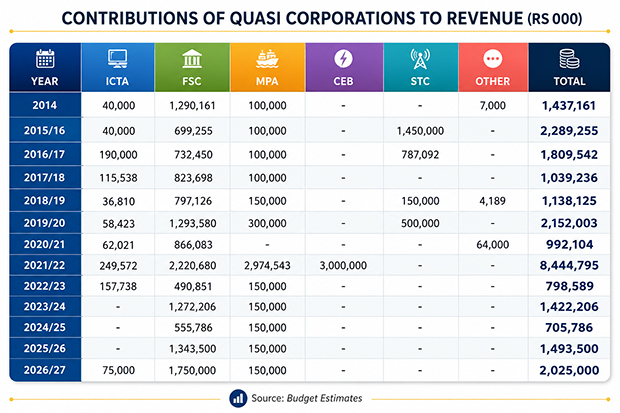
It is not unusual for the government to tap on income of quasi corporations to raise revenue. While for the FSC it is mandatory by law, other institutions have contributed in varying degrees to government revenue. In fact, the FSC has contributed Rs 15 billion to the Consolidated Fund since its inception. The FSC has been the most regular and generally highest contributor to recurrent revenue in the past decade compared to other statutory bodies like Information and Communication Technology Authority, State Trading Corporation, Mauritius Ports Authority whose contributions are lower and more ad hoc as the Table shows. For instance, the CEB contributed Rs 3 billion in 2021/22 at a time when capital investment to enhance our energy generation was needed. In that year, the Minister of Finance extracted an unprecedented amount of Rs8.4 B from quasi-corporations irrespective of the fact that the statutory body was making a loss.
The 2026/27 Budget had projected a contribution of Rs 1.75 B from the FSC which is 30% higher than its contribution in 2025/26. Obviously, such an amount could not come about from the one-digit growth of the industry. It is worth adding that GBCs grew by 7.5% between 2010 and 2019 but their growth in the past three years has been only 3.1%. Obviously, the only alternative that can yield substantial income is a review the fee structure.
The cost of doing business
While there is a grain of truth in the need for higher income to maintain, improve and innovate its wide range of services in a very dynamic and sophisticated industry the bottom line is the budgetary support which FSC provides more than other statutory bodies especially in the context of the tight budgetary situation. The review has raised the concern of many stakeholders about the increasing costs and constraints in the industry which have been building up over time. The case for enhanced competitiveness and the numerous constraints have been addressed at length in an article by Ms Kiran N. Meetarbhan in l’express of 1 July 2026 and in many others. Small changes ultimately can make a big impact. Benchmarking based on prescribed rates may be a theoretical exercise. Perhaps the industry should conduct a study of the actual costs of doing business for the Global Business Sector taking into account both explicit and implicit costs and taxes which will reveal the degree of our competitiveness or otherwise. This will be in line with what the Minister stated: “The total cost of doing business is a more realistic parameter instead of just the regulator’s licence fee.” It may also shed light on whether the demand for our services is elastic or inelastic. I believe that in the short run the demand for our financial services may be inelastic but they will not remain so in the medium or long run especially given the large number of actors in the international arena. Sooner or later higher costs will take their toll.
Publicité
Publicité
Les plus récents