Publicité
Neither a populist Budget nor transformative reforms!
Par

Partager cet article
Neither a populist Budget nor transformative reforms!
The low-tax liberal economy has reached its limit; we are in a most enormous fix and are now looking at a doom loop: higher taxes draw us away from the low-tax economy, and lower spending puts the welfare state at risk. In such cases, only shock therapy can enforce the necessary harsh discipline to ensure that the system can perhaps be brought back to life again – back to its unjust, unequal, unfair state. Government is not prepared for an electric shock to bring the outdated low-tax liberal economy back to life. So, it is neither a populist budget nor transformative reforms, but a kind of compromise that satisfies the ultimate beneficiaries of the present economic system – the low-tax liberal model.
What else would you expect? What has been going on for years? The gradual dismantling of the wel fare state. Mind you, they now have enough arguments to convince you that it is inevitable and in your own interests – some of their chatwas are already posting that “pension reform is a must.” They keep repeating that “it is financially unsustainable in the context of an ageing population.” What they are not telling us is why the reduction in the budget deficit for FY 2026-2027 has to rely solely on pension reform and some cosme tic changes to taxes, which will not bring in much revenue, when the major structural reforms needed to revive a dying economic system are being kicked down the road. That is what is scandalous about the pension reform!
Have a look at the table below. The figures reveal the hypocrisy of this Go vernment: their so-called resolve to build fiscal resilience has relied solely on the reform of our pensions and the abolition of the CSG allowances. Other reforms, including meaningful efforts at revenue mobilisation – not cosmetic ones that will not bring in much revenue – and the strengthe ning of mechanisms to control expen diture, have just been kicked down the road. Most of the items in “Expense” have gone up or remained the same as a percentage of GDP, except social benefits.
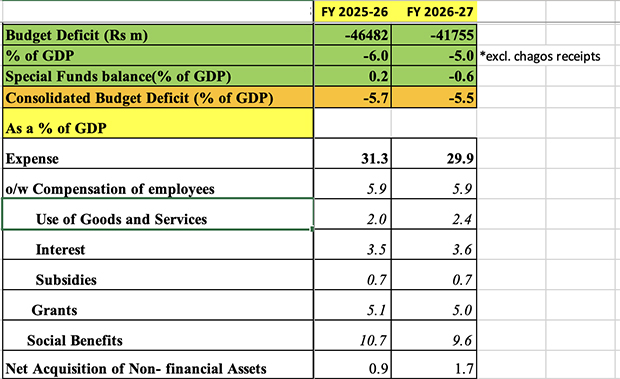
We were told that, with the reintroduction of Pro gramme-Based Budgeting (PBB), we would see grea ter efficiency and effectiveness in the public sector and a substantial reduc tion in wastage, operational costs, and budget variances by linking funding directly to measurable outputs and national outcomes. The figures do not show this! We are also being told that a major reorganisation and ratio nalisation of parastatals will be carried out, but the figures show that grants to parastatals, excluding transfers to spe cial funds, are likely to remain more or less the same.
A shrinking capital budget
Another item in total expenditure, besides social benefits, that is showing a significant decline compared to pre vious years is capital spending (net ac quisition of non-financial assets) – a mere 0.9% of GDP, one of the lowest levels experienced in more than two decades. Is this how Government will be boosting productivity, investing in AI and driving growth? Are they really committed to laying down the foun dations for future growth, or is it just publicity stunts – “effets d’annonce”? With such dismal capital spending (public sector investment as a percen tage of GDP at current market prices for 2025 and 2026 – one of the lowest levels registered since 2008 – at 3.5% and 3.7%, respectively) and with pri vate sector investment on the decline for three consecutive years, both in terms of growth rate and as a percen tage of GDP, they are forecasting rather optimistic real growth rates of 3.1% for FY 2025-2026 and 3.5% for 2026-2027.
Our economy is left perched on the edge of stagflation, marked by high inflation and slowing growth. The present low-tax liberal economy, or a welfare system grafted onto a low tax liberal economy, which has served the owning class – the oligarchs and the economic elite – well so far, is now doomed. We have to adopt another, more inclusive, sustainable and fair model of development. “More or less status quo politics” means continuing with an unequal, unstable and doo med economic system. Continuing with the present economic system is not an option.
Publicité
Publicité
Les plus récents