Publicité
“Digested week”
Digital discipline: Redrawing the line on mobile phone use in schools
Par

Partager cet article
“Digested week”
Digital discipline: Redrawing the line on mobile phone use in schools
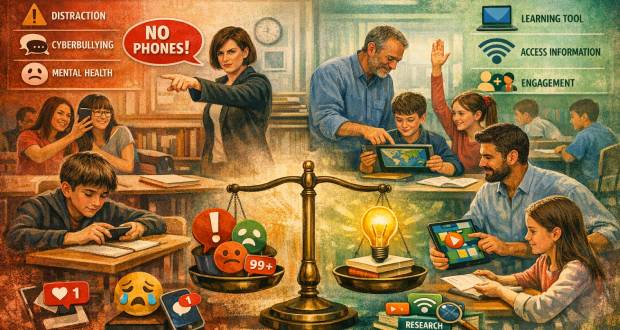
© AI-Generated illustration by Microsoft Copilot
The ban on mobile phone use in schools, announced last year, is expected to take effect in the second term – starting on 20 April 2026. The Ministry of Education is finalising the legal framework, which still requires several layers of institutional approval. While the stated goal is to reduce distractions and improve learning conditions, the measure has sparked significant debate.
? Introduction
The Ministry of Education is preparing to introduce new regulations governing the use of mobile phones on school premises. An information session held on 30 March at the Atal Bihari Vajpayee Institute of Public Service and Innovation brought together college rectors and key education stakeholders. The meeting aimed to clarify the direction, objectives and implementation mechanisms of the upcoming measures.
The new framework introduces a phased approach to managing personal mobile devices on school premises. While disciplinary measures will apply in cases of non-compliance, the Attorney General’s Office has ruled out any form of monetary sanction for students or their guardians. The ministry emphasises guidance and accountability rather than punitive action, seeking a balanced approach that supports both discipline and student welfare.
? Student wellbeing as a priority
Several countries, including England and France, have already adopted restrictive policies on mobile phone use during school hours. These measures are not viewed solely as sanctions, but also as tools to improve student focus, reduce bullying and foster a calmer learning environment. Mauritius is now aligning itself with this global movement, adapting it to its own educational context. The reform places student well-being at the heart of decision-making. The ministry aims to create a learning environment that supports academic success, emotional stability and healthy social development. Limiting mobile phone use is seen as a way to reduce distractions and promote more meaningful interactions within the school community.
The scale of digital usage in Mauritius is massive. In 2025, the country recorded 2.1 million mobile connections – representing a penetration rate of 168%. Internet access reached 1.01 million connections, or nearly 80% of the population. Social media usage remains high, with 859,000 accounts, although many individuals maintain multiple profiles. Between 2024 and 2025, social media identities increased by almost 40,000, confirming the steady rise of digital engagement.
This widespread connectivity comes with risks. According to the Ministry of ICT, an average of 17 cybercrime cases are reported daily, not counting unreported incidents. Since 2018, the MAUCORS online reporting system has registered 19,000 cases. These figures highlight the urgency of strengthening digital safety measures, particularly for young users. The government announced in December 2025 the introduction of a child-specific SIM card to provide a safer digital environment by filtering harmful, illegal or inappropriate content. How far has this measure to protect minors and regulate technology use, particularly within schools, progressed in implementation?
? Collaboration within schools
Education Minister Mahend Gungapersad has called upon rectors to fully support the implementation of the new regulations, which still require Cabinet approval. He stressed the importance of adhering to legal and administrative frameworks and ensuring that the measures do not disrupt school operations. The minister also highlighted the essential role of rectors in monitoring student behaviour and understanding the dynamics of their institutions. The government’s aim is to reduce classroom distractions and improve learning, but the decision is also dividing the education community.
The president of the Union of Rectors and Deputy Rectors of state schools, Vikash Ramdonee, acknowledges the risks that technology poses to students’ mental health and performance, but stresses that effective regulation is difficult to implement. He highlights gaps in the current system, including teachers’ limited capacity to monitor students and parents’ lack of understanding, raising questions about shared responsibility. He highlights the need for a clear legal framework supported by adequate and logistical help from the ministry to support the reform while urging for a constructive national debate.
On the other hand, teachers’ unions argue for a more nuanced approach that reflects real classroom needs and modern teaching practices. UPSEE president Arvind Bhojun warns against the misconception that teachers use phones for personal reasons, insisting that smartphones have become essential pedagogical tools in a digital era. He recalls how the Covid-19 crisis forced educators to reinvent their methods, relying on digital tools to maintain learning. Since then, many have created online resources and digital lessons that remain widely used. With institutions like Cambridge and the MES offering online content, he believes banning devices could hinder innovation. He also regrets the lack of logistical support and the absence of incentives to help teachers acquire digital equipment.
GTU president Vishal Baujeet criticises the lack of consultation of primary schools. He believes that a uniform ban is unsuitable and advocates for a regulated, context-based use rather than a blanket prohibition. The GSSTU shares this view: its president, Yugeshwar Kisto, stresses the need to distinguish between students’ use and teachers’ use, as phones remain essential for internal communication within schools. Unions are thus calling for deeper dialogue to avoid implementation challenges and ensure a coherent public policy.
? Beyond the ban
Ultimately, the reform raises a broader question: is unrestricted access to mobile devices compatible with the attention, safety and well-being that schools are responsible for safeguarding? A total ban on mobile phones before age 15, already adopted in countries like France and Australia, reflects growing concern over distraction and mental health. Such measures aim to create calmer, more focused learning environments. The ministry has expressed hopes that this initiative will spark a deeper national conversation on balancing digital innovation with the protection of youngsters. Is it prepared to go as far as those countries? As the second term approaches, the central question remains: how can schools balance discipline with the realities of digital era teaching?
Note: The issue of cyberbullying associated with mobile phone use has deliberately been avoided as it will be addressed in our next article in the context of rising school violence.
Publicité
Publicité
Les plus récents