Publicité
Failure to address climate change
Par

Partager cet article
Failure to address climate change
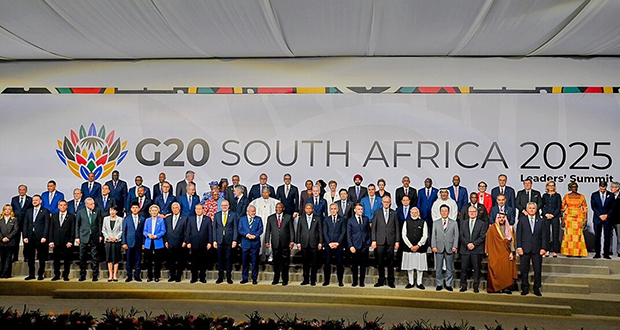
The G20 may set the agenda, but it is the planet which pays the bill – the world’s smallest nations feel its decisions the most.
Origins and global influence
The G20 (Group of Twenty) is an international forum that brings together the world’s major economies, 19 countries plus the European Union to coordinate global economic policy, financial stability, and development priorities. It emerged in 1999 in the aftermath of the Asian financial crisis, initially as a meeting of finance ministers and central bank governors seeking better international financial cooperation. In 2008, during the global financial crisis, the G20 was elevated to a leaders’ summit, becoming the primary platform for economic governance at the highest political level. Since then, its mandate has expanded far beyond finance to include climate change, energy transitions, global health, digital governance, development and geopolitical stability.
Today, the G20 represents about 85% of global GDP, 75% of global trade, and twothirds of the world’s population, giving it significant influence even though it remains an informal forum without legally binding powers.
When G20 holds the world’s economic steering wheel, but not always the courage to change direction
The G20 has quietly but profoundly shaped the way we live today by influencing the global economy, stabilising financial systems, and setting the direction of major international policies. Formed in response to recurring economic crises, the G20 created the frameworks that guide how countries coordinate on interest rates, trade rules, banking regulations, and global taxation – decisions that directly affect the price of food, fuel, housing and even job opportunities. It played a decisive role during the 2008 financial crisis, preventing a global depression, and continues to influence digital regulation, debt relief for poorer nations, health security, and climate finance. Whether we realise it or not, the standards agreed in G20 meetings ripple through every country: shaping the stability of our savings, the cost of loans, the resilience of supply chains, and the direction of global economic growth.
Through its influence – for better or worse – the G20 has become one of the most powerful forces shaping everyday economic reality across the world.
The problem of global warming could be the solution
The G20 plays a decisive role in global warming and carbon emissions because its member states collectively produce around 75–80% of global greenhouse gases, making their actions or inaction pivotal to the planet’s climate trajectory. As the world’s largest economies, they have the financial power, technological capacity, and political influence to accelerate the transition to clean energy, phase out fossil fuels, and scale up climate finance for vulnerable countries. Over the years, the G20 has helped shape global climate policy by promoting renewable energy targets, reaffirming the Paris Agreement, supporting carbon-pricing mechanisms, and calling for reductions in coal use.
Yet, progress remains uneven and often slow, with several members still heavily dependent on oil, gas, and coal.
As a result, the G20 operates simultaneously as the world’s biggest climate problem and its most essential climate solution – the forum where major emitters must align their policies if global temperature rise is to be kept within safe limits.
At the G20 forums, promises are there globally, but delivery at the local levels are often delayed or non-existent.
A failed commitment to address climate change
Despite its economic power and political influence, the G20 has largely failed to confront climate change at the scale and speed required, and this failure is increasingly visible. Although members regularly issue statements of concern, their actions tell another story: G20 countries are responsible for around 75–80 % of global emissions, yet many continue to expand coal, oil, and gas production, subsidise fossil fuels, and delay concrete timelines for phase-outs.
Commitments made in G20 communiqués are often vague, non-binding, or diluted by political compromise, allowing the most carbon-intensive members to block stronger language. The group has also failed to mobilise sufficient climate finance for developing nations, leaving adaptation and loss-anddamage needs unmet.
Ultimately, the G20’s inability to turn pledges into enforceable action has made it a symbol of global climate inertia – a forum capable of shaping the future, yet repeatedly unwilling to confront the fossil fuel interests that endanger it.
The first African-hosted G20
The 2025 G20 Leaders’ Summit was held on 22–23 November in Johannesburg, marking the first time in history that a full G20 summit took place on African soil. Under the theme “Solidarity, Equality and Sustainability,” South Africa’s presidency focused on strengthening disaster resilience particularly against climate-related threats, advancing cleanenergy financing, addressing unsustainable debt in poorer nations, promoting inclusive development, and tackling global inequality and economic instability. Throughout 2025, South Africa organised nearly 130 preparatory and working-group meetings leading up to the summit.
Running alongside the main event was a Social Summit (18–20 November), which gathered civil society organisations, youth, women, and disability groups, reflecting an effort to broaden participation beyond governments and embed social inclusion at the heart of the G20 agenda.
Aims: opportunity, visibility, and limitations
The 2025 Johannesburg G20 – the first ever hosted on African soil – marked a historic shift in global governance, signalling longoverdue recognition of Africa’s demographic, economic and geopolitical weight in the international system. Under South Africa’s presidency, the agenda centred on priorities that strongly resonate across the continent and the wider Global South, including sustainable debt solutions, climate resilience, and financing a just clean-energy transition – areas where African countries have consistently called for fairer global rules and improved access to resources.
The summit’s focus created a rare convergence between Africa’s development aspirations and the concerns of small islands and climate-vulnerable states. Yet, despite this symbolic breakthrough, major challenges persisted: geopolitical tensions among major powers, the absence or low-level representation of some influential leaders, and doubts about the G20’s capacity to move from declarations to enforceable reform. As such, while Johannesburg 2025 elevated Africa’s voice on the world stage, it also underscored the limitations of existing multilateral structures and the need for deeper transformation to match rising expectations.
A window for change, not a guarantee for small islands
The 2025 Johannesburg G20 summit offered both opportunities and stark reminders for Mauritius. Commitments on climate finance, clean energy transitions and disaster resilience could support the island in reducing fossil fuel dependence and strengthening coastal protection. The emphasis on sustainable debt solutions and blue economy development aligns closely with Mauritius’ strategic priorities for its Exclusive Economic Zone (EEZ) and marine resources. Yet, the summit also exposed the limits of global cooperation: major emitters remain slow to act, and geopolitical tensions could delay tangible support for small islands and developing states.
For Mauritius, the message is clear – global agreements alone cannot guarantee security or sustainability; proactive diplomacy, regional alliances, and domestic action are essential to turn G20 promises into concrete benefits for the island and its people.
Summit without solutions: The urgent need for climate action
Despite the high stakes and global attention surrounding both COP30 (30th Conference of Parties) in Belém, Brazil and the G20 summit in Johannesburg, the reality is stark: neither summit delivered concrete, enforceable solutions to the climate crisis.
COP30 faltered on a clear roadmap for phasing out fossil fuels and securing climate finance, leaving vulnerable nations and small island states exposed to escalating risks.
Similarly, the G20 highlighted priorities such as clean-energy transitions, debt sustainability, and disaster resilience, but geopolitical tensions and vague commitments undermined their practical impact.
Together, these two landmark gatherings underscore a troubling pattern: while international forums continue to convene world leaders and generate headlines, meaningful action lags behind, leaving the planet’s most vulnerable communities to face the growing consequences of inaction.
The urgent lesson is clear – rhetoric alone is no longer enough; transformative, enforceable measures must replace promises if global climate goals are to be achieved.
Publicité
Publicité
Les plus récents