Publicité

Blue in the face
By Nicolas RAINER</B>
It?s always nice to know that the country?s decision-makers are on the ball. They closely scrutinize international events in order to take pre-emptive action before the country can be affected by any potential fall-outs. They pour off reams of data so that they can plan far into the future. The Sustainable Island concept, for example, is irrefutable proof of government?s dedication to making the world a better place.
I was thus hugely surprised to read about the government?s decision to opt for the ring road-harbour bridge-bus way. Although it comes as a huge relief that the government has finally decided to tackle the transport conundrum (other than by battering it to death with experts? reports), this solution is fatally flawed and thus not a solution at all.
Could the advent of Peak Petrol have eluded the sagacity of our sages? If so, they really should get up to speed with the situation. It?s not that complicated. Peak Petrol simply means that demand for the resource is greater than its supply. The situation is so bleak that oil companies have resorted to exploiting tar sands in Western Canada in order to feed the world?s addiction to black gold. The process involved in extracting crude oil from the sticky sands is so mind-bogglingly energy-intensive that nuclear reactors are currently being built to power the plants.
Mind you, the oil companies aren?t losing too much sleep over the costs involved in such a mammoth undertaking. They?ll post record profits whatever happens. You and I, on the other hand, will be forced to dig even deeper in our threadbare pockets. Elementary deduction tells us that the government should be steering people away from cars instead of perpetuating our dependence on them.
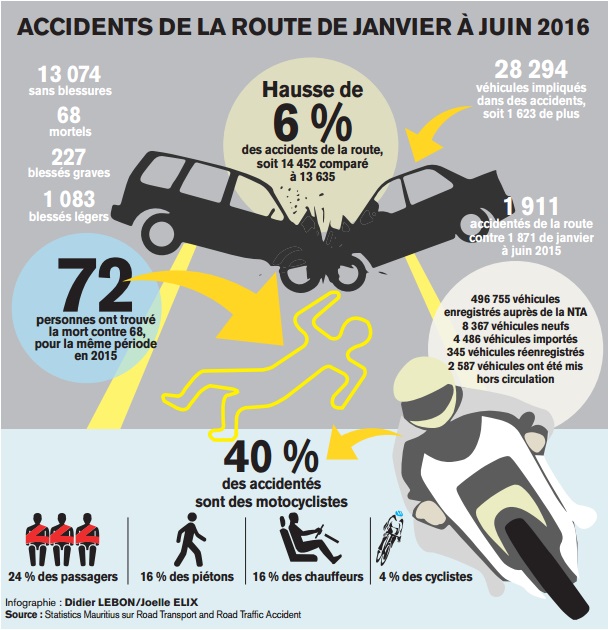
It gets worse though. According to the World Health Organization (WHO), road accidents claim 3,000 lives every year. It calls road safety a "major and growing public health concern". And, as recently as yesterday, this newspaper reported on the prevalence of respiratory infections in the country. Vehicle emissions are one of the main causes of respiratory diseases. More roads mean more cars. More cars mean more accidents and respiratory illnesses. Logical.
Moreover, policy makers everywhere are harping on about climate change. Everyone agrees that it has become imperative to reduce carbon emissions. Last week, Sir Nicholas Stern, author of the key Stern Report on Climate Change, said that he had "underestimated" the risks of global warming. And yet the Mauritian government has decided to go ahead with a project that will add to the atmosphere?s carbon content instead of diminishing it. Naturally, the minister of Environment hasn?t batted an eyelid at the ring road-harbour bridge-bus way triple whammy, which is both an affront to everything the Kyoto Protocol stands for and a death blow to any push for clean public transport.
It?s rather worrying that a government that has been elected for five years can make decisions that will affect Mauritians long after its mandate has expired. Tianli is another example of dubious decision-making that instantly springs to mind. Surely some sort of oversight committee should be established in order to ensure that such projects truly are in the country?s best interests.
It?s seems that not only Liverpool FC?s John Arne Riise has been scoring own goals recently. Fortunately for him, his team will get another chance to make up for his mistake. We won?t be that lucky.
Publicité
Publicité
Les plus récents