Publicité
Digested week
War in the Middle East: A distant conflict, a national stress test
Par

Partager cet article
Digested week
War in the Middle East: A distant conflict, a national stress test
? Global shockwave
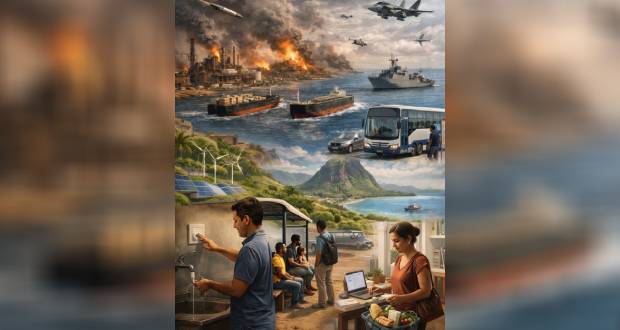
The Iran-US-Israel war has triggered the largest disruption in the history of the global oil market, according to the International Energy Agency. Iran’s blockade of the Strait of Hormuz, through which a fifth of the world’s oil and Liquefied Natural Gas (LNG) normally passes, has sharply reduced global supply and driven prices upward. This has cascaded into energy shortages, transport disruptions, food insecurity and economic slowdowns, especially in import-dependent countries. The crisis is not only economic, but it is also intensifying climate vulnerabilities and agricultural pressures.
Across countries, governments are boosting domestic renewable energy to reduce dependence on imported fossil fuels, treating energy infrastructure as national security assets, increasing physical and cybersecurity. Some countries have implemented electricity rationing, reduced working hours and even closed schools to reduce energy demand. To reduce fuel consumption, governments have introduced driving bans on certain days, fuel rationing, promoted public transport and carpooling while reducing public sector working hours.
The conflict has also disrupted fertiliser supply chains and agricultural production. Governments are responding by securing alternative import routes and supporting farmers facing fertiliser shortages, while encouraging local food production. In Asia, restaurants have shrunk menus, removed gas-intensive dishes, or closed temporarily due to LNG shortages. Across regions, governments are asking citizens to actively support national resilience measures through energy-saving and transport adjustment behaviours, food and household resilience as well as social solidarity.
? Local emergency measures
Mauritius is almost entirely dependent on imported fuel for electricity generation, transport, and food logistics. When the Iran–US–Israel war disrupted oil exports and blocked key supply routes, Mauritius immediately felt the shock as one of the most exposed countries in the Indian Ocean region. The government has declared the situation an energy emergency. Despite the diversification of supply sources, it still has to absorb massive cost increases in fossil imports and protect the Central Electricity Board, which “cannot be allowed to collapse”. Electricity rationing and restrictions are already envisaged, especially in high consumption areas. Moreover, price surges are already affecting public transport operators, while putting stress on food prices – especially imported staples.
The private sector is adapting to this rising energy pressure on logistics and shipping costs. Business Mauritius has urged its 2,000 member firms to cut non-essential use, optimise cooling, use remote work, and even close offices at least once weekly. Major groups like Mauritius Telecom, IBL and Currimjee have already shifted to partial telework, anticipating a looming oil shock, currency strain, fragile supply chains. Some enterprises are already reassessing investment plans, pausing energy-intensive projects, while others quietly test internal rationing scenarios. The aim is to absorb the shock without triggering panic. Behind the scenes, another shift seems to be emerging: the state and private sector are now moving in tandem, adopting a defensive posture, with a shared understanding that the next crisis will require discipline rather than last-minute reactions.
? Responsibility and solidarity
Public frustration targets the government. Citizens – especially low- and middle-income earners – are exasperated at rising prices. For years during and after the Covid-19 pandemic, they had been used to a spoon-feeding State that had deployed all sorts of allowances and weakened national finances through mismanagement. Today, though it is a bitter pill to swallow, we must face the fact that government does not have much choice. Some prices have already gone up; electricity tariffs will follow, and upcoming imports will cost even more without mentioning local products that depend on imported inputs.
With debt near 90% of GDP and reserves depleted, monetary expansion cannot solve the problem. However, there are potential alternatives that could change behaviours and really help the country at large.
• A review of the subsidy system could go a long way to support those in real need. Everybody knows that subsidised rice, flour and even gas cylinders are misused, benefiting everyone rather than vulnerable groups, and sometimes being diverted to illegal commercial or industrial use. A shift toward targeted support – such as food stamps redeemable only for essential, zero VAT items – and gas vouchers could offer a more efficient and controlled alternative.
• Transport adjustments should be reinforced to reduce fuel misuse. The use of public transport, reduction in non-essential travel, car-pooling, and support for small operators to reduce pressure on households.
• National energy-saving campaigns should be reinforced to educate and raise awareness among the population – limiting use of high consumption appliances, reducing peak hour electricity demand, avoiding unnecessary lighting and air conditioning.
• The food system should be stabilised by avoiding panic buying, reducing food waste, supporting local producers and adapting temporarily to price fluctuations.
? Wishful thinking?
However, will this crisis change our mindsets and our capacity for compassion? Are the government, the major business entities and banks that generate billions in profits prepared to lead by example? We should point out the decision of an MP, who announced on Saturday that he is forfeiting twenty percent of his salary for the next six months. Will his example have a snowball effect on his colleagues and other affluent people? This could go a long way to appease the general frustration of the average citizen and bring back the spirit of responsibility and solidarity that seems to have evaded our nation.
Mauritians should remember the Wakashio and Covid-19 nightmares as well as past fuel shocks. This crisis – still far from a lasting solution with the blockade of the Strait of Hormuz being extremely volatile – could be a stress test of national resilience, a wakeup call for energy diversification, a moment of collective responsibility and discipline to keep our energy, transport, and food systems steady… The war, though far away, has disrupted our whole lives – forcing us to rethink how a nation keeps moving. Government measures can only go so far; the rest depends on all of us, who share the same fate.
Publicité
Publicité
Les plus récents