Publicité
25 years of autonomy
Rodrigues needs stability and effectiveness, not just proportionality
Par

Partager cet article
25 years of autonomy
Rodrigues needs stability and effectiveness, not just proportionality
1.Introduction
The establishment of the Rodrigues Regional Assembly (RRA) in 2001 was one of the most significant constitutional innovations within the Republic of Mauritius. It granted Rodrigues meaningful self-government while preserving national unity. Since the first election in 2002, the Assembly has become the principal institution through which Rodriguans exercise democratic control over their social, economic and administrative affairs.
The Rodrigues electoral system was designed to balance two objectives: first, effective government capable of providing stability and delivering results, and second, fair representation ensuring that parties with significant support obtain a reasonable share of seats. The resulting electoral model was a compromise between First Past the Post (FPTP) and Proportional Representation (PR). Its purpose was to preserve the benefits of stable government while correcting excessive distortions between votes and seats. Twelve members are elected through FPTP elections in six two-member constituencies, while up to six (then five) members are allocated through a compensatory mechanism.
2.The mixed FPTP/PR formula converted into full PR since 2002
Nearly twenty-five years and five elections later, enough evidence exists to assess whether this balance has been maintained. Electoral systems do more than count votes. They shape representation, influence government formation and determine the balance between fairness, proportionality, stability, effectiveness and inclusion.
The evidence suggests that the Rodrigues system has gradually shifted towards proportionality. It has been successful in aligning seat shares with vote shares. However, the corrective mechanism has become so influential that the system now operates much closer to full PR than originally intended. As a result, proportionality has increasingly been achieved at the expense of the three equally important objectives of stability, governability and effectiveness. The full compensatory formula repeatedly narrows or neutralises the governing advantage produced by constituency elections, often resulting in very small governing majorities and greater political fragility.
3.What five elections reveal
Although political circumstances varied, the outcomes of the five elections since 2002 show a remarkably consistent pattern.
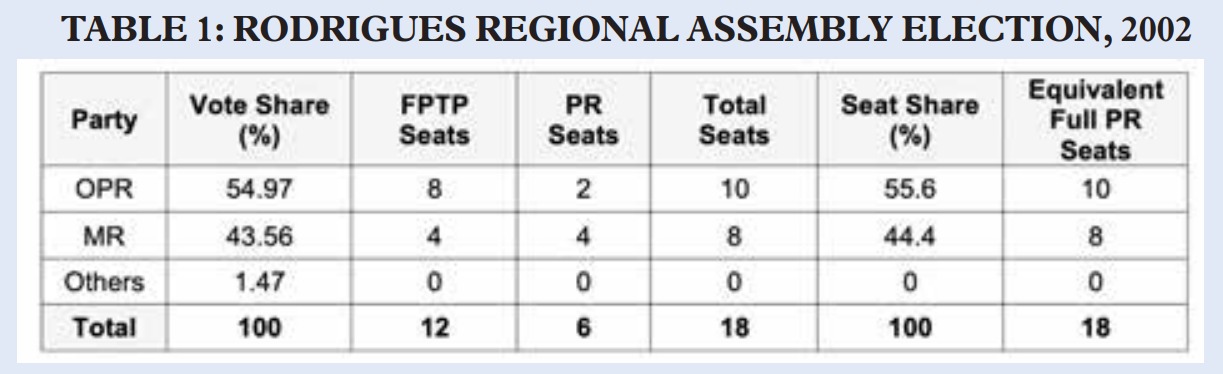
The inaugural election immediately demonstrated the effect of the compensatory mechanism. OPR (or l’Organisation du peuple rodriguais) won 54.97% of votes and eight of the twelve constituency seats, while MR (Mouvement Rodriguais) won four seats on 43.56% of votes. Following the allocation of PR seats, the final distribution became 10 seats to OPR and 8 to MR, mirroring vote shares and reducing the governing advantage from four seats to two. The election established a pattern that would recur in subsequent contests. Outcomes increasingly reflected proportional representation rather than constituency results.
The 2006 election reinforced the same trend. The constituency contest ended in a dead heat, while the final outcome was determined by compensatory seats. MR obtained 55.6% of seats on 55.8% of votes, and OPR secured 44% of seats on 43% of votes, producing a result similar to a full PR model.
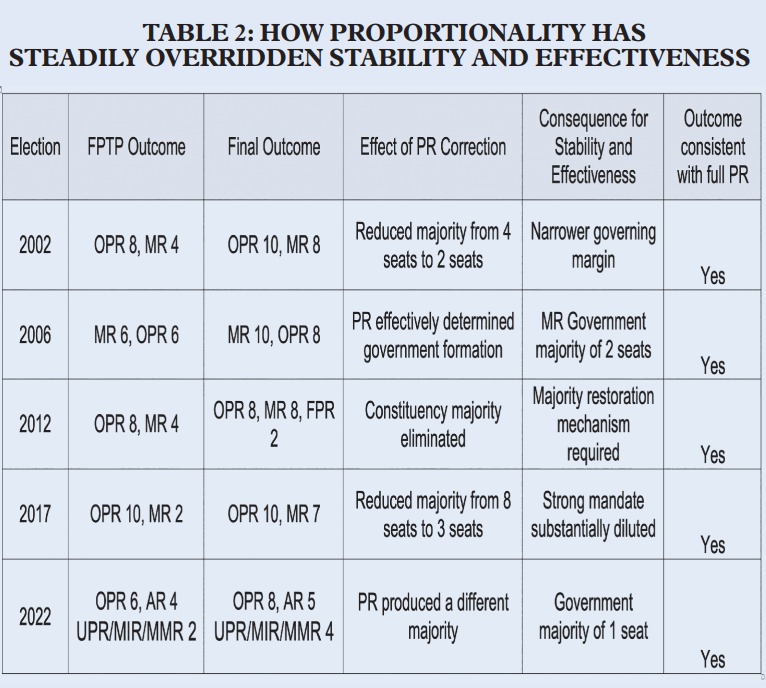
The 2012 election exposed the tensions within the system more clearly than any previous contest. OPR won eight constituency seats and secured a clear majority of four seats under the FPTP component. Following the PR allocation, OPR lost its majority. The Assembly became evenly split between OPR and MR with eight seats each, with FPR (or Front patriotique rodriguais) holding the balance with two PR seats. The anomaly triggered the majority-restoration mechanism, expanding the Assembly to 21 members to create a governing majority of only one seat.
In 2017, OPR won ten of the twelve constituency seats while MR secured two. Under pure FPTP, OPR would have enjoyed an eight-seat advantage. However, all five PR seats went to the opposition, reducing the governing majority to only three seats despite a decisive constituency victory.
The 2022 election provided the clearest illustration of the system’s compensatory nature. In a three-party contest, the final allocation closely reflected vote shares and again altered the outcome generated by constituency contests. It demonstrated that political control depends much more on the PR allocation than on FPTP results.
4.A structural shift towards proportionality
The evidence from Table 2 is striking. Across all five elections, the system has consistently succeeded in producing highly proportional outcomes. However, it has also systematically compressed governing advantages generated by constituency victories. The challenge facing Rodrigues is no longer one of fairness and representation. It is how to maintain these achievements while restoring a more appropriate balance with stability and effectiveness. As shown in the last column, there would have been no difference in election outcomes had Rodrigues embraced a full PR voting system.
5.Why stability and effectiveness matter
Fair representation is a fundamental democratic value, but it is not the only one. Electoral systems must also be judged according to whether they produce governments capable of governing effectively, implementing policies and responding to citizens’ needs. The experience of Rodrigues demonstrates some of the risks associated with excessive proportionality in a small legislature.
Governing majorities become fragile. In an Assembly of fewer than twenty members, a shift involving only one or two members can fundamentally alter political control. A resignation, a defection or a political dispute can affect governmental stability in ways that would be inconsequential in a larger legislature. The narrower the majority, the greater the risk that strong personalities, competing ambitions and political rivalries may translate into institutional instability and reduced effectiveness in government.
The purpose of regional autonomy was not simply to guarantee mathematical representation. It was also to establish institutions capable of governing Rodrigues effectively and advancing its economic and social development. Electoral arrangements must therefore be evaluated according to both fairness and effectiveness.
6.Lessons for electoral reform in Mauritius
The Rodrigues experience is particularly relevant because the electoral reform debate in Mauritius often proceeds in the opposite direction. Rodrigues illustrates the risks of an excessively compensatory system. Mauritius, by contrast, has traditionally experienced the converse problem. The FPTP system has generally delivered stable and effective governments with clear parliamentary majorities, but it has also generated significant disparities between vote shares and seat shares, leading to concerns about fairness and underrepresentation of parties.
Indeed, many electoral reform proposals in Mauritius have sought greater proportionality precisely because FPTP has sometimes transformed modest vote pluralities into overwhelming parliamentary majorities. Rodrigues and Mauritius therefore illustrate opposite ends of the same democratic spectrum. Together they demonstrate that successful electoral reform requires a careful balance between stability and effectiveness and representation, rather than the pursuit of any single objective in isolation.
7.A reform agenda for Rodrigues
The proposed reforms retain the underlying philosophy of the RRA Act. They seek to restore the original equilibrium intended by the legislation: to provide for stability, governance and effectiveness while ensuring fairness.
i.Retain the 12 constituency seats
The constituency component should remain unchanged. Constituency elections strengthen accountability, maintain links between representatives and communities, and ensure that local concerns remain central to political decision-making. These benefits continue to be valuable and should be preserved.
ii. Replace the existing compensatory formula
The current full compensatory mechanism should be replaced by a more measured corrective system. The allocation of PR seats should address serious disproportionality rather than reproduce full proportional representation. The objective should be meaningful fairness, not mathematical perfection.
iii.Maintain the 10% threshold
The existing requirement that parties obtain at least 10% of valid votes should be retained. The threshold prevents excessive fragmentation while ensuring representation for parties with substantial popular support.
iv.Guarantee meaningful opposition representation of 33% of seats
Any unsuccessful party or alliance securing at least one-third of valid votes should be guaranteed approximately one-third of seats. In an Assembly of eighteen members, this would correspond to six seats. No corrective seats would be allocated where constituency results already provide that level of representation. A party holding four of the twelve constituency seats, for example, would receive no additional allocation, even if it polls more than 33% of votes. The intention is not to guarantee full PR but to ensure that substantial electoral minorities remain meaningfully represented in the Assembly. It preserves fairness while avoiding excessive compensation that threatens stability and effectiveness.
v.Introduce a multi-party adjustment mechanism
Where the unsuccessful party obtains less than one-third of the vote, corrective representation should be allocated proportionately to its level of electoral support rather than by reference to the one-third benchmark. Where two or more unsuccessful parties qualify for PR seats, the threshold of opposition representation should increase to 40% of seats. Corrective seats should then be distributed among those unsuccessful parties according to their respective vote shares and existing constituency representation. This ensures that third parties obtaining significant support are not excluded entirely from representation while preserving a workable majority for the governing party.
vi.Introduce a limited majority premium
In circumstances where constituency results are tied despite a clear difference in vote shares, the party obtaining the higher number of votes should receive a modest majority premium. A two-seat premium is recommended. This would help avoid deadlock and provide voters with a clear governing outcome.
vii.Preserve the primacy of constituency elections
Government formation should depend primarily on constituency victories. The corrective seats should assist representation without overriding the core electoral verdict delivered by voters through constituency contests.
8.Testing the proposed model
Applying the proposed formula to previous elections illustrates its effects.
In 2002, OPR would have retained its 8–4 constituency advantage, producing a stronger and more stable majority while still leaving the opposition with meaningful representation of 33% of seats. No corrective seats are required.
In 2006, a two-seat premium would have resolved the deadlock and allowed the party with the larger share of votes to govern with a workable majority.
In 2012, OPR would have kept a three-seat majority while the third party would still have obtained representation with one seat. The complex majorityrestoration mechanism would not have been required.
In 2017, the opposition would have received three corrective seats to reach 33% meaningful representation, but the winning party would have retained a much stronger governing majority of five seats.
The 2022 election is particularly instructive because electoral systems influence how parties behave. The contest reflected a tacit understanding between Alliance Rodriguaise (AR) and UPR/ MIR/MMR, which fielded candidates in three constituencies each against OPR. Electoral alliances, candidate placement and campaign strategies are shaped by the incentives embedded in the voting system. Parties would almost certainly adjust their strategies under a different electoral formula, so future outcomes could differ significantly from those observed in 2022. They could well form a full electoral alliance and field candidates in all six constituencies against OPR.
9.Additional reforms
Electoral reform should not be limited to seat allocation.
i.Gender equality for elections
Women constitute a majority of the population of Rodrigues, yet remain underrepresented in political institutions. Three reforms should therefore be adopted:
• Gender parity among FPTP candidates in each constituency.
• Gender parity on party lists.
• A zipper system requiring alternating genders on party lists.
ii.Gender equality for commissioners
Gender equality should also extend to the Executive Council and the appointment of commissioners. Representation should exist not only in legislatures but also in positions of executive authority.
iii.Anti-defection measures
Because governing majorities in Rodrigues are often narrow, a single defection can destabilise an administration. A carefully designed anti-defection framework should be introduced. Such a framework should discourage opportunistic floor-crossing while protecting democratic freedoms and providing independent adjudication of disputes.
10.Comparing the current and proposed electoral formulae
Electoral reform inevitably involves trade-offs. Table 3 compares the expected performance of the current and proposed systems against the principal democratic objectives that the Rodrigues electoral framework seeks to achieve.
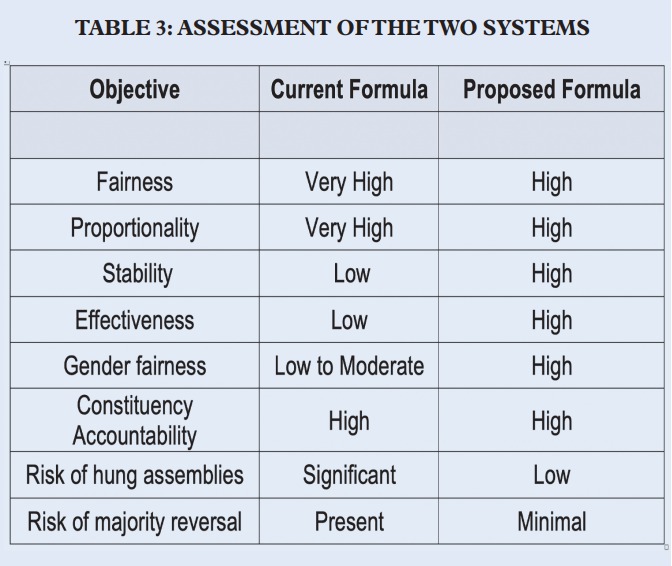
Under the current formula, fairness and proportionality are maximised, but at the cost of stability, effectiveness and majority reversal. The proposed model accepts a modest reduction in proportionality in exchange for significant gains in stability and effectiveness, while preserving constituency accountability and meaningful opposition representation. It also strengthens inclusion through gender parity for candidates, party lists, Commissioners and the Executive Council. By making the corrective mechanism a measured balancing device rather than a fully compensatory PR system, the risk of majority reversal is substantially reduced.
11.Conclusion
Twenty-five years of experience provide a clear basis for institutional reflection. The Rodrigues electoral system has been successful in achieving fair and proportional representation. However, the compensatory mechanism has become so influential that it frequently weakens the governing advantages generated by constituency elections, resulting in narrowing majorities and greater political fragility. The proposed reforms seek to restore that balance while preserving meaningful opposition representation and promoting greater inclusion, particularly through stronger representation of women in both the Assembly and the Executive Council. The objective is to ensure that proportionality, stability, effectiveness and inclusion reinforce one another as the foundations of a mature and successful autonomy. As Rodrigues enters its second quarter-century of autonomy, the priority should be to retain the gains of fair representation while strengthening the capacity of the Regional Assembly to provide stable, effective and inclusive government for the benefit of all Rodriguans.
Publicité
Publicité
Les plus récents