Publicité
Série – Essais de Maurice Lam (2/5)
Redrawing the Subsidy System : A reform worth debating
Par

Partager cet article
Série – Essais de Maurice Lam (2/5)
Redrawing the Subsidy System : A reform worth debating
In essay 1, I (picture) argued that Mauritius needs to improve the way it allocates public resources. Subsidies are a practical test of that proposition. They protect purchasing power and social cohesion, but they also carry costs that are often poorly understood. When assistance is embedded in prices, households cannot easily see what the state pays on their behalf, or who ultimately finances it.
This essay does not propose an overnight abolition of subsidies. It proposes a change in direction: gradually replace broad price support, where justified, with transparent assistance to households that need it. The purpose is to invite public feedback before detailed choices are made. No household should be asked to accept a reform whose consequences have not been properly assessed.
What the present arrangements cost
The State Trading Corporation (STC) figures indicate that support for rice, flour and cooking gas rose from Rs 874 million in 2017/18 to Rs 5.05 billion in 2024/25: approximately 5.8 times the earlier amount. The reported 2024/25 components are Rs 2.5 billion for flour, Rs 2.0 billion for cooking gas and Rs 550 million for rice. These are the figures on which the present discussion begins, taken from the STC annual reports.
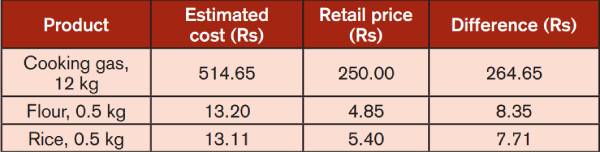
STC price estimates dated 2 April 2026 suggest the following gap between the estimated real cost and the retail price: These figures are price snapshots, not a forecast of future market prices.
The estimated cost may change with procurement, exchange rates, freight and the method used to calculate it. The 2025/26 budget estimates contain an allocation of Rs 2.00 billion to a Price Stabilisation Fund, a Free Travel Scheme provision of Rs 1.70 billion and bus-industry support of Rs 1.02 billion. Adding these to the STC 2024/25 figure gives an indicative Rs 9.77 billion. It is not a consolidated actual expenditure figure: it combines different years and potentially different financing and service obligations. It must not be treated as a reliable savings baseline until reconciled.
Who pays, and who benefits?
The STC fuel-price structure of 29 September 2026 shows a Rs 7.20-per-litre levy. This levy is used by the government in financing the subsidies on gas, rice and flour. This means the cost of support is partly recovered from fuel users rather than appearing solely as a straightforward budget payment. Transport operators, businesses and motorists face the levy, and some of its cost may pass through into prices paid by consumers.
But the incidence is not simple. Better-off households may consume more subsidised products in absolute terms, while poorer households may gain more relative to income. A fuel levy may affect those without cars indirectly through delivery costs. We should measure both sides before claiming that one household pays for another.
The relevant question is not merely whether the rich receive some subsidy. It is how much of every Rs 100 of assistance reaches different income groups, and whether a better system could protect vulnerable households at a lower total cost.
A principle, not yet a finished scheme
My preferred direction is to separate the price of an essential product from the decision to support a household. Under a carefully phased reform, prices would progressively reflect actual costs, while eligible households would receive assistance directly. This would make public support more visible and give families more freedom to choose what they need.
There are, however, legitimate reasons to retain limited product-specific protection. Cooking energy and basic food are necessities. If market prices are volatile, if competition is weak, or if cash payments cannot reliably reach a household, a narrowly designed entitlement or transitional price safeguard may be preferable. The final design should follow evidence, not ideology.
Who should qualify?
The Social Register of Mauritius is a logical starting point, but it cannot be the only gateway. Working families just above its threshold, self-employed households, people with irregular earnings and households facing sudden income loss also need consideration. Eligibility should reflect household size and circumstances, not simply total income. Assistance should taper gradually as resources rise so that earning one additional rupee does not trigger a sudden loss of support.
The population can be divided into three broad groups: households on the Social Register receiving full support; other low-income households receiving partial support; and households above the threshold paying full prices. This is a useful framework for debate, not an agreed eligibility formula. Thresholds, household equivalence scales, disability adjustments and appeal rights still require study.
How should assistance be delivered?
A secure monthly transfer through a bank account, card or another accessible payment channel could give households choice and make government assistance visible. A digital family card is one possible instrument, not the reform itself. It must not exclude people without smartphones, formal bank accounts or stable digital access. Nor should the design automatically vest control of the benefit in a single household member without considering family circumstances and safeguarding against misuse.
Transfers must also be reviewed when essential prices change. A fixed payment that is adequate at launch may quickly become inadequate. An independently published formula or periodic review could protect purchasing power while keeping fiscal costs visible.
Gas, rice, flour and other essential goods
For cooking gas, one option is to move towards the market price and compensate eligible households through a monthly transfer. Another is to preserve a limited subsidised quantity for a transition period. Using a one-cylinder monthly limit may help control misuse but could disadvantage larger households or those with different cooking needs. Actual consumption data are needed before setting a cap.
For rice and flour, unrestricted cash assistance may give families more choice than product quotas. But if policy aims to guarantee minimum access to basic food, restricted entitlements deserve consideration. The 17 essential goods associated with the PSF should be assessed individually; they need not all be treated in the same way.
Any reform must also consider the structure of importation and distribution. Removing a subsidy does not guarantee competitive retail prices. Competition, procurement transparency and the justification for any margin controls should be examined alongside household assistance.
Transport is a different problem
The state supports public transport not only to help passengers but also to sustain a network. A bus on a rural route must operate even when few people board. This makes transport fundamentally different from subsidising a bag of flour.
For students, government could introduce digital student coupons, paid to operators when journeys are taken. This could improve information about passenger use and reduce some payment distortions. But a payment system based solely on journeys could undermine routes with low demand and high social value. A better approach may combine payment for contracted service obligations, such as coverage, frequency, accessibility and punctuality, with reimbursement for verified passenger journeys. Students could receive a secure travel entitlement usable across approved operators, subject to safeguards for school schedules, transfers and those unable to use digital systems. For older people, the proposal to replace free travel with a means-tested allowance deserves open debate. A fixed allowance might benefit infrequent travellers but disadvantage pensioners who depend on repeated journeys for medical care or family support. Essential mobility should be protected before any entitlement is withdrawn.
Nor can we assume every employer covers every worker’s transport costs. Self-employed people, jobseekers, informal workers and employees without full reimbursement require explicit consideration. Operator contracts, service standards and financing should be reviewed separately from passenger entitlements.
What could the country save?
One simple illustration puts the saving at about Rs 5 billion, by assuming that the new system would retain only half of the indicative Rs 9.77 billion envelope. That is a scenario, not a forecast. The figure should not be presented as a likely outcome.
The correct calculation begins with a reconciled baseline. It then deducts new household transfers, administration, transitional protection, transport service payments and any revenue lost through a reduction in the fuel levy. Only the balance is a net fiscal saving. If government reduces the levy and increases help to households just above the Social Register, savings will necessarily be smaller than the gross amount removed from existing subsidies. Three financing choices should be tested openly: retain the fuel levy and redirect its proceeds to transparent transfers; reduce the levy while retaining part of its financing role; or finance the transfers from general taxation. Each has different consequences for inflation, distribution and the deficit. The public should be shown those trade-offs.
How to proceed without repeating the pension-reform experience
A subsidy reform can fail even when its economic rationale is sound. People may distrust the eligibility test, fear sudden price increases or doubt that promised payments will arrive. These concerns are not merely resistance to change. They are risks a responsible government must address.
A credible sequence would begin with publication of the true subsidy accounts and an independent assessment of who benefits. It would then test eligibility and payment systems in a limited pilot, including urban and rural households. The government should publish the effects on different household types, consult consumer groups, transport operators and social organisations, and guarantee timely appeals and transitional protection. Only after the system has demonstrated that it works should prices or entitlements change.
The evidence we still need
Before deciding on the final design, six pieces of analysis need to be undertaken:
• A reconciled subsidy account: actual annual cost, funding source, legal commitments and possible overlap for each scheme, using a common financial year.
• A household incidence study: how subsidies and fuel levies affect income groups, household sizes, regions, students and pensioners, including indirect price effects.
• A household microsimulation: winners and losers under cash, restricted entitlement and hybrid options, with explicit price and inflation scenarios.
• A costed fiscal model: transfers, eligibility, take-up, administrative costs, transport obligations, fuel-levy alternatives and net deficit impact.
• A market and transport review: import competition, price formation, operator contracts, route economics, service quality and access to essential journeys.
• An operational and legal readiness assessment: Social Register coverage, tax-data use, privacy, payment access, fraud controls, grievance handling and pilot results. These studies are not reasons to postpone discussion. They are the work needed to turn a promising principle into a reform that citizens can judge fairly.
Questions for public discussion
• If cooking gas moved towards its supply cost of about Rs 515, and eligible households received a monthly transfer to cover the difference, would you support the change? What would make you oppose it?
• Would you prefer unrestricted cash support, limited entitlements for essential goods, or a combination of the two? Why?
• How should the state identify working families and other households whose needs are not adequately captured by the Social Register?
• Should the fuel levy be retained to finance targeted support, reduced, or replaced by general taxation?
• What minimum transport rights should remain available to students, pensioners, disabled people and rural communities?
• What evidence and guarantees would you require before accepting a change in prices or existing entitlements?
The choice before us
Mauritius should not preserve every subsidy simply because it is familiar. Nor should it withdraw assistance merely because a spreadsheet shows an apparent saving. The purpose of reform is to protect those who need help, allow prices to convey economic costs, preserve essential services and use public money more effectively.
The first decision is therefore not how quickly to remove subsidies. It is whether Mauritians agree on the principle that public assistance should be more transparent, better directed and demonstrably fair. If there is agreement on that direction, the detailed studies and public consultation can determine the most credible route.
The next essay will examine water and electricity, where the same questions of affordability, efficiency and public accountability arise, but where infrastructure investment and service reliability add further complications.
Publicité
Publicité
Les plus récents