
Publicité
Reclaim our soil
Break the corporate seed monopoly and fight for seed sovereignty!
Par

Partager cet article
Reclaim our soil
Break the corporate seed monopoly and fight for seed sovereignty!
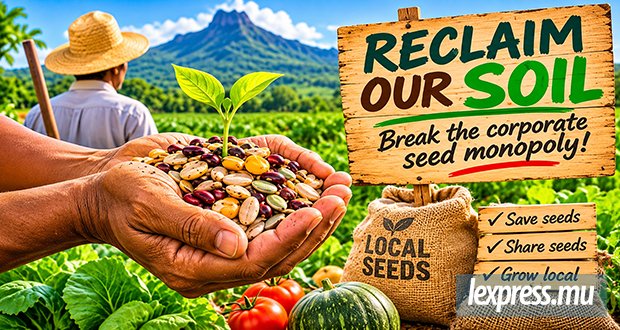
For generations, the earth belonged to the people (ti-planter, backyard gardeners & marsan bazar). The seeds belonged to the farmers. Today, corporate hegemony is quietly suffocating our agricultural freedom, shifting control from community-driven agriculture into the hands of cold, commercial monopolies. When corporations own the seeds, they own our stomachs and our health, our food security, our heritage, and our future. The battle lines are drawn. From the heart of the African continent to our local soils here in Mauritius, it is time to dismantle the corporate seed industrial complex and reclaim our right to save, breed, share, and replant our own lifegiving heirloom crops!
Global resistance
Greenpeace Africa is fighting back!
Corporate giants are using predatory international frameworks like UPOV 91 and restrictive Plant Variety Protection (PVP) acts to establish intellectual property rights over nature itself. In many nations, these draconian laws have restricted smallholders’ ability to save or sell seeds from their own harvests, particularly when protected varieties are involved. Even worse, commercial hybrid seeds are not always true-to-type when replanted from one generation to the next. This can encourage farmers to purchase new seeds each season, increasing their dependence on commercial suppliers and production costs.
Regional laws can restrict traditional indigenous seeds by subjecting them to rigid Distinctness, Uniformity and Stability (DUS) requirements, which may favour uniform commercial varieties over natural, resilient biodiversity. Now, the corporate empire is facing growing resistance. There is a new shield: community seed banks. Greenpeace Africa is actively supporting grassroots initiatives that help preserve, clean and store indigenous seeds, strengthening local communities’ ability to protect their agricultural heritage and seed diversity.
A landmark victory has also been achieved in Kenya. On November 27, 2025, the High Court in Machakos, presided over by Justice Rhoda Rutto, delivered a landmark judgment in Wathome & 14 others v Kenya Plant Health Inspectorate Service & another; Greenpeace Environmental Kenya & 2 others (Interested Parties) ([2025] KEHC 18166 (KLR), Petition No. 11 of 2022). The petition, filed by 15 smallholder farmers and supported by Greenpeace Africa’s campaign, challenged provisions of Kenya’s Seed and Plant Varieties Act and its accompanying regulations. The court declared several provisions unconstitutional, marking a significant victory for farmers’ rights to save, exchange and share indigenous seeds. Greenpeace Environmental Kenya was listed as an interested party in the proceedings.
MU AGRO CRISIS
The Mauritian seed landscape Mauritius stands at a dangerous crossroads. Our island remains heavily and precariously reliant on imported seeds. According to the Director of Audit Report 2024-2025, imports accounted for 98% of the country’s seed requirements over the three financial years ending June 2025. This dependence leaves local agriculture vulnerable to global supply chain disruptions, phytosanitary restrictions and currency fluctuations.
Re-establishing locally adapted, openpollinated heirloom seeds bred by local farmers that thrive naturally in our home soil will ensure biodiversity and freedom. Local state-regulated bureaucracy is a reality. Regulatory control is tightly exerted by the National Plant Varieties and Seeds Office under the formal Seeds Act. Returning seed management directly to the hands of the farming communities as a sacred, shared public commons is imperative.
Fragile, single-use hybrid varieties can contribute to a cycle of financial dependency, as local farmers may need to repurchase fresh seed lots every single season. We must respect the eternal cycles of life. Campaigning and building our agricultural future will guarantee freedom for replanting, saving, and sharing open-pollinated varieties (OPVs) freely season after season. Our climate-resilient heritage varieties – our traditional manioc/cassava, sweet potato, arouille/taro, and the deeply ridged, local pomme d’amour – are gradually disappearing under corporate & multinational onslaught. We must halt this erosion before our heritage is lost forever.
SEEDS OF HOPE
The Mauritian grassroots revolution
Despite the legal and structural limitations imposed upon us, grassroots action is alive, breathing, and fighting back amongst our eco-conscious citizens and organic farmers. The vanguard of autonomy is Rodrigues resistance! In Rodrigues, the Rural Women’s Assembly (RWA) Mauritius has turned traditional maize cultivation into a defiant symbol of food autonomy, passing down indigenous farming knowledge and protecting local seeds from extinction.
The last line of defence: Government units like the National Plant Genetic Resources Unit (NPGRU) maintain vital gene banks in Curepipe and Nouvelle-Découverte, to rescue, conserve and multiply local plant genetic resources.
Agroecology activism: Local civil society groups and passionate home gardeners are campaigning tirelessly to popularise openpollinated, traditional varieties that thrive in local soils without requiring expensive, potentially harmful chemical inputs.
The frontlines of action Support “Made in Moris” seeds!
Let us not wait for the system to change – we can practice seed sovereignty today by bypassing corporate agro-dealers and promoting the bazar network, which is the backbone of informal sovereignty. Our traditional bazar in Port-Louis, Flacq, and Vacoas are the ultimate grassroots seedsharing hubs. Seek out the ti-planter and multigenerational merchant families selling loose seeds in handwritten paper packets.
This is where we can find traditional, locally adapted varieties. Choose the resilient, small local lalo over smooth commercial giants; hunt down heritage pois carré, zantac, gandol, embrevade, grow pipengaille & patole adapted to our island humidity; buy acclimatised lay (garlic), soya, ditin, kotomili & persi; and plant true, robust local pomme d’amour lines.
The backyard autonomy hub
Reputable family nurseries like Serre de Palma represent a vital middle tier for homescale food security. Bypass the fragile, finicky seedling stages of corporate hybrids by purchasing hardy, open-sun-grown seedlings (semis), aromatic herbs, and heritage fruit tree grafts directly from them.
Digital “e-bazars”
The revolution has gone online. Radically change your backyard by using platforms like tizardin.mu to get seeds advertised as local, including white cucumber, pumpkin and pipengaille, delivered straight to your door. Check the variety and origin of the seeds before purchasing. Online exchanges between gardeners and growers can also provide opportunities to swap saved seeds and discover local varieties. Every time we buy from a commercial monopoly, we fund our own dependency. Every time we buy from a ton bazar, swap a seed online, or plant a letan lontan backyard fruit tree, we take a step closer to food sovereignty.
Reject corporate control! Save your seeds! Share your harvest! Reclaim Mauritian Sovereignty!
Publicité
Publicité
Les plus récents