Publicité
[In Focus] Social exclusion
“Children of a lesser god”: media, politics, and the traps of youth crime
Par


Partager cet article
[In Focus] Social exclusion
“Children of a lesser god”: media, politics, and the traps of youth crime
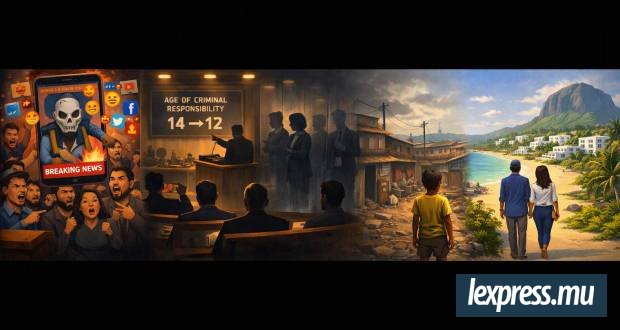
Following the recent riots across the island, the Mauritian government has proposed lowering the age of criminal responsibility to 12. Facing outcries from child rights experts, legal, and other voices, the government is stalling with a parliamentary committee. Beyond media panics and social media outrage, does this bill risk permanently sacrificing the system’s most marginalized children?
The recent civil unrest across Mauritius, sparked by water shortages and a severe cost-of-living crisis, took a dark turn following the police shooting of a 27-year-old woman on 9 October 2026. Dozens of young people were arrested during subsequent arson attacks, looting, and street clashes. They now face provisional charges. In response, the government first proposed dropping the age of criminal responsibility from 14 down to 12. After facing immense backlash from all sides, they softened their approach by proposing a parliamentary select committee to look into the issue.
But can we really solve youth violence just by passing harsher laws? Or is it time to look at the root causes if we want to build a truly inclusive society and restore our image as a “paradise island”? When we talk about “children of a lesser god”, we are talking about young people who have been made invisible, abandoned by the system, and pushed to the financial margins of society. Their lives are shaped by broken institutions that feel like an indifferent god – completely incapable of giving them a fair shake. Sadly, both the media and the government in Mauritius tend to treat these vulnerable minors as inherently bad individuals, rather than questioning the failed system that created them. Behind our booming economy and celebrated multicultural harmony lies a deep, hidden fracture that badly needs to be healed.
Under the surface
To truly understand youth violence in Mauritius, we have to look past the headlines. In a recent opinion piece published in l’express (21 October 2026), clinical psychologist Vijay Ramanjooloo pointed out a dangerous national obsession: we focus entirely on the symptoms of crime while ignoring the causes. Society fixates on viral, dramatic videos of street fighting – symbolised by figures like “Boxer Man”. This sensationalised crime reporting reduces complex human problems into cheap entertainment, stopping us from seeing what is really happening beneath the surface.
The reality in our neglected suburbs and coastal areas is incredibly harsh. Local sociologists, social workers, and psychologists all agree: juvenile delinquency in Mauritius is the direct result of intergenerational poverty and the failure of our education system that leaves so many – very often illiterate and innumerate – by the roadside. Moreover, we live in a hyper-capitalist society that constantly tells young people to buy and consume things, yet blocks any real path for them to climb the economic ladder.
Family and community support networks have collapsed and our schools lack the safety nets needed to catch struggling kids. This leaves young people in a vacuum. It is exactly where organised crime syndicates step in, hooking vulnerable, hopeless youth onto the devastating synthetic drug trade (simik). By focusing only on the aggression of a few minors, mainstream society avoids admitting its own role in creating these broken lives.
Manufactured panic
This shift from a local social problem to an urgent “national security crisis” is heavily driven by the media. In Mauritius, traditional news outlets have moved online, sparking a desperate race for digital clicks. This has led to an overwhelming focus on sensational local crimes (faits divers). News stories routinely show acts of violence on a loop without any context, stripping away the psychological or economic reality behind the behaviour. By constantly linking crime to specific housing estates, the media brands these neighbourhoods as toxic. Just living in a certain area becomes an immediate barrier for a teenager looking for a job or a fresh start.
Social media makes this hostile environment even worse. The Facebook comment sections of major news outlets are filled with public hatred, with people demanding the return of corporal punishment or immediate jail time. When kids look into this media mirror and see themselves labelled only as “thugs” or “future inmates”, their self-esteem is destroyed. Some give up entirely and turn to severe drug abuse. Others decide that since society has already condemned them, they might as well play the part – wearing their violent persona like an armour just to force the world to notice them.
Punitive trap
It is this media-driven panic that pushed the government to act after the violent unrest of mid-October. Faced with hundreds of millions of rupees in property damage across the island, the Cabinet considered a radical penal shift: changing the Children’s Act to lock up kids as young as 12. However, following public outcries, instead of passing an immediate decree, it has now proposed a motion to set up a parliamentary select committee. The committee’s goals sound wide-reaching: investigate the root causes of youth crime, debate the prosecution age, look into parental responsibility, and crack down on adults who use children to commit crimes. Yet, while it is presented as a helpful step, this committee risks becoming a tool for political theatre – designed to calm voters while keeping a highly repressive system in place.
This political move has created a massive divide between the government and local experts, who argue the law violates basic human rights. Barrister Anshi Cootthen, who strongly warns that criminal law should never be written out of raw public emotion, reminds us that Mauritius signed the United Nations Convention on the Rights of the Child, whose Committee’s General Comment No. 24 (2019) recommends a minimum age of at least 14 and urges States not to lower it. The Ombudsperson for Children, Aneeta Ghoorah, has also formally protested the move, writing directly to the Attorney General and the Minister of Gender Equality and Family Welfare to demand that we stick to the 14-year limit to protect our children under the African Charter on the Rights and Welfare of the Child.
Meanwhile, experts on child development are deeply worried about how a 12-year-old actually thinks. Mélanie Valère-Cicéron from the non-governmental organisation (NGO) DIS-MOI points out that research shows a 12-year-old’s brain is simply not mature enough to control impulses or fully understand complex legal consequences. Her organisation is calling for real data on these kids rather than knee-jerk jail sentences that only create repeat offenders.
Sociologist Rajen Suntoo notes that youth violence comes from broken homes, poverty, and peer pressure. He warns that labelling 12-year-olds as criminals just throws them into a permanent underclass. Even NGOs open to tougher rules, like Prisheela Mottee’s Raise Brave Girls, insist that any changes must include psychological tests and a guaranteed “second chance” through educational rehabilitation. Blaming parents is another easy way out for the State. By framing a massive social crisis – like the total lack of youth rehab centres and mental health clinics – as just the moral failure of individual parents, the government successfully shifts the blame. Putting a traumatised 12-year-old on trial or fining a struggling family living in a neglected housing project allows the State to avoid the harder, more expensive work of investing in true social justice.
New social contract
As a society, Mauritius has continuously chosen the easy route: fixating on the spectacle of violence, like “Boxer Man”, instead of fixing the broken system beneath it. Trying to solve this by lowering the criminal age to 12, or burying the question in a parliamentary committee, is a trap. It will not reduce crime; it will only condemn vulnerable children to a lifetime of marginalisation by giving them a criminal record before they even grow up.
To break this vicious cycle, we must abandon these harsh, populist political moves. Instead, we need to listen to the experts on the ground. We must expand restorative justice, invest heavily in mental health and trauma support, and give young people a platform to tell their own stories through citizen journalism. Until Mauritius confronts the cracks in its own economic paradise, our laws will simply continue building prisons for the very children we failed to protect.
Publicité
Publicité
Les plus récents