Publicité
Interview
Jim Adams : “Mauritius is ‘ideally positioned’ as a hub for AI-driven space data”
Par

Partager cet article
Interview
Jim Adams : “Mauritius is ‘ideally positioned’ as a hub for AI-driven space data”
The former Deputy Chief Technologist at the National Aeronautics and Space Administration (NASA), was in Mauritius this week as part of the U.S. State Department's Freedom250 Speaker Program. In this exclusive interview with l’“express”, Jim Adams makes the case for Artemis – and argues that Mauritius has more to gain from space than it might think.
? Physicist Brian Greene described the Artemis programme as a mix of curiosity, geopolitical rivalry, and national pride. Having worked at the heart of NASA, which of those three forces is really driving the programme – and does it change the nature of what we are achieving?
A lot of people, including Brian Greene, want to frame this as a new space race. But what Artemis really is, is planet Earth taking the next logical step out into space. We've done low Earth orbit, we've done the International Space Station, we've conquered space around Earth with robotic spacecraft – and now it's time to move on. This time, it isn't the United States trying to gain dominance over a nation. Today, it is all of Earth going to the Moon. That is the invitation from the United States. Some nations may choose not to join us, but so far 67 nations have signed the Artemis Accords, all agreeing that this should be the next step, and all agreeing on rules of behaviour as we go.
? Apollo 17 was NASA's sixth and final moon landing. Gene Cernan, its commander, was the last human to walk on the moon before climbing back into the lunar module on 14 December 1972. No one returned for 54 years. Who made that decision to stop – and was it the right one?
I think it was. When you look at what it costs to send humans to the moon for just three days, to bring back – and this may sound pejorative – rocks, six missions were enough. We tried seven times, but we went six times, and we learned as much as we could in terms of human activity in space beyond Earth. What happened next was a budget decision. The United States stopped going to the moon so that we could afford to do other things – like build a space shuttle, a space truck. Why did we need that? Because the downstream goal was to build an International Space Station, and the only way to do that was to have a transportation system for cargo and crew. The shuttle programme has since ended – because the space station is built and has been operating for 25 years. We turned over cargo and crew transport to companies like SpaceX and continued contracting with our Russian partners for Soyuz launches. It was a logical progression. Now we know how to live and work in space, and the next logical step is to move beyond low Earth orbit – to the Moon. What we leave behind is a legacy of low-Earth orbit operations, such that commercial entities are now building their own private space stations down there. That opens an entirely new commercial angle to the space economy worldwide.
? In 1969, 600 million people watched Neil Armstrong step onto the moon. Artemis 2 just broke the record for the furthest humans have ever travelled from Earth, surpassing even Apollo 13, which set that record under very different circumstances. Why hasn't this historic moment produced the same collective impact?
It's a different world. When I was 11 years old and we went to the moon on Apollo 11, there were three news channels in the United States, and everybody watched one of them right after dinner every night. So, everyone knew that Neil Armstrong, Buzz Aldrin and Michael Collins – who remained in orbit – were on their way, and everyone was holding their breath as that lander came down so close to the crater. Today, with all the live streaming, cable channels, different news outlets, an accomplishment like Apollo 11 would get buried in the noise. That's why people like me – retired from NASA, but still travelling the world – need to keep telling that story.
? Artemis 2 was a test flight, not a landing – and yet the crew witnessed things no human eye had ever directly seen: the far side of the Moon, Earth setting behind the lunar horizon, a solar eclipse seen from just behind the Moon. What did you learn from having human beings on board that no simulation can truly replace?
When we flew to the far side of the moon, the crew was able to see moonlight illuminating the Earth. Normally, what we see from Earth is sunlight reflecting off the Moon and coming back to us. This time, the Artemis astronauts, positioned at the far side, looked past the Moon – and there was Earth, its dark side facing them, with moonlight illuminating it. They could see cities lit at night, oceans, cloud formations. Even more significantly, they could detect evidence of human activity in Earth's atmosphere – from the moon. Why does that matter? Because our technology for examining distant stars and searching for planets is improving rapidly. Someday, we'll want to know whether those planets have an atmosphere – and whether those atmospheres show evidence of life. That's one of the three great questions of space science.
? Brian Greene argues that the lunar South Pole – with its frozen water and potential for fuel extraction – is what transforms Mars from a science-fiction fantasy into an engineering challenge. How close are we, realistically, to that vision?
Brian Greene is pointing to the idea that the water found in permanently shadowed regions of the Moon represents an energy source that could get us to Mars. That's true. There's a great deal of ice in those regions. Water is hydrogen and oxygen. If we can melt it and electrolyze it, we'll have the fuel we need to continue on to Mars – without carrying it out of Earth's gravity well. However, there is still a great deal to be done before a crewed Mars mission is feasible. We could send humans to orbit Mars, but we couldn't bring them back. We could potentially land on Phobos or Deimos, the two moons of Mars – but we couldn't safely get them down to the surface. There are six significant technologies NASA needs to master before we can credibly say we can go to Mars and return.
? The Nancy Grace Roman Space Telescope, targeting launch as early as September 2026, will generate 1.4 terabytes of science data every day, searching for habitable planets and probing dark matter. NASA is already exploring AI pipelines to process it. Are we entering an era where AI discovers the universe before human eyes ever see it – and what does that mean for science?
It's a very important question about the data flood we are now facing. We are inundated. Our capability to retrieve data – far more than we can process with human minds or laptops – is simply mind-boggling. And it isn't only the Nancy Grace Roman Space Telescope. Radio astronomy, if you know about the Square Kilometre Array Observatory – and Mauritius, I should note, has its own radio telescope – all generate so much data that we need tools like AI to sort through it and fuse different datasets to make the best use of what we have.
We sent a probe to Pluto in 2006. It took nine years to get there, spent two weeks flying by – and then took two years to radio all the data back to Earth. Scientists today, ten years on, are still working through that data. We live in a data age. I see AI as a tool to help us manage that – just as the typewriter was a tool for an earlier generation. I don't think AI will discover the universe before humanity does. But I do think there are ideal locations around the world that could become major centres for data processing, AI-assisted analysis, and data fusion. Mauritius is ideally positioned for exactly that.
Space is increasingly dominated by a handful of national and private giants. When you meet Mauritian researchers or officials face to face, what do you honestly see – a future partner, or a country simply too small to matter in this race?
When I meet Mauritians and we begin talking about space, they get just as inspired as anyone else I've had the privilege to speak with anywhere in the world. And immediately – as Mauritians – they turn towards home. What matters to Mauritius? Controlling the Exclusive Economic Zone (EEZ). Combating unlicensed fishing. Addressing climate change. Agricultural challenges. These are issues that affect nearly every Mauritian, nearly every day. And these are precisely the issues that space data can inform. Space won't solve those problems – but it will inform the people who are going to try to solve them. I look forward to Mauritius joining the Artemis Accords someday – not because Mauritius wants to send someone to the moon, but because it would have a seat at the table, with access to all 67 collaborating nations as humanity moves forward.
? Many Mauritians have never heard of the Artemis Accords. What exactly are they? And what's in it for us?
The Artemis Accords are a set of guidelines – a non-binding agreement, currently signed by 67 nations – governing behaviour as humanity moves out into space. Just as there are rules of maritime navigation – if a ship declares SOS, you are obligated to respond – there are now agreed rules for space. Nations signing the Accords agree to come to each other's aid, to use compatible hardware and communication systems, and to establish shared norms around activities such as resource extraction on the moon. It is roughly twelve principles that the signatory nations agree to uphold. And it doesn't require a national space programme to join. Just as Mauritius is beginning to develop its space capacity – MIR-SAT-1 was a major accomplishment – the Mauritius Research and Innovation Council (MRIC) is already discussing creating a space segment. Joining the Accords wouldn't mean sending an astronaut to the moon. It would mean being part of the conversation as humanity goes further out into space, together.
? Before coming to Mauritius, you toured South Africa alongside Dr. Jim Green, NASA's longest-serving Planetary Science Division Director, for the first African Lunar Symposium. What did that experience tell you about Africa's appetite for space science, and where does Mauritius fit in that larger African picture?
It was instructive in ways we didn't fully anticipate. What we learned from setting up Africa's first lunar symposium is that these things need to grow organically from within the communities they're meant to serve. I wouldn't call the symposium a failure, but we learned a great deal. And sitting here in Mauritius, thinking about Small Island Developing States – a term I'll admit I don't entirely like – I think about how they need to come together and determine what is important to them, and then look to space, or to other disciplines, for solutions. Consider this: Mauritius's EEZ is equivalent to 65 percent of the area of the United States. It is an enormous territory to manage with such a small population. That scale demands smart tools.
? Finally, if you had to pick one single moment – one image still to come in space exploration – that could bring the world together the way Apollo 11 did in 1969, what would it be?
The first human born in space. That is the moment that will galvanize the world. We will begin to understand, collectively, that we are a species of explorers – that exploration is in our nature, and that we will continue moving forward and outward as we develop as a society.
All Credits: NASA
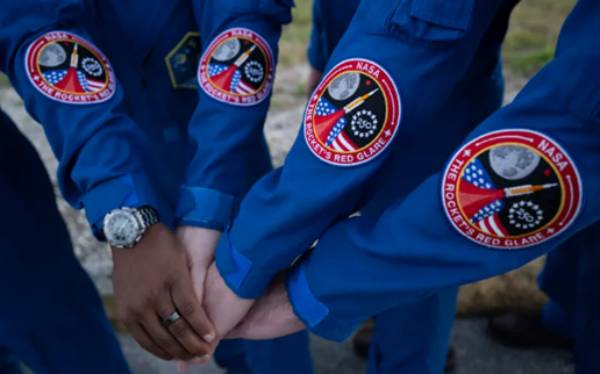 NASA's "Rocket's Red Glare" emblem to celebrate America's 250th anniversary.
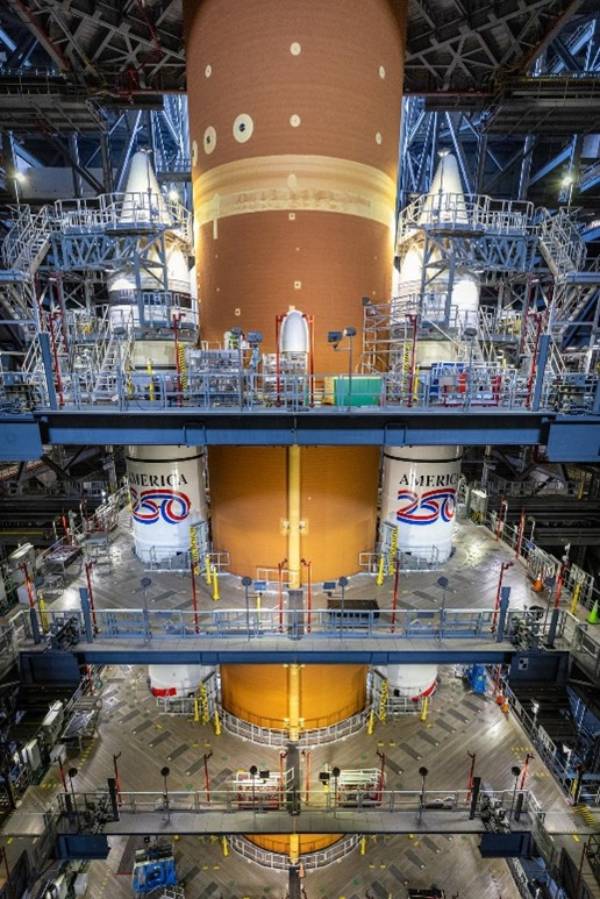 America 250 emblem on the twin Space Launch System.
Publicité
Publicité
Les plus récents