Publicité
Digested week
Blue Economy: Great ambitions or pipe dreams
Par

Partager cet article
Digested week
Blue Economy: Great ambitions or pipe dreams
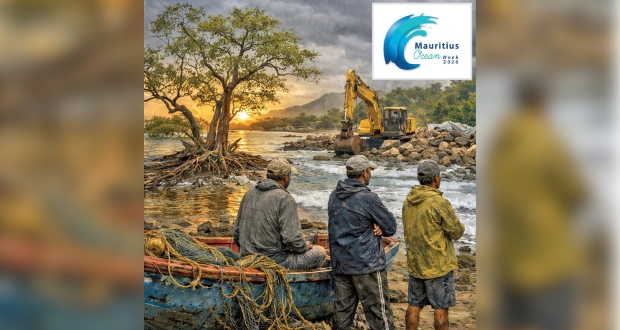
© IA Generated Illustrations.
Mauritius Ocean Week 2026, held from 4–9 May under the theme “The Bridge to the Blue Future: Uniting Stakeholders for a Sustainable Ocean Economy”, was led by the Ministry of Agro-Industry, Food Security, Blue Economy and Fisheries. It gathered scientists, policymakers, industry leaders, communities, and youth to help shape practical, inclusive pathways toward a resilient ocean economy.
Introduction
Mauritius Ocean Week 2026 aimed at connecting sectors and fostering practical, community-based approaches that protect marine ecosystems while supporting livelihoods. Its core forum – Les Assises de l’Océan (4–6 May) held at the Docks, in PortLouis – featured panels on climate impacts on fisheries, sustainable aquaculture, marine biodiversity protection, and financing blue innovation. Parallel activities promoted ocean awareness and Mauritian maritime heritage through guided visits, cultural events and training on sustainable fishing practices.
National ambitions
In his address, the Minister of AgroIndustry, Food Security, Blue Economy and Fisheries, Arvin Boolell, described the theme “The Bridge to the Blue Future: Uniting Stakeholders for a Sustainable Ocean Economy” as a defining moment. Mauritius is a nation with Africa’s largest and the world’s twentieth largest Exclusive Economic Zone (EEZ), giving it both rights and responsibilities. As a major ocean state and a vulnerable small island developing state, our country must adopt sustainable ocean plans and take leadership in building a robust blue economy. The ocean is Mauritius’ next economic, social and environmental frontier.
Although the ocean economy contributes around 10% of GDP and aims at doubling it, its potential remains underexploited. Growth, however, must not come at the expense of biodiversity. Integrated coastal zone management, collaboration with NGOs and lessons from coastal erosion highlight the need for protection and restoration. Promising sectors include offshore wind, tidal energy, aquaculture and maritime trade. He warned of depleted fish stocks and stressed the fight against Illegal, Unreported and Unregulated fishing, which costs the SADC region up to USD 11 billion annually.
Minister Boolell outlined four priority areas: people, through better integration of fisheries, tourism, energy and maritime trade, with a forthcoming Blue Economy Bill; finance, including blue bonds and debt-for-nature swaps, inspired by Seychelles’ pioneering approach; and science, particularly blue-carbon ecosystems – mangroves, seagrass beds, coastal marshes and coral reefs – which store carbon, support fisheries and tourism, and protect coastlines from storms and tsunamis. Mauritius, he added, will revive national conservation networks and establish a UNDP-supported Blue Carbon Tech Hub for blue-carbon assessments and supporting growth in sustainable fisheries, renewable energy, biotechnology and AI-driven monitoring.
Major challenges
Government funding included Rs 164 million in the 2025-26 Budget for restoring marine habitats, combating coastal erosion and reducing pollution. A meagre pittance, when we consider the challenges of addressing declining fish stocks and ensuring sustainable fishing practices while protecting coral reefs and dealing with a receding coastline.
Kenzy Brunet of the Mauritius Fishermen Cooperative Federation stresses the urgency of reform, criticises delays in policy implementation and highlights the paradox of high fish imports despite Mauritius’ vast marine territory. “All the fishing sector was waiting for the ‘Assises de l’Océan’ hoping for a change; when we met the junior minister for Finance to express our concerns, I told him it’s a shame that we are surrounded by 2,2 million km2 of sea and import Rs 22 billion of fish.” It is indeed notable that the average Mauritian consumer can no longer afford to eat fish. Fresh local fish is scarce on the market and costs around Rs 1,000 per kilo, while frozen fish imported from South-East Asian countries is offered at around Rs 600 per kilo.
Judex Ramphul, president of the fishermen’s union, with 45 years’ experience, also calls for a functional fish market to ensure affordable prices. He urges government to prioritise the situation of local fishers and invest in training young Mauritians for the fishing sector, as many young people are willing to join the industry if proper training is provided. He insists that fishing remains a profitable sector and proposes creating specialised training schools, noting that Mauritius’ vast EEZ, including Saint-Brandon and Nazareth, offers significant marine resources that should be managed by qualified Mauritians.
Coastal erosion in Mauritius is now considered a major environmental and economic crisis, driven primarily by sealevel rise, stronger cyclones, and human pressures. Mauritius is losing shoreline at an alarming pace. Some areas retreat by up to 20 metres per year, and sea levels around the island are rising at 8 mm annually, more than twice the global average. This accelerates beach loss, damages coral reefs, and threatens coastal infrastructure, tourism, and fisheries.
The main drivers are climate change with rising seas, storm surges, and increasingly intense cyclones that are eroding beaches and flooding coastal zones. Mauritius recorded a 4.7 mm/year sea-level rise – higher than the global average. Human activity is another major hurdle with coastal development and poorly planned infrastructure weakening natural buffers. Moreover, coral reef degradation through bleaching and reef decline reduce natural wave protection, accelerating erosion.
The incident in Tamarin last week should serve as a wake-up call. Its public beach, at the meeting point of the Tamarin and Rempart rivers, is highly dynamic due to constant sand movement and the absence of a coral reef. Erosion worsened in December 2025 after an unauthorised human intervention altered the river mouth. Following an environmental assessment, temporary corrective measures include desilting the river mouth, placing rocks along 150 m of coastline and monitoring the whole process.
Government has launched several rehabilitation projects along the south-east and west coasts but, despite international funding and multiple studies, progress remains fragmented. Experts call for a coordinated national strategy, stronger scientific monitoring, and deeper community involvement to protect Mauritius’ rapidly disappearing coastline.
Conclusion
Minister Boolell called for collaboration, innovation and a shared commitment to sustainable ocean management, stressing that Mauritius’ future economic growth depends on preserving marine ecosystems. He also urged youth participation and collective action to write a new chapter for Mauritius’ future as a resilient ocean economy.
However, the country’s blue economy ambitions risk remaining pipe dreams as fish stocks shrink, coasts erode and fishermen struggle while imports rise. Without rapid, coordinated action, bold plans will stay disconnected from reality. Only decisive implementation, communitycentred policies and genuine protection of marine ecosystems can turn urgency into a sustainable future.
Publicité
Publicité
Les plus récents