Publicité
Slavery: “The Gravest Crime Against Humanity”
Par

Partager cet article
Slavery: “The Gravest Crime Against Humanity”
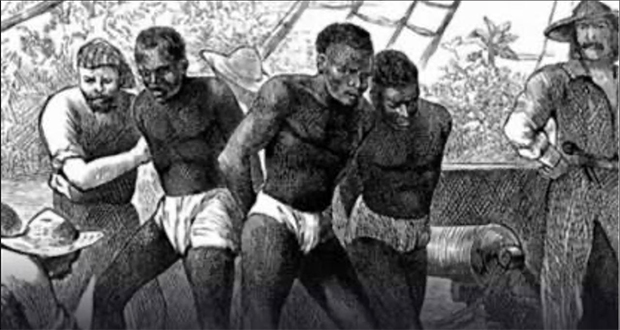
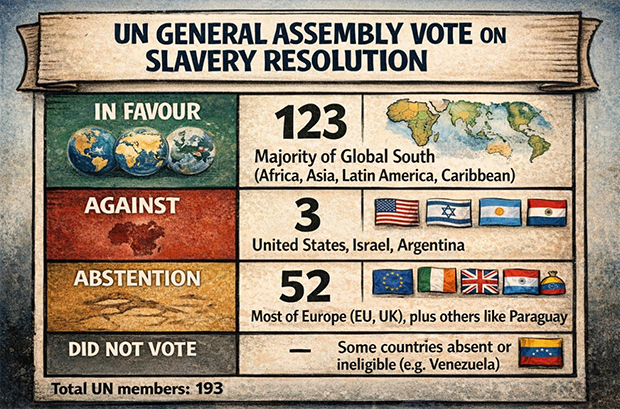
This past month, the global conversation on slavery took a giant leap forward. On the 25th of March 2026, the United Nations passed a resolution that affirmed chattel slavery and the trafficking of Africans as “the gravest crime against humanity,” and called for reparatory justice. Just as interesting as the resolution itself are the reactions that it evoked. The motion was supported by 123 countries, including all participating African countries, India, China and Russia. 52 countries abstained, including all European Union member states, as well as the United Kingdom, Canada and Australia. 3 countries voted against: Argentina, Israel, and the United States of America.
A Notable Resolution
This resolution is noteworthy in several respects. Firstly, it recognizes slavery not as a crime confined to the past, but as a history that continues to bleed into the present. In other words, it insists that while slavery is now outlawed, its “moral, legal, social and economic logics” continue to shape the world we live in. African-American scholar Saidiya Hartman calls this “the afterlife of slavery.” She explains the term by drawing attention to the ways in which descendants of the enslaved continue to face “skewed life chances, limited access to health and education, premature death, incarceration, and impoverishment.”
In a world where it is still common to hear that “slavery is a thing of the past” and that both individuals and societies should “get over it,” such an emphasis on temporal continuity is powerful, and provides the basis for calls to “reparatory justice” – justice that is not just theoretical and retrospective, but future-oriented and actualized through concrete action. Indeed, another striking aspect of the resolution is that it calls for member states to commit to concrete steps such as formal apologies, restitution of artworks and artifacts, and legal and policy changes to frontally address racism and structural discrimination. The resolution thus refuses the possibility that a member state condemn slavery in words while continuing to profit materially off the unequal world it leaves behind.
Finally, the resolution is significant in its insistence that there is no corner of our present world that remains untouched by the “worldbreaking” and “world-redefining” institution of chattel slavery, which birthed “the racial capitalist system [that] transform[ed] the fates of all peoples across the world.” The resolution seems to suggest that no nation can count itself as removed from the resolution, and no person can consider themselves unconcerned. It was rather paradoxical to me, then – especially as both a Mauritian and a scholar of Mauritius – that despite initially addressing the institution of “chattel slavery,” the resolution then moved on to focus particularly on the “transatlantic slave trade,” thereby perpetuating the frequent invisibilisation of chattel slavery in the Indian Ocean.
Telling Reactions
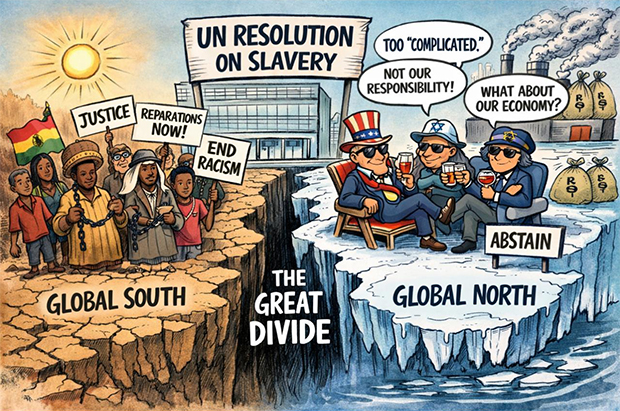
Just as interesting as the resolution itself are the responses that it generated. The voting pattern was fractured in a way that largely reflected the divide between the Global South and the Global North. All African countries, including Mauritius, as well as most from Asia and Latin America, showed solidarity with the resolution put forward by Ghana. On the other hand, Western countries largely abstained, and the United States went even further by opposing the resolution.
Several of those who did not support the resolution cited an issue with the use of the term “gravest.” The resolution does not use this superlative lightly: it rationalizes its use by underlining “the definitive break in world history, scale, duration, systemic nature, brutality and enduring consequences that continue to structure the lives of all people through racialized regimes of labour, property and capital” created by chattel slavery. However, certain abstaining and opposing countries opine that by suggesting that chattel slavery was worse than other crimes against humanity, the use of the superlative creates a dangerous hierarchy between different forms of human suffering. This objection may sound rather ironic in the light of the hierarchy of human suffering already in place, whereby students around the globe are much more likely to learn of the horrors of WWII than those of chattel slavery – even when the latter continues to have much more tangible effects on their lived experiences.
Another argument brought up against the resolution was the fallacy of retroactively seeking reparations for a system that was legal at the time. This logic suggests that because chattel slavery was legal then, it cannot entail reparations now. But the entire reason why chattel slavery was able to wreak the havoc that it did, and alter the world to the extent that it did, was because it was enshrined in law. To have any hope of righting its wrongs and altering the world in the opposite direction would also need the support of a robust framework. The UN resolution and call to reparations, while not legally binding, could be the foundation of such a framework.
Unfortunately, the fight for the recognition of slavery as the gravest crime against humanity is not over. But it is well on its way… and Mauritius, by voting in support of the resolution, is on the right side of history.
******
Un Vote on Slavery Resolution Exposes Global Media Divide
A review of global media coverage of the United Nations General Assembly vote declaring the transatlantic slave trade “the gravest crime against humanity” shows broad agreement on its historic significance, but sharpdivergence in framing, emphasis and interpretation—particularly between Global North and Global South narratives.
1. Procedural clarity vs.legal framing
International wire services including the Associated Press, Reuters, Agence France-Presse and Bloomberg largely adopted a restrained, process-driven tone.Their reports foregrounded the vote count (123 in favor, three against, 52 abstentions), the non-binding nature of the resolution and the legal arguments advanced by Western states.Emphasis was placed on the principle of non-retroactivity cited by the United States, the European Union and the United Kingdom,framing the debate as one rooted in international law rather than moral contestation.
2. Moral reckoning and historical narrative
Anglo-American broadsheets such as The Guardian, The New York Times and The Washington Post framed the vote as a landmark moment in historical reckoning. Coverage stressed the enduring legacy of slavery, racial capitalism and systemic inequality. These outlets also engaged in deeper intellectual inquiry, highlighting debates over memory, accountability and whether labeling slavery as the “gravest crime” risks hierarchizing historical atrocities.
3. Geopolitical divide and postcolonial lens
Global South and pan-Arab outlets—including Al Jazeera, Africa News, The Hindu and Mail & Guardian (South Africa)—emphasized geopolitical tensions. Their reporting underscored a divide between a “global majority” backing the resolution and Western powers resisting it. The vote was frequently framed within a broader postcolonial struggle, linking calls for reparations to ongoing inequalities in global economic and political systems.
4. Advocacy and normative interpretation
Human rights organizations such as Human Rights Watch and Amnesty International presented the resolution as a turning point. Their analyses highlighted structural injustices rooted in slavery and called for institutional accountability, positioning the vote as a step toward reparative justice rather than a symbolic gesture.
5. Regional and popular media framing
Asian outlets including The Times of India, South China Morning Post and Nikkei Asia focused on diplomatic implications, noting Western acknowledgment of slavery’s injustice alongside rejection of legal liability. Meanwhile, mainstream outlets like BBC News, CNN and People magazine simplified the narrative, emphasizing the optics of the United States being among only three countries voting against the resolution.
Emerging themes
Across coverage, three dominant themes emerge: near-universal recognition of slavery’s moral gravity; deep disagreement over reparations and legal responsibility; and a persistent geopolitical divide in how history, law and justice are interpreted in the international order.
(Source: AP)
******
Ce que «L’express en pense» en pense : Pousser plus loin la réflexion
À partir d’une résolution onusienne passée presque inaperçue, Dr Nikhita Obeegadoo ouvre une brèche. Elle ne se contente pas de qualifier l’histoire – elle interroge les mots, les silences, et les rapports de force qui les sous-tendent. Ce que révèle ce vote, au fond, n’est pas seulement une reconnaissance tardive. C’est une cartographie du pouvoir mondial. Et c’est précisément là que l’express entend poursuivre le débat.
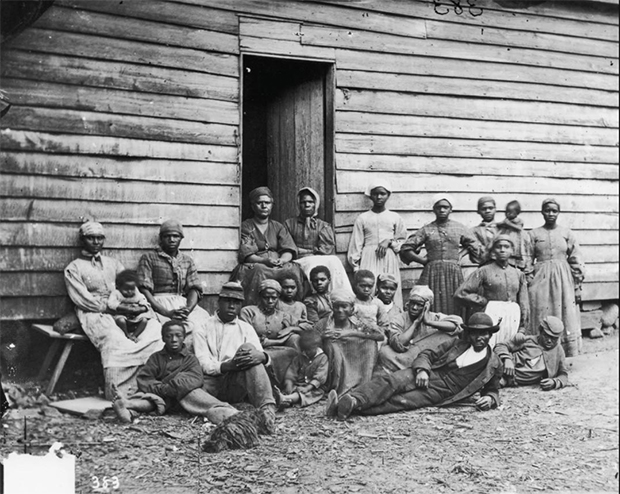 ■ D’anciens esclaves fraîchement libérés posant en Virginie, aux États-Unis, vers 1850. © 1850 FOTOSEARCH/GETTY IMAGES
? Dépasser la fracture Nord-Sud
Parler de «Global South» et de «Global North» ne suffit plus. Ci-contre, Dr Obeegadoo nous invite à déconstruire ces catégories. Le Sud vote-t-il par solidarité historique – ou parce que cette mémoire devient un instrument politique face à un ordre international dominé par l’Occident ? Le Nord, lui, s’abstient : est-ce prudence juridique, hésitation morale, ou stratégie économique visant à contenir toute dérive vers des réparations contraignantes ? Ce vote doit être lu comme un langage codé. Une diplomatie de la mémoire.
? Du principe moral au champ de bataille politique
Le débat sur les réparations ne peut rester à l’état d’horizon moral. Il doit être posé en termes concrets – et conflictuels. Qui paie ? Qui décide ? Qui contrôle les mécanismes ? Une question s’impose : les réparations pourraientelles reproduire les dépendances qu’elles prétendent corriger ? Derrière l’exigence de justice, se profile un enjeu de gouvernance mondiale.
Ce débat rejoint des combats contemporains : restructuration de la dette, justice climatique, accès inégal aux ressources. La mémoire de l’esclavage n’est pas tournée vers le passé — elle irrigue les inégalités du présent.
? Maurice comme argument, non comme décor
L’un des apports majeurs de cette réflexion est de déplacer le regard. Trop souvent, la traite transatlantique monopolise l’attention. Or, l’océan Indien reste un angle mort de la mémoire globale.
Maurice peut – et doit – devenir un contre-récit. Une île où esclavage et engagisme se croisent, où la mémoire est fragmentée, parfois silencieuse. Comment cette invisibilisation a-t-elle façonné notre système éducatif, notre diplomatie, notre conscience nationale ?
Ici, Maurice n’est pas un cas parmi d’autres. Elle est une clé de lecture.
? Hiérarchies de la mémoire : une injustice contemporaine
Pourquoi certaines tragédies deviennent-elles universelles, tandis que d’autres restent périphériques ? Pourquoi la Seconde Guerre mondiale structure-t-elle une mémoire globale, quand l’esclavage demeure régionalisé ?
Cette hiérarchisation n’est pas neutre. Elle reflète – et perpétue – des rapports de domination. Nommer un crime comme «le plus grave» n’est jamais innocent. C’est un acte de pouvoir.
? Une mémoire incarnée, une pensée engagée
Ayant récemment traversé Dakar et Banjul, Dr Obeegadoo nous rappelle que cette réflexion n’est pas abstraite. Elle est géographique, presque physique. Il y a, dans ses mots, le sel de l’Atlantique et le poids des départs sans retour. On reconnaît en elle une passeuse de mémoire, de sens, de vérité. Une écriture qui ne cherche pas à convaincre, mais à ne pas trahir.
Ce texte n’est qu’un début. L’express poursuivra cette exploration avec Dr Obeegadoo, en interrogeant sans détour les hypocrisies, les stratégies et les impensés qui entourent cette résolution.
Car au fond, la question demeure : que faisons-nous de cette vérité désormais nommée ? Et surtout – qui aura le pouvoir d’en écrire la suite ?
La Rédaction
Publicité
Publicité
Les plus récents