Publicité
United States: Donald Trump addresses congress for first time with new tone but same substance
Par

Partager cet article
United States: Donald Trump addresses congress for first time with new tone but same substance
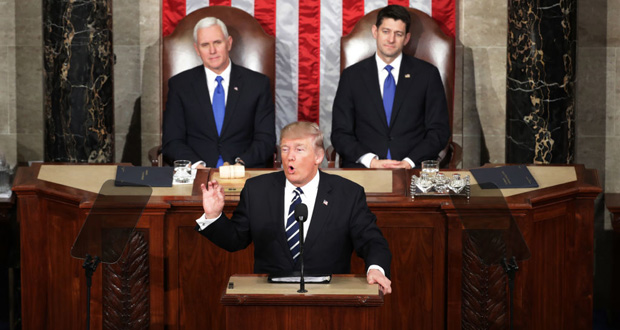
The President Donald Trump received mixed reviews. This, after he delivered his first ever speech to a joint session of congress this week.
The presidential address to a joint assembly of the US Senate and House of Representatives was an opportunity for the Commander-in-Chief to present his agenda and aspirations in front of all elected congressional officials. 48 million Americans watched on TV although US news outlets noted though that the new president’s TV audience was far less than the 66.9 million viewers who watched President Bill Clinton’s first address in 1993 and 52 million who watched President Barack Obama’s initial speech in 2009.
Trump sounded the most “presidential” yet in his address to US lawmakers following a first month in power that featured plenty of controversy and conflict. Tone was the main difference between his maiden speech before the US Congress and the aggressive communications strategy of his election campaign and first weeks in the White House. The President rattled off clichés and rhetoric with positive sentiment and called for national unity throughout his one hour-long address. Although the President’s tone was more upbeat than usual, overall the substance remained the same
Written by his 31-year old senior advisor, President Trump’s speech contained few surprises and primarily focused on things he wants to keep out of the United States. The President started by acknowledging Black History Month and condemning recent vandalism and violence against Jewish and immigrant targets in the US. However, it wasn’t long before he was railing against the threat of “radical Islamic terrorism,” promoting the Great Wall with Mexico to eliminate drugs and crime, and also highlighting crimes perpetrated by illegal immigrants upon American citizens.
Congresswomen protest
Republican lawmakers cheered wildly, while female Democratic congresswomen symbolically protested by wearing all white outfits. They did not stand in applause when Donald Trump stated he would request “one of the largest increases in national defense spending in American history”. Nor did they approve of his desire that congress “slash restraints” put in place by key government agencies, which regulate food, job and pharmaceutical markets to protect the common citizenry. Trump’s declaration that “the time for trivial fights is behind us” and call for “all citizens to embrace this renewal of the American spirit” belied the fact that he ran one of the most divisive political campaigns in US history to conquer the top office.
Unlike his gloomy inauguration speech that painted the US as a land of carnage and broken dreams, Donald Trump’s address to congress this week promoted American enterprise and innovation as solutions to problems that face the country. Fact-checkers noted however that many of the statistics he cited to support an optimistic outlook on the future were inaccurate. For example, Donald Trump took credit for several job-creating business deals that were made well before his election. He also overestimated the number of jobs that would be created by two controversial energy pipelines, which may soon hover above pristine natural environments in the US. He portrayed illegal immigrants as dangerous criminals even though official research indicates the vast majority of unauthorized aliens are simply here to work and combined they commit less than 1% of crime in America
President Trump’s first major political speech as president was full of stirring “America First” statements, but once again he provided few specific policy details about how to solve complex issues that range from healthcare to income tax. His electoral base and sympathetic news outlets cheered presidential sounding talk that included grand, but vague quotes like “the time for small thinking is over,” but many remain concerned that he will resume his attacks via social media and choose to bully legislators and media rather than convince them of the merits of his policy proposals.
Publicité
Publicité
Les plus récents