Publicité
Women betrayed as nation faces impossible target
Par

Partager cet article
Women betrayed as nation faces impossible target

On 3 July 2005 the Southern African Development Community?s (SADC) attention will shift to Mauritius as the island holds its general elections.
One of the last countries with the opportunity to meet the SADC target of 30% women in decision-making by 2005 it will take a miracle to move the current 5.6% women in Parliament and eight percent women in the cabinet to anything close to the target.
The 16 women being fielded by the two major alliances, out of a total of 60 seats, will never make 33%, even if every one of them wins - which is unlikely. And if we can?t achieve this, then how does our government propose to achieve the 50 percent target set by the African Union?
At the SADC Heads of State summit in August, Mauritius hands over leadership of SADC to Botswana. At this point, the Mauritian government will be called upon to assess progress made in terms of its commitments. What will the Mauritian Prime Minister have to say for himself?
Like many other countries in the region, Mauritius is quick to sign commitments concerning women?s rights, but slow to deliver. In September 1995 the Mauritian government committed itself to the Beijing Declaration and Platform for Action. In May 1996 it ratified the Convention on the Elimination of all forms of Discrimination Against Women (CEDAW). This was followed in September 1997 by the signing of the SADC Declaration on Gender and Development and the Addendum on the Prevention and Eradication of Violence Against Women and Children in 1998.
On 8 July 2004 at a special session on gender during the SADC Heads of State Summit in Mauritius, SADC leaders signed the Solemn Declaration on Gender Equality in Africa. This calls for an equal, not just 30%, representation of women in decision-making.
Mauritius is conscious of the embarrassing irony of being one of the region?s most progressive political and economic success stories, but coming last as far as women?s political representation is concerned. But the political will to act in an island steeped in patriarchal traditions has been sadly lacking.
More than two years before the election, a commission on electoral reform led by South African Constitutional Court Judge Albie Sachs commented on the ?democratic deficit? in Mauritius as a result of the low representation of women. Noting that women tend to be much better represented in proportional representation (PR) systems it suggested a mixed First Past the Post (FPTP) and PR system.
<B>Patriarchs of the ruling alliance</B>
But the patriarchs in the government alliance, Mouvement Militant Mauricien / Mouvement Socialiste Militant are clinging relentlessly to an outmoded ?winner-takes-all? electoral system. Is it because our leaders do not want women in Parliament that the Sachs report has been shelved?
Granted, the MMM/MSM alliance has fielded 10 candidates, a 100% increase compared to the five candidates in the 2000 general elections. However, this is only 17% of the total 60 available seats.
The government alliance has not come up with any proposals on how it intends getting more women into government. But what has the opposition Social Alliance, a main contender in the elections, done? They have fielded even fewer candidates than in the 2000 general elections: six women out of a total of 60 candidates, or 10% of the total.
Many women in Mauritius do not buy the argument of our Minister of Women, Arianne Navarre Marie, who has argued that women are too busy with household chores and that they do not want to be pushed into the political arena. She was present when Prime Minister Berenger launched the Gender Links study, Ringing up the Changes, Gender in Southern African Politics, a book that looked at women in politics in the SADC region and was launched in Parliament. Why could she not ring up the changes in her women?s league?
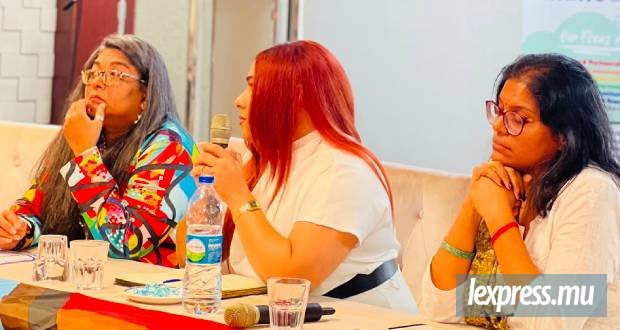
Over 30 dynamic and powerful women participated in a recent workshop in Mauritius organised by Gender Links and the Mauritian Media Watch Organisation. Every one of them declared that they were prepared to stand as candidates if only they were given a ticket. Where have all these women gone?
Many have argued that it is primarily women who undertake much of the grassroots work in electoral campaigns. Is the problem that Mauritian men are afraid that dinner will not be served if their wives are in Parliament?
It is time for real action to be taken against male leaders who sign yet more commitments with no intention of keeping them. Mauritian women will join their sisters in making that point at the SADC Heads of State summit in August. Enough is enough!
<B>Loga VIRAHSAWMY</B>
Publicité
Publicité
Les plus récents