Publicité
In Focus
Water under pressure: Mauritius’ race against the clock
Par


Partager cet article
In Focus
Water under pressure: Mauritius’ race against the clock
© AI-Generated by Microsoft Copilot.
The 2024–2025 drought was El Niño combined with a 40-year trend of declining rainfall driven by climate change. The recent World Meteorological Organization warning of a stronger El Niño does not bode well for Mauritius and Rodrigues, already under pressure with reservoir levels below historical averages and rising demand. The challenge is no longer coping with a drought cycle but adapting to a future where water scarcity may become recurring rather than exceptional.
The narrative
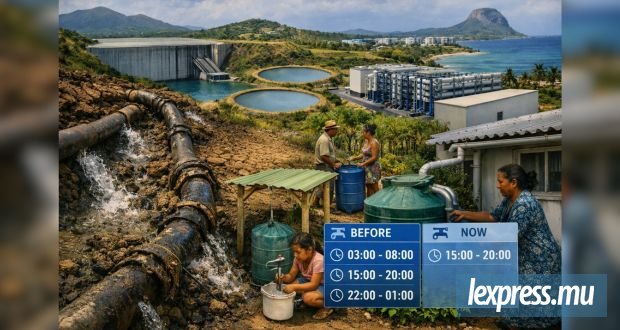
Early in June, Mauritius’ seven main reservoirs stood at 65.4% capacity, down from over 84% a year ago. Mare-aux-Vacoas, the largest, was at just 45%. In April, the minister of Energy and Public Utilities, Patrick Assirvaden, warned that urgent restrictions were coming. Last week, the Central Water Authority (CWA) announced a new schedule in upper Plaines-Wilhems and Moka, reducing supply from three daily slots totalling nine hours to a single five-to-six-hour slot from June 26. Other regions are expected to follow.
Mauritius relies almost entirely on rainfall and the biggest obstacles to water security remain unresolved. Recent assessments by the CWA and the African Development Bank show that 58–62% of treated water is lost before reaching consumers through 1,500 km of pipes aged 50–80 years. The government has launched a pipe replacement programme targeting 200 km annually, backed by billions of rupees in investment, including a Rs 2.9 billion Indian credit line-funded package, aiming to reduce losses below 45%.
During an official site visit in March, Minister Assirvaden announced that the Rivière-des-Anguilles Dam project was moving forward on a fast-track timeline. This Rs 9–11 billion mega-project, delayed for over 15 years, is being funded by a consortium of international agencies to stabilize long-term water security for some 50,000 households in the southern regions of Mauritius. Contract allocation is expected by next August and actual construction by next December, targeting completion in November 2029.
Another major concern is that during heavy downpours, water rushes rapidly down the island’s volcanic slopes into the ocean. Only 7–9% of the island’s expected 4,000 mm annual rainfall is thus captured. A 2025 study by local and international researchers led by Dr Jay Rovisham Singh Doorga of Université des Mascareignes proposes ten strategically located mini-reservoirs to intercept river runoff before it reaches the sea, potentially boosting storage by 500,000 m³. The project’s viability, however, depends on an estimated USD 100 million investment.
The Marshall Water Plan
In October 2025, Minister Assirvaden published the government’s Marshall Water Plan to mobilise additional water resources over the next few years. “Sustainable water governance requires coordinated action from Government, partners, and citizens alike,” he said. The plan focuses on six pillars: increased groundwater use, expansion of surface resources, recovery of runoff, reuse of treated effluent, construction of minidams, and desalination. At a consultative workshop with the Agence française de développement (AFD), the minister stressed the need “to rethink the way [Mauritius] manages and protects its water resources” to meet growing demand and withstand climate impacts.
Harnessing the ocean
To move beyond reliance on rainfall, the government is turning to the ocean. A major pillar of the Marshall Water Plan is a reverse osmosis (RO) desalination plant with a capacity of 50,000 m³/day to supply up to 250,000 people in the North, the most water-stressed region due to tourism, real estate development, population growth, and recurrent droughts. Solar-powered RO desalination is being evaluated with technical collaboration from Morocco and Saudi Arabia. The plant would cost USD 50–75 million, plus 15–20% for marine pipelines and integration into the CWA network, while daily operating costs could reach Rs 1.4–2.3 million. From feasibility studies to commissioning, the project could take three– four years. With public debt already high, financing remains a major question: “Without funding, even the best plans run dry.”
Desalination is not new in Mauritius. Since the early 2000s, major hotel groups in coastal areas have operated their own plants to relieve pressure on the national network. Beachcomber Resorts & Hotels uses desalination as an alternative potable water source, and other groups such as LUX*, Constance, Sun, and Heritage have followed since the mid-2010s. Their RO plants typically produce 50–150 m³/day to 300–600 m³/day for 200–1,500 guests, with capital expenditure ranging from Rs 12M–25M to Rs 60M–120M.
In Rodrigues, three desalination plants are operated by the Rodrigues Public Utilities Corporation. A new plant at Pointe-Coton will have a future capacity of 4,300 m³/day, potentially tripling output. Rodriguan hotels depend on the public network because centralised desalination is more cost-efficient at island scale.
Milking the sky
Not all solutions require billion-rupee investments. Rainwater harvesting (RWH) is increasingly seen as practical and cost-effective. High tourism demand makes freshwater selfsufficiency essential for coastal resorts, which since 2010 have invested in RWH systems and use 100% recycled wastewater for landscaping, irrigation, cleaning, and cooling towers. Compared to desalination, RWH is far cheaper: Rs 0.5M–2M for small hotels and Rs 2M–5M for large resorts.
Rodrigues depends heavily on RWH because it has no major rivers, limited groundwater, and irregular rainfall. A 2023– 24 government scheme costing Rs 9.75 million supports household and community tanks as well as small businesses. Most households have tanks and pumps because piped water is distributed once every eight to 24 days.
RWH systems are affordable, easy to install and user-friendly. In Mauritius, a pilot scheme costing Rs 490,000 for 20 vulnerable households was launched in December 2025 in Sainte-Croix, funded through a Chinese microgrant. The Minister of Social Security, Ashok Subron, said the scheme would be extended to ~40,000 vulnerable households because water scarcity affects “all families, whether rich or poor”. Mauritius has ~420,000 households, of which 56% could install RWH. If 180,000–230,000 households adopted it, they could store 180,000–230,000 m³ per rainfall event – equivalent to La Nicolière’s full capacity.
An expert voice
Former CWA chief engineer and hydrologist, Dev Gujjalu, speaking to l’express, argues that Mauritius’s water crisis stems from structural failures rather than temporary shortages. The root causes are ageing pipes, reliance on climate-sensitive reservoirs and rapid urbanisation. While “each drop of water counts’’, nearly 60% of the 830,000 m³ produced daily is lost – compared to Singapore’s 5%, where “the slightest leak is treated as an emergency”. A 5% loss reduction could save Rs 250,000 daily if leak detection and pipe replacement targeted the most damaged pipes without political considerations. Master plans, he warns, may take years to implement, leaving citizens without reliable access in the meantime.
Conclusion
Mauritius has the plans, the data and the partners. What it has lacked, for decades, is the will to act before the taps run dry. That luxury is gone. Reservoir levels are falling. Pipes are leaking. The clock is running. Mauritius does not have another decade to get this right. Will the Marshall Water Plan deliver or join the long shelf of attractive documents gathering dust? The next El Niño will not wait for the answer.
Publicité
Publicité
Les plus récents