Publicité
The winter of discontent
Par

Partager cet article
The winter of discontent
Introduction
In light of the crushing tax burden of the seventies, the dire need for a major review of the income tax system was felt. Many representations and proposals were made prior to the 1979-80 budget presentation, especially by the Mauritius Tax Payers’ Association. There were high expectations that the budget would provide the much-awaited relief to taxpayers. Matters came to a head when the budget did not make any tangible income tax changes to alleviate the burden, sparking an outcry among taxpayers and the population.
Instead, the budget announced a battery of additional indirect taxes which had a direct impact on inflation. New tax measures were expected to yield almost 20% of additional revenue, the highest increase in the seventies. It meant that recurrent revenue would increase by 63% between 1975-76 and 1979-80. There was much disillusion and dissatisfaction not only among taxpayers but also in the private sector and consumers in general. The Mauritius Tax Payers’ Association called for protests and a rejection of the budget. Protracted discussions ensued between the Association and the Ministry of Finance which culminated in a number of income tax changes incorporated in the budget; the main ones are given below.
1979-80 Budget revisited
First, the personal deduction was raised from Rs 4,500 to Rs 5,500 or by 22%, the biggest increase in the seventies. The limit on a few other deductions was also adjusted upward more or less along the same lines.
Second, income of a working wife could be taxed separately at the option of the taxpayer. This was a landmark development in line with equality of treatment between men and women for tax purposes. It constituted a major victory for women’s rights. Previously, a wife’s income was cumulated in the husband’s, which resulted in the couple’s income being taxed at higher marginal tax rates. It is worth adding that in the UK, women were allowed to request separate taxation as from 1972-73.
Third, earned income relief known as “emoluments relief” to the tune of 5% was introduced on earned income subject to a maximum of Rs 5,000. It differentiated wage and salary earners from those with other sources of income. The justification for earned income relief lies in the fact that income from personal effort should be taxed more lightly than other forms of income like investment or property income. Such income earners incur real costs in terms of work effort and sacrifice of leisure as well as monetary costs and education and training expenses in earning income.
Fourth, the tax brackets and rates were both modified. The first slab of taxable income of Rs 10,000 was divided into two; a new marginal tax rate of 5% on the first income range was introduced and the second range of Rs 5,000 was taxable at 10%. This change benefited all taxpayers, small and large.
The modifications brought to the budget constituted a first attempt at income tax reform with a couple of fundamental changes which marked a watershed in the development of our income tax system, notably separate taxation for women and earned income relief. Most importantly, the 1979-80budget broke the ice. It recognized the necessity of an annual review which almost became the norm thereafter. Different Ministers of Finance took into account the needs of taxpayers in the formulation of the budget, which determined the general acceptability of the budget.
The impact
The tax concessions did not result in a big shortfall in income tax revenue, which dropped by 13% between 1978-79 and 1979-80.
Most of the deductions were subject to a ceiling, which meant that the deductions only partially covered the expenses incurred and the taxpayer contributed a fair share of expenses. They were meant to prevent abuse and overstatement of actual expenses. Moreover, they fulfilled specific needs; for example, life assurance or pensions deductions were expected to encourage savings, deduction of interest to encourage investment in housing and medical care deduction to meet unforeseen circumstances.
It is believed that generally only high-income earners could afford certain deductions like deductions of savings and interest payments which would reduce their tax bill and make the system regressive. In absolute terms, it was true that taxpayers with income exceeding Rs 250,000 availed themselves of deductions averaging Rs 36,406 compared to taxpayers with income less than Rs 20,000 who claimed deductions of only Rs 7,200 in 1978-79. However, deductions were a declining percentage of income ranging from 56.2% at the lower income level to 10.3% at the higher income level. The deductions, therefore, imparted a higher degree of progressivity to the income tax system.
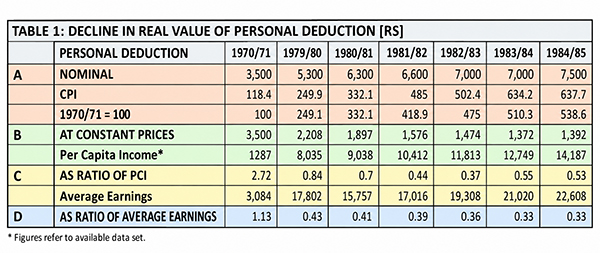
A comparison of the effective tax rates between 1978-79 and 1979-80 shows the impact of the tax changes on taxpayers. The average effective tax rate fell from 14.7% to 12% between 1978-79 and 1979-80, a decline of almost 20%, whereas the decline between 1970-71 and 1978-79 was less than one percentage point. The impact was favourable on all income groups as the effective tax rate for each group declined but it was more substantial for lower income groups than for high-income taxpayers as Figure 1 shows. In spite of these changes, the tax burden for the latter remained high in view of highly progressive rates ranging from 5% to 75%. The effective tax rate for income earners less than Rs 20,000 fell by almost 50% whereas for those above Rs 250,000 only declined from 60% to 55%, that is, by less than 10%. Thus, the tax burden was still crushing for high-income earners since the marginal tax rates at the upper end remained unchanged.
Thereafter, piecemeal changes continued to be made year after year. First, between 1979-80 and 1984-85, most of the deductions and allowances were revised every year except for 1983-84. The personal deduction rose from Rs 4,500 to Rs 7,500.
Second, the lowest two tax bands were increased from Rs 5,000 to Rs 6,500 but were still too narrow compared to the other bands.
Third, a new deduction was introduced in 1984-85 regarding relief for employment of household employees. A taxpayer was entitled to deduct Rs 1,200 per employee subject to a maximum of three employees. This deduction was introduced at a time when the unemployment rate was very high and any measures that would create jobs were welcome. It was also intended to protect the interests of domestic workers since they had to be registered at the National Pensions Fund.
Fourth, the case of emoluments relief is interesting. One year after its introduction, the emoluments relief was extended to agricultural income earners, a concept which is broader than purely wage and salary earners. In the following year, pensioners and persons with disabilities were entitled to a higher rate of 10%. The emoluments relief increased to 6% in 1984-85 subject to a maximum of Rs 6,000, which had to be shared between husband and wife if an election was made to file a separate return.
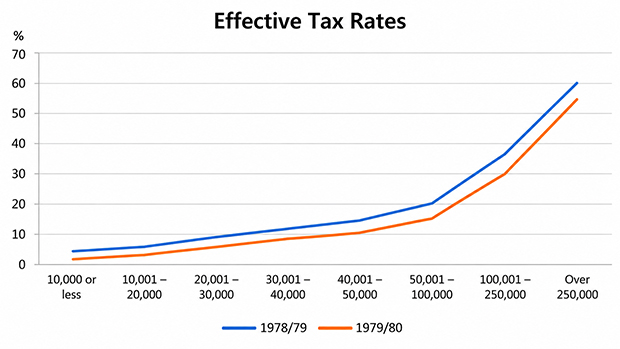
In spite of these changes, the real value of deductions fell mainly due to the impact of the two devaluations on inflation as shown in Table 1. The real value of the personal deduction dropped by 60% between 1970-71 and 1984-85.
Conclusion
It cannot be denied that all these changes did improve the tax system but fell short of a major reform that would encourage work effort and unleash the creativity and potential of the people. The recessionary conditions that prevailed in the economy after 1979, mainly due to the devaluations of the rupee in October 1979 and September 1981 and Cyclone Claudette in December 1979, meant that it was not a propitious moment for any major reform. The few measures taken after 1979, although in the right direction, were more symbolic. The huge budget deficit did not provide much scope for change in spite of good intentions. It fell upon the new governments that came to power in 1982 and 1983 to bring about major fiscal policy reforms. Only an economic revival would permit a more drastic reform. Taxpayers, therefore, had to “wait and hope”.
Publicité
Publicité