Publicité
Law and order
The scars of unrest: three generations remember
Par

Partager cet article
Law and order
The scars of unrest: three generations remember
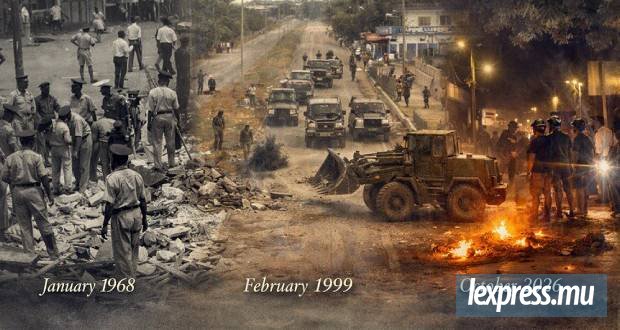
Across six decades, three riots have tested Mauritius’ fragile balance between freedom and discipline. In 1968, 1999 and 2026, each of them forced the country to confront its contradictions: justice demanded, order imposed, memory rewritten. Seven witnesses recall what those days left behind.
Social fault lines of 1968, 1999 and 2026
Mauritius has experienced three major episodes of civil unrest over the past six decades, each exposing deep social fractures and testing the nation’s resilience. The first erupted in January 1968, just weeks before independence. Communal tensions between Creole and Indo-Mauritian Muslim communities, amplified by political uncertainty and rival gangs, escalated into open street violence in Port-Louis. Dozens were killed, hundreds injured, and mixed neighbourhoods such as Plaine-Verte and Cité-Martial were permanently reshaped. A ten day state of emergency was declared, and order was restored only after British troops from the King’s Shropshire Light Infantry were flown in from Singapore. The riots cast a long shadow over the young nation’s birth on 12 March 1968, underscoring the fragility of communal coexistence.
The second major rupture came in February 1999, following the death of musician and activist Kaya in police custody. Kaya was arrested after performing at a concert advocating cannabis decriminalisation. His death – officially attributed to self-inflicted injuries but contradicted by an independent autopsy showing severe blunt force trauma – triggered widespread grief and anger, particularly within the Creole community. Days of violent clashes, burning barricades and paralysed commercial centres followed, disrupting schools and daily life. The unrest exposed longstanding institutional failures and systemic marginalisation. Subsequent inquiries, including the Lam Shang Leen Commission, attempted to address these grievances, while Kaya’s legacy endured as a symbol of cultural dignity and resistance.
The most recent crisis unfolded after the shooting of 27-year-old Élodie Thomas in CampLevieux on 9 October 2026. Occurring amid severe water shortages, inflation, rising energy prices and growing distrust toward authorities, the incident sparked nationwide protests and a temporary curfew. Schools again closed as tensions rose. The shooting intensified demands for police accountability, transparency and reform, highlighting persistent institutional vulnerabilities and the urgent need to rebuild public trust.
Seven voices, three riots
• C. L. – 81 – Early Australian immigrant
“I was a young reporter in January 1968, newly married and living in Port-Louis when the riots erupted weeks before independence. Tensions between Creole and Muslim gangs exploded in Plaine-Verte and spread to Cité-Martial and Roche-Bois. I saw homes burning, families fleeing, and the death toll rising. British troops were brought in under a state of emergency, and for two weeks the whole island lived under curfew. I pleaded for a curfew permit from the magistrate overseeing curfew operations because I didn’t trust the MBCTV van to bring my wife home from work. Those days changed Mauritius forever. Many Creoles left – including us – because we no longer felt secure or hopeful. We didn’t want to start a family in Mauritius – it felt too unsafe. It was an exodus of civil servants, professionals and families who left for greener pastures in Australia and Europe because they believed the island’s fragile coexistence had shattered.”
• S. O. – 80 – From police quarters
“I grew up inside a police station. I was eight when racial clashes erupted in my father’s village. I heard gunshots and screams, saw injured people carried in, blood everywhere. I sat on the bed crying, begging God to protect my father. Even as a child, I tried to tend to wounds, powerless in the face of the violence. At eighteen, during the Port-Louis clashes, our police flats became a refuge for families of all backgrounds who had lost everything. Later, during the Kaya unrest, my father was paralysed, and I stayed by his side, glued to the news, worrying for other relatives in the police still on duty. Today, living abroad, I watch the 2026 events unfold from a distance. My heart bleeds to see police families relive this fear. I know the anxiety that comes when officers become targets. I also know there are bad officers who dishonour the uniform, and I wish the force would clean itself up.”
• A. B. – 65 – Media observer
“I grew up as a policeman’s son and saw the police as a respected institution. My father served in several districts, where officers were then moral guides, mediators, even witnesses at weddings. Over time, politics infiltrated the force, eroding discipline and prestige. The uniform has lost its prestige. During the 2026 riots, officers couldn’t reach affected areas because they lacked vehicles. Many work without tasers, proper gear or psychological support. The sergeant involved in the Thomas shooting had a prior violent incident, yet was still armed. Senior officers chase promotions instead of reform. Mauritius came close to catastrophe. Seeing officers without vehicles or protection was heartbreaking. The force needs deep restructuring and independent oversight.”
• P. P. – Early 60s – Legal and social observer
“Mauritians reacted with remarkable solidarity toward the Thomas family while firmly condemning the violence. That solidarity deeply moved me. For me, the rioters were manipulated by drug networks rather than motivated by rising costs or the shooting itself. The police acted with restraint, arrested the suspect quickly, and allowed investigations to proceed. Now, the priority is identifying those who orchestrated the unrest and rehabilitating neighbourhoods under the influence of traffickers. The residents of these neighbourhoods must be seen differently – with dignity.”
• F. R. – 55 – Political and social analyst
“In 1999, I was studying abroad when the riots broke out. I watched the events on French television, and was horrified and felt powerless as I watched from abroad. My siblings were still in school, and when transport shut down, one of them was stranded. A mother rescued all the children she could fit in her car, including my sibling. That mother’s courage has marked me forever. The distance amplified everything – fear, helplessness, and the scarcity of information. Those images have stayed with me. In 2026, I was on the ground, expecting unrest that I had already warned about. Watching hours of footage, it was clear that the violence came largely from youths tied to trafficking networks. Driving through affected areas, the damage and the rapid cleanup were unmistakable.”
• M. N. – 46 – Economic & social observer
“My great-uncle lived through the 1968 riots and cried when he spoke of losing friends. In 1999, I was in Port-Louis when violence erupted again. We had to rush back home in the north where we lived. My grandmother didn’t know who Kaya was; she only felt the fear returning. In 2026, when Élodie Thomas was shot, I couldn’t sleep. It reminded me of 1999 and of shootings I had witnessed abroad during my studies. Fireworks still unsettle me because of past shootings. I worry about authority figures who misuse power, and about young people drawn into violence because of poverty, exclusion and the underground economy. The widening gap between rich and poor is visible everywhere, and many youths feel abandoned. We need dialogue – across families, institutions and communities – and we must learn from these events instead of forgetting them.”
• J. M. L. – 38 – Pastoral leader
“I grew up in Sainte-Croix and lived through both 1999 and 2026. My parents, from a workingclass background, valued education, and my siblings moved abroad. I became a social worker and pastoral leader because I care deeply about our youth. What troubles me is not anger – people have the right to protest – but the violence and the age of those involved. These are our young people – our children – and we are worried. Are they manipulated? Do they understand the consequences? Many parents have withdrawn from their responsibilities, leaving teachers overwhelmed and children unsupervised in pockets of poverty. It’s the violence behind the anger that frightens me. Solutions must come from the communities themselves. The State, NGOs, social workers and residents need to sit together. A country cannot progress while leaving part of its population behind. Maybe something good can come out of something bad.”
Trust to rebuild
Across three generations of Mauritians, the testimonies converge less on what caused each crisis than on what each one left behind: fear, displacement, institutional fragility and deep social fractures. Those memories resurfaced in 2026, when the shooting of Élodie Thomas revived the fears of past unrest and exposed persistent vulnerabilities in policing, social cohesion and public trust – a resemblance in what people felt, not in what set each crisis off.
Several witnesses emphasise the need for stronger institutional accountability. They call for an independent police oversight body, transparent recruitment, psychological assessment of officers, and adequate equipment to ensure both public safety and police protection. Others highlight the importance of addressing socio-economic disparities that leave young people feeling abandoned, vulnerable to manipulation and drawn into underground networks. They argue that meaningful dialogue must involve families, educators, social workers, NGOs and residents themselves, especially in neighbourhoods long affected by poverty and marginalisation.
The testimonies also underline the necessity of recognising and supporting communities living under the influence of traffickers, and of treating their residents with dignity. Finally, witnesses stress the importance of collective memory: learning from past violence, educating younger generations, and ensuring that the country does not forget the lessons of 1968, 1999 and 2026.
Publicité
Publicité
Les plus récents