
Publicité
In focus
Road safety | Danger at every turn: Can the law keep up?
Par


Partager cet article
In focus
Road safety | Danger at every turn: Can the law keep up?
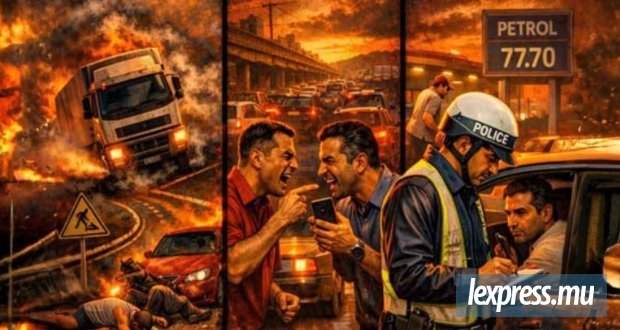
© AI-Generated illustration by Microsoft Copilot
Road fatalities are rising and congestion is worsening. As the government answers with tougher laws and a costly new motorway project, the question is whether these measures can reach the deeper problems on the country’s roads. Meanwhile, the 10 per cent rise in fuel prices has triggered a domino effect, squeezing drivers and households and undermining the social fabric.
A rising toll
Every morning, Mauritius repeats the same routine. Engines start, buses fill up, motorcycles squeeze between cars and lorries leave their depots before sunrise. For some the frustration is about time, for others money; for far too many families this year, the road is where a loved one never came home. By 28 September, 117 people had died in road accidents since January 2026, among the latest victims two young people and a 58-year-old woman. Behind the figure lies a triple problem: a road-safety crisis, a transportcost crisis and an infrastructure challenge.
Accidents rarely have a single cause. Alcohol, drugs, speed, dangerous manoeuvres and phone use remain the main concerns, but fatigue, impatience and stress also play a part. In August, with the toll at 98, Land Transport Minister Osman Mahomed announced another tightening of the Road Traffic Act. The amendments took effect at midnight on 30 September. Driving under the influence of alcohol or drugs can bring a licence suspension of two to six months, a fine of Rs 200,000 to Rs 500,000 and up to five years’ imprisonment for a first offence; with heavier penalties for a second conviction. Penalties are also higher for causing death by dangerous driving and for road rage.
Law meets road
The new rules were tested almost immediately. Just after they came into force, a 63-year-old motorcyclist was stopped at La Tour-Koenig after allegedly recording readings above the legal limit: 36.74 mg at about 00:15, then 34 mg and 30 mg on an Alcotest 9510. It illustrates the new approach: act before a crash, not after. On penalty points, it is too soon to say.. Mahomed insists that tougher laws are only part of the answer. He defends the penalty-point system, operational since 31 January 2026, as a way to change behaviour rather than simply punish it, reviewed every semester and tightened where necessary.
After the first assessment in June, the points for using a handheld phone at the wheel rose from three-six, to five-ten, and phone use appeared to fall. A recent crackdown in Phoenix saw dozens of drivers stopped within an hour, many caught texting while creeping forward in traffic. In September, Mahomed cautiously said seven months was too early for a final verdict, and speeding was still the most recorded offence. A points system can make dangerous driving costlier, but it cannot repair a badly designed road, light a dark pedestrian route or relieve a road carrying more vehicles than it was built for.
Enforcement must work alongside prevention, and it has its own difficulties: proving an offence, policing consistently and ensuring penalties actually deter. For Alain Jeannot, president of the NGO Prévention routière avant tout, the real test lies on the ground. Tougher penalties will deter only if backed by consistent controls, he says: “Once people realise there is no real threat, the warning quickly loses its effect.”
On road rage, he wonders what evidence will establish an offence and whether surveillance footage could help. “Effectiveness will be measured by the fluidity of the procedures.” Separately, the 2 October edition of “Sekirite nou priorite”, a weekly podcast on lexpress.mu, covered the new sanctions. The regular guest, Barlen Munusami, a retired sergeant of the Police Traffic Branch, reminded drivers that “failing to respect their responsibilities can have serious legal consequences”.
The new road rage offence has already been tested. Last week, a 26-year-old driver, travelling with his wife and 18-month-old child, was allegedly slapped after being cut off. At the police station, the suspect reportedly offered him Rs 5,000 to withdraw his complaint. He was arrested for bribery and fined Rs 10,000; his road rage case returns to court next February.
Moreover, questions persist about the integrity of licensing procedures, fitness tests and roadside policing. Vehicle owners allegedly resort to bribery to avoid fines or licence-point deductions, undermining enforcement and weakening public trust in the system.
Another critical issue is the fastgrowing vehicle fleet that causes familiar peak-hour bottlenecks. The government’s answer is better connectivity: the 2026–27 Budget allocates Rs 2 billion to the M4 Motorway, linking Forbach with the airport. In Parliament, some questioned whether a 2012 feasibility study justifies a project costing more than Rs 10 billion. National Infrastructure Minister Ajay Gunness said work is advancing and funding is available. Yet more roads do not automatically mean fewer cars. Should Mauritius keep answering congestion with asphalt, or give more weight to public transport and better traffic management?
Fuel squeezes everyone
The pressure shar pened on 29 September, when petrol rose from Rs 70.65 to Rs 77.70 per litre and diesel from Rs 71.25 to Rs 78.35. The 10 per cent rise, decided by the Petroleum Pricing Committee, followed higher international oil prices and a Price Stabilisation Account deficit estimated at Rs 3.63 billion. Almost everything sold in Mauritius has travelled by road, so higher transport costs can feed into the price of goods and services.
Buses and lorries spend long hours on the busiest routes, and a vehicle with defective brakes or worn tyres can turn an ordinary trip into disaster. Yet road-fitness compliance has a price: a taxi driver must budget for fuel and other running costs; a bus operator or small business for the same, plus salaries. Raising fares offsets costs, but passengers are squeezed too. For Suren, a taxi driver from Flacq, rising costs are hard to manage: “Fuel, one of my biggest expenses, has added to the pressure. Insurance, road tax, servicing, tyres and repairs eat into my earnings, while potholes add wear to my vehicle. Yet I must be careful about raising fares, because my passengers are struggling too.”
The tests ahead
A safer road network needs more than penalties: better lighting for pedestrians, regular vehicle inspections, firm action on drink-driving, effective public transport, traffic management, driver education and, perhaps most importantly, a change in the culture of road use. For Mahomed, the test is whether tougher enforcement and the penalty-point system can change behaviour and reduce fatalities. For motorists, the test is simpler: Can they afford to fill the tank? Can a taxi driver still make a decent living? Can a family rely on the bus? Can a pedestrian safely walk along a secondary road without fearing the next vehicle?
There is no single answer. New penalties may change behaviour, new roads may improve connectivity, better public transport may reduce dependence on cars and stronger inspections may prevent mechanical failures. The challenge is to make them work together. Without a mindset change, consistent enforcement and long-term planning, Mauritius risks continuing down a road where mobility becomes more costly – economically, socially and in human lives.
Publicité
Publicité
Les plus récents