Publicité
In focus
Price Stabilisation Fund: Protecting wallets while watching the deficit
Par


Partager cet article
In focus
Price Stabilisation Fund: Protecting wallets while watching the deficit
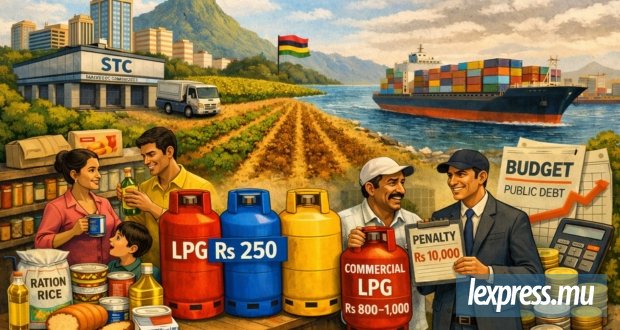
© IA Generated Illustrations.
Mauritius has long used subsidies to cushion households from rising food and energy costs. The 2026-2027 Budget injects another Rs 2 billion into the Price Stabilisation Fund and widens support, but with high public debt and global volatility, doubts grow over the model’s sustainability and who ultimately foots the bill.
The narrative
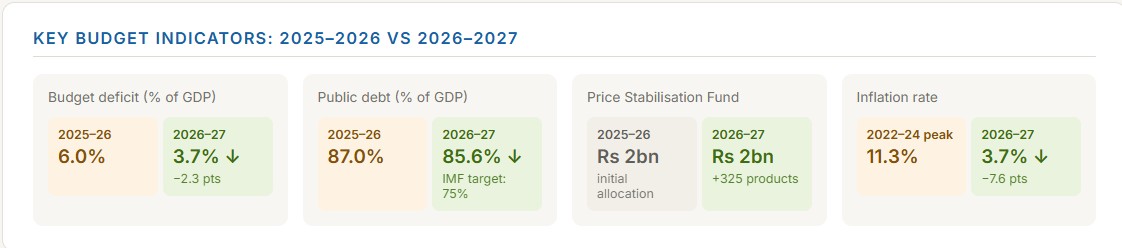
Government faces a delicate balancing act: restoring public finances after years of rising debt while easing household pressure from high living costs. Inflation may have eased to 3.7%, yet purchasing power remains fragile. Instead of trimming support, the 2026-2027 Budget expands the Price Stabilisation Fund (PSF) to cover hundreds of products – from canned tuna and lentils to infant food – signalling that protecting household budgets remains a political priority.
Mauritius’s subsidy system dates back to the 1970s oil crisis, when soaring import prices threatened social stability. By the late 1970s, nearly 60% of the import cost of ration rice was subsidised, with public expenditure on food subsidies rising from Rs 100 million in 1976/77 to Rs 230 million by 1981/82. The system’s sensitivity was tested in 2006 when Finance Minister Rama Sithanen abolished universal rice and flour subsidies, triggering panic buying and strong public backlash.
Created in 1982, the State Trading Corporation (STC) centralised imports of strategic commodities, enabling bulk purchasing and price control. Launched in 2011, the Price Stabilisation Account (PSA), cushions petroleum price swings. With 98% of households relying on LPG for cooking and water heating, the PSA’s cross-subsidy mechanism – funded partly by petrol and diesel levies – means motorists indirectly support food and energy affordability.
The Price Stabilisation Fund
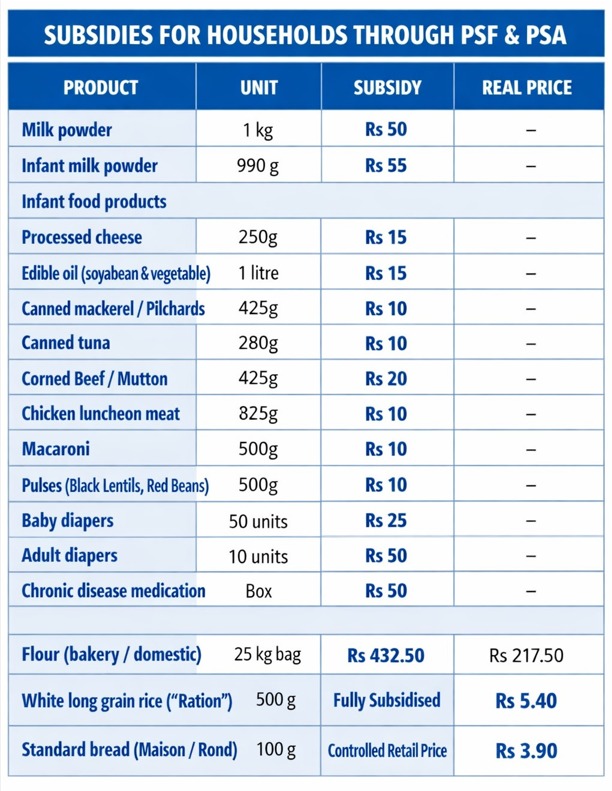
Introduced in the 2025-2026 Budget with a Rs10 billion framework, the PSF was designed to stabilise prices. The 2026-2027 Budget added Rs 2 billion, extending subsidies as from 1 July 2026 to 325 everyday products, cutting Rs 10–20 per item. Operated through the STC, the fund caps profit margins on subsidised goods and ensures controlled retail prices across middle-income and essential household categories.
The billion-dollar question
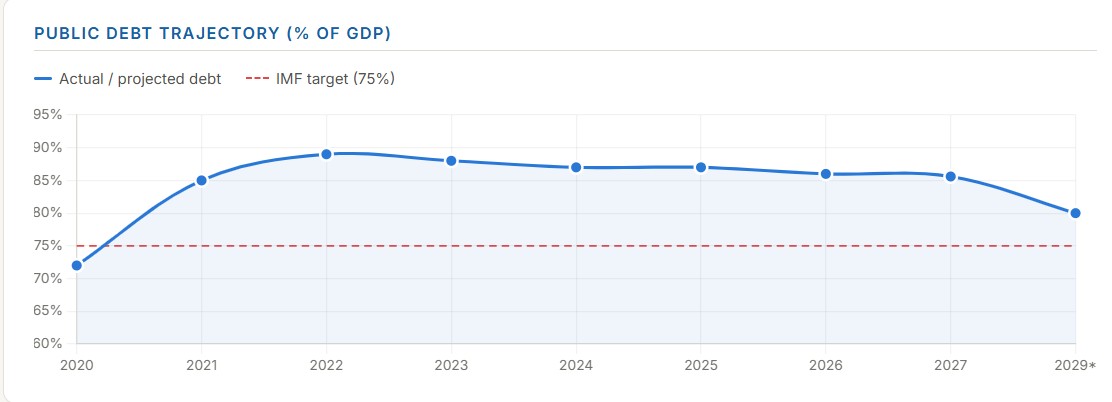
The budget deficit is projected to fall from 6.0% of GDP in 2025-2026 to 3.7% in 2026-2027, with public debt declining to 85.6% of GDP by June 2027 – still above the IMF’s 75% debt-to-GDP target. Each rupee spent on subsidies raises the key question: can Mauritius sustain universal support while reducing debt?
To finance social spending, the Budget introduced a 35% income tax band for individuals earning above Rs 12 million annually and higher excise duties on sweets, alcohol, and tobacco. Are there no other avenues – such as heavily taxing luxury products – that could have been targeted? Longerterm strategies such as the ‘25 by 35 Food Security Project’ to produce 25% of food locally by 2035 and a National Food Reserve aim to reduce import dependency and gradually ease the structural need for subsidies.
Universal vs Targeted
Mauritius’s universal subsidy model benefits all consumers regardless of income. Advocates say it guarantees affordable access without complex eligibility checks. Critics argue it wastes resources, as wealthy households and businesses profit alongside vulnerable families – some upper-income consumers even buying ration rice and canned foods for pets.
A major leakage occurs in LPG subsidies. Domestic 12kg cylinders are sold at Rs 250 against a real price of Rs 800-1,000, meaning subsidy per unit of at least Rs 500. Yet, commercial operators often purchase and use household cylinders illegally to avoid paying 50–60% higher commercial rates, thus diverting 30–40% of social protection funds.
To curb abuse, the Ministry of Commerce has tightened regulations: Rs 10,000 fixed penalties, fines up to Rs 100,000, and jail terms of three years for repeat offenders. Retailers may sell only four domestic cylinders to an individual to prevent hoarding and deviation from proper use. However, normal households use one or two cylinders monthly.
We contacted the ministry to have explanations on this figure of four cylinders and its rationale, but without success. Is the ministry really exerting control on businesses and LPG gas sellers that are breaking the law? Will it put up a system that ensures fairness to those who really need it… Enforcement effectiveness in commercial misuse remains debated. Consumer advocates demand transparency on whether retailers pass on full benefits to households. Claude Canabady of Consumers’ Eye Association urges directing funds to vulnerable families with stronger monitoring.
Suttyhudeo Tengur of the Association for the Protection of the Environment and Consumers shares this view and warns that success should be measured by real reductions in household expenses, not by budget allocations alone – a benchmark the current model struggles to meet.
Besides, the clock is ticking and are there no shorterterm strategies and measures that could be implemented to rationalise the subsidy system by making sure that those who most need the subsidies are looked after.
International experience
Globally, subsidy systems are shifting toward targeted support rather than universal models. The United Kingdom provides Cost of Living Payments directly to low-income households via Universal Credit; Singapore offers USave rebates and GST vouchers to eligible families; India’s Pradhan Mantri Ujjwala Yojana subsidises LPG only for lowincome households, with four cylinders per year credited directly to beneficiaries’ bank accounts. Each model balances social protection with fiscal discipline – a balance Mauritius has yet to achieve.
Conclusion
The 2026-2027 Budget confirms that price stabilisation through the subsidy system remains central to government strategy. Yet long-term sustainability is uncertain. With debt still soaring high, policymakers face a stark choice and must choose between persisting with universal subsidies or shifting toward targeted mechanisms that would protect the most vulnerable without straining the public purse. As global markets grow more volatile and Mauritius stays heavily import-dependent, the debate on the subsidy system – arousing passions from most stakeholders – will only intensify in future Budgets.
Publicité
Publicité
Les plus récents