Publicité
In focus
Climate change | Vanishing coasts: Human vs Environmental struggle
Par


Partager cet article
In focus
Climate change | Vanishing coasts: Human vs Environmental struggle
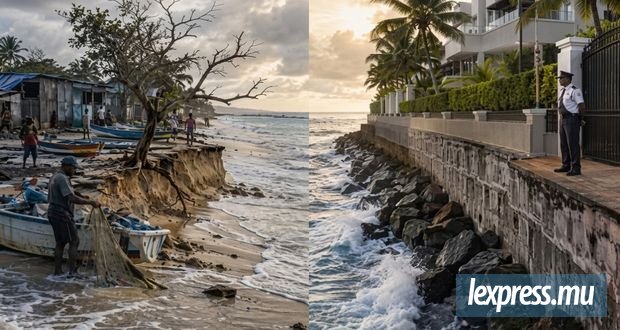
On Mauritian beaches, climate change is hard to ignore: sand disappears beneath stronger waves, and shoreline that once buffered the land is steadily narrowing. Erosion is no longer a warning – it is a lived reality. But another struggle unfolds along the coast: who has the right to occupy and protect these fragile spaces, as private development pressures land meant to stay public. The result: a crisis where climate change, land rights, inequality and economic interests collide.
The growing pressure
Data from the Ministry of Environment and Meteorological Services show sea levels around Mauritius rising at approximately 5.6mm a year, almost twice the global average. Between 11% and 20% of the coastline faces severe erosion, with significant shoreline retreats at Wolmar, Albion, Mon-Choisy and Trou-aux-Biches. Rising seas alone are not to blame: erosion also stems from urban development, sand extraction and hard coastal structures disrupting sediment flow, compounded by stronger storm surges.
Mauritius is especially vulnerable as a small island state whose economy and identity are tied to the coast. More than 35% of the population lives in coastal areas, and thousands of artisanal fishers depend directly on lagoons for their livelihoods. Coral reefs – among the island’s most important natural defences – have also suffered significant degradation from warming waters, bleaching and pollution.
For an artisanal fisher, a shrinking beach is not a statistic – it can mean a damaged boat, an inaccessible landing site or a longer journey to find fish, as lagoon changes affect octopus, reef fish and other species that communities depend on. The erosion of the coast becomes the erosion of a livelihood. The same vulnerability is visible among low-income families living in precarious shelters (lakaz tol) in places such as Roche-Bois, Pointe-aux-Sables and Riambel. A storm surge or unusually high tide can threaten the roof over their heads and their security – while raising an uncomfortable question: who gets protected when the coastline becomes harder to defend?
The high-water mark battle
That question is central to the controversy over the Pas Géométriques – under Mauritian law, an 81.21-metre strip of state-owned coastal land measured from the high-water mark and intended to preserve public access to the sea. Private bungalow owners, luxury villa developments and hotel operators have been accused of extending lawns, installing hedges, building concrete walls and putting up security gates that restrict access to areas meant to remain public – in some cases effectively obstructing access to the beach.
The controversy is not simply about walking along a beach; it reflects a broader struggle over whether scarce coastal land remains public or becomes fragmented by private interests. The recent site visit in Pointed’Esny by Housing and Lands Minister Shakeel Mohamed highlighted alleged illegal occupations and barriers preventing public access. His message was clear: “The beach belongs to all Mauritians.” And he intends to extend his visits to other sites. But enforcement might prove harder than his declaration: delayed notices and disputes over older leases can prolong cases for years.
Perhaps the most contentious part of the debate is the perceived gap in treatment between vulnerable families and wealthier developments. Informal structures built by low-income families can face swift demolition, particularly on state or environmentally sensitive land. Yet, when larger developments are accused of encroaching on public coastal space, proceedings often take far longer, entangled in administrative and legal processes – fuelling accusations of double standards.
This is not to suggest that vulnerable families should occupy dangerous areas indefinitely. The real question is equitable enforcement without ignoring the social consequences of displacement: a family removed from a shelter needs somewhere safe to go, and a development on public land must equally face enforcement – otherwise coastal management risks becoming a system where rules are strongest against those least able to resist them.
The global crisis
Mauritius is not alone in this conundrum. Coastal communities worldwide face the same pressures: Senegal, Ghana and Nigeria face severe shoreline loss linked to sand mining; the Mekong and Ganges-Brahmaputra deltas see erosion compounded by land subsidence; coastal parts of Europe, the US and the Caribbean experience growing beach loss and storm impacts.
For small island states, the stakes are especially high: erosion threatens housing, food security, tourism and cultural heritage. Closer to home, the Maldives offers a preview of the stakes: 80% of its land sits at under 1 metre above sea level, eroding beaches endanger infrastructure and freshwater lenses, while tourism and fisheries – which account for nearly half of its GDP – already face direct risk.
In Mauritius, tourism depends heavily on beaches, making erosion both an economic and environmental concern. Hotels often resort to sand nourishment and seawalls – but hard structures can transfer erosion elsewhere along the coast; thus, protecting one property can unintentionally expose another. This is why experts favour an integrated approach over concrete barriers alone.
Beyond the seawall
Mauritius has already begun exploring mangrove restoration, coral farming, beach nourishment and other nature-based interventions that restore ecosystems rather than rely solely on hard engineering. Reefs, mangroves and seagrass beds function as natural defences while supporting biodiversity.
However, climate change is advancing faster than many adaptation measures can be implemented, and Mauritius needs long-term coastal monitoring, stronger development regulation and better enforcement of public-access rules.
The issue also feeds into the international agenda, namely the Pre-COP31 Program scheduled to take place in Fiji and Tuvalu from October 5 to 8, 2026, which will focus on how oceans and climate are interconnected. It will put local island experiences at the centre of world talks while offering small island states a chance to seek greater support. Moreover, erosion destroys homes that cannot simply be rebuilt elsewhere, and climate finance could help fund protection, restoration and managed relocation.
Challenging resilience
A resilient coastline cannot be measured only by seawalls built or beaches replenished. It must also be measured by whether fishers can keep earning a living, vulnerable families have secure alternatives to unsafe shelters, and citizens can access public beaches. As the sea advances, every metre of coastline becomes more valuable.
The real challenge is not only to hold back the sea, but also to ensure that the burden of a changing coastline does not fall disproportionately on those least able to bear it. Mauritius’s future coastal policy will have to bring together climate adaptation, marine conservation, housing security, public access and responsible development – choices that will decide whether future generations inherit beaches that are accessible, or a coastline defined by concrete walls, retreating sand and displaced communities.
Publicité
Publicité
Les plus récents