Publicité
Portrait
Cathriona Bonnefemme : The young lady and the sea
Par

Partager cet article
Portrait
Cathriona Bonnefemme : The young lady and the sea
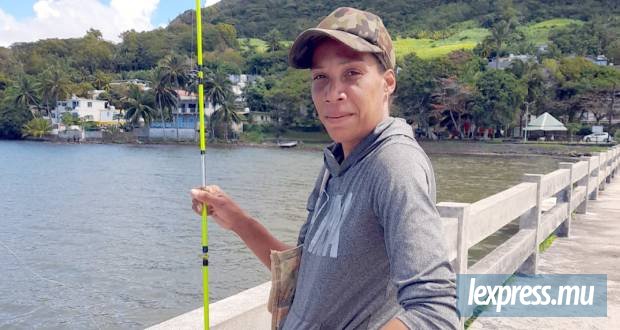
There is, of course, no comparison between the colossal story of Hemingway’s The Old Man and the Sea and the quiet encounter I had today with a young woman by the sea. Yet, as I walked along the jetty at the foot of the green, hilly coastal village of Bois-des-Amourettes, I was reminded of Santiago, the old fisherman whose courage and endurance have made him a timeless figure in literature.
There, at the edge of the village, I came upon a shy young lady quietly fishing with a simple hand line. She had come to the sea hoping to bring home a fish or two. Her name is Cathriona Bonnefemme, a daughter of the village and a child of the coast. She was not there merely to pass the time. She was patiently waiting for the sea to yield one of its small treasures.
Cathriona tells me that fishing is more a pastime than a means of earning a living. Yet, in a rural village where people have traditionally depended upon the land and the sea, such a pastime can never be entirely separated from the necessities of life. It was an ordinary working day, but under the wide, open sky, Cathriona was practising the craft she loves. Behind her quiet manner lies a story of hardship and perseverance.
She had once hoped to continue her schooling at the Lycée de Beau-Bassin. But life, with its unexpected turns and burdens, brought her studies to an end in Form IV. The long journey from Bois-desAmourettes to Flacq and then on to Beau-Bassin, followed by the return journey late in the afternoon, became too heavy a burden. The cost and difficulty of travelling several kilometres by taxi eventually made further schooling impossible. She had to face life as it came.
The sea, however, was there. Like a patient mother who never entirely turns away her children, the sea offered the family another means of getting by. Cathriona is the second of nine children – six boys and three girls. In a large village family, every little contribution matters, and the sea has sometimes helped to put food on the table.
Just as Santiago sets out with determination to secure his catch, Cathriona waits patiently for a fish to take the bait. Her tackle is simple. Her bait is a sandworm dug from the damp shore, often from sand stained yellowish by rainwater running down from the hills. She keeps the worms carefully in a small tin bowl. There is something almost homely about this humble fishing equipment. Nothing is elaborate. Nothing is wasted. The line, the hook, the bait, and the fisherwoman’s patience are all she needs.
Shared generosity
For the village line-fisher, the bait is more than a piece of food placed on a hook. It is the lure, the little trick used to tempt a cautious fish from beneath the water. Cathriona knows that the sea can be generous one day and tight-fisted the next. She therefore waits without fuss, her fingers resting lightly on the line. She knows several kinds of fish by name – giblo, rouget roche and mulet, among them. She also gathers tec-tec, palourde and bigorneau along the shore. These small sea treasures are part of the old coastal life of Mauritius, a life in which the shore was not merely a place to admire but also a place from which families could draw a little nourishment.
When the catch is good, Cathriona does not keep everything for herself. She shares with relatives and neighbours. On another day, someone may return the kindness. This quiet exchange is part of village life: one neighbour helps another, and what is given today may come back tomorrow in another form.
Cathriona is truly a child of the sea. Yet she has not depended upon it alone. She once worked in a restaurant, but the long hours eventually proved too demanding. Another opportunity came from the airport region, but the absence of public bus transport on Saturdays and Sundays made the job impractical.
And so, she returned to the sea. Perhaps this is why I find her story so moving. She does not speak of the sea with grand words. She simply comes to it, as generations of coastal people have done before her. The sea may open its hand and offer a catch, or it may remain stubbornly silent. Cathriona accepts both possibilities without complaint. There is a quiet strength in such patience. She does not quarrel with the sea. She waits.
Fishing is no child’s game for anyone who comes to the shore hoping to bring home even a small fry. Cathriona understands that the sea must also be allowed to replenish itself. The tiny fish that are too young to be taken must be returned to the water so that they may grow, breed and multiply. For the fisherfolk, the future depends upon this balance. A sea stripped bare today will have little to offer tomorrow.
Wisdom of coastal life
Cathriona therefore knows that the sea is not simply a storehouse from which one can take without thought. It is a living world that must be respected. The fisherwoman takes what is needed and leaves the young fish to grow. Such knowledge may not come from a classroom or a textbook, but it is part of the wisdom handed down by coastal life.
Unlike Santiago, whose great marlin is eventually reduced to bones by the sharks, Cathriona is usually able to carry her modest catch home. Whether it is one fish or two, she accepts it with gratitude. Her victory is not measured by the size of the catch. It is measured by the fact that she tried.
The shy young lady I noticed at the beginning of my walk therefore turns out to be much more than a woman sitting quietly beside the sea. In her I see courage, dignity, perseverance, and patience. With the fishing line resting between her fingers, she seems to embody the quiet endurance of ordinary village people who have learned to face life’s uncertainties without complaint. She is cautiously optimistic. She has rarely returned home entirely empty-handed, and perhaps this is what keeps her coming back. There is always the possibility that the next cast will bring a fish. There is also another hope she carries in her heart: the hope of finding suitable employment and making use of the potential she possesses.
As I leave the jetty, I find myself thinking again of Hemingway’s old fisherman. Santiago had his vast ocean, his great struggle, and his magnificent marlin. Cathriona has her village shore, her modest hand line, her sandworms, and the uncertain promise of a small catch. Their worlds are very different. Yet beneath that difference lies something common to both: the courage to wait, the strength to endure and the determination to try again when the sea gives nothing.
The sea teaches no easy lessons. It teaches patience. It teaches humility. And, above all, it teaches us that even a small catch can be a victory when it has been earned through hope, perseverance, and honest effort. And there, at Boisdes-Amourettes, beneath the changing Mauritian sky, the young lady and the sea quietly tell that story.
Publicité
Publicité
Les plus récents