Publicité
Série – Essais de Maurice Lam (3/5)
Water: Stop paying for inefficiency, Start investing in reliability
Par

Partager cet article
Série – Essais de Maurice Lam (3/5)
Water: Stop paying for inefficiency, Start investing in reliability
Mauritius is rationing water. Households face interrupted supplies, businesses cannot always count on reliable service, and the Central Water Authority (CWA) continues to lose money. When the rains fail, the weakness of our water system becomes visible. But the problem goes beyond rainfall. It is also about how we manage our water, maintain our pipes, collect our bills and finance the infrastructure on which the country depends.
Water is not an ordinary commodity. Every household needs it. Every business depends on it. No country can build a modern economy without a reliable water supply. Yet water must be collected, treated, stored and delivered. Pipes must be maintained and replaced. These services cost money, whether consumers pay for them directly or taxpayers pay through government subsidies.
The previous essay argued that Mauritius should move towards the real economic cost of gas, rice and flour, while protecting households that need help. The same principle applies to water, but with an important difference.
Before asking Mauritians to pay more, we must establish what an efficient water service should cost, how much water is genuinely being lost, and who is responsible for putting matters right. Equally, we cannot insist that every leak be repaired before financing the investment needed to repair it.
The answer is neither permanently cheap water nor an unconditional tariff increase. It is a reform in which better management, investment, fair pricing and public accountability advance together.
What the CWA’s accounts reveal
The CWA’s annual reports for 2023/24 and 2024/25 present a troubling financial picture.
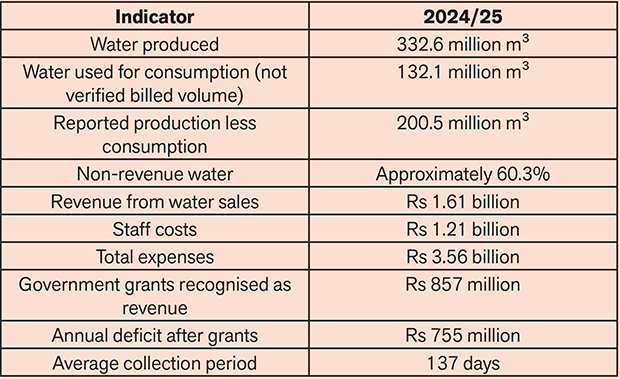
Three facts deserve attention.
First, revenue from water sales covers less than half the CWA’s reported annual expenditure.
Second, staff costs alone amount to approximately three-quarters of water.
Third, even after recognising Rs 857 million in government grants, the CWA reported a deficit of Rs 755 million. This is smaller than sales revenue, grants and expenses alone would imply, because the CWA also records other income.
The government also injected Rs 700 million of equity in 2023/24. These figures describe an institution heavily dependent on public support. However, an accounting deficit is not the same as a cash operating shortfall: the CWA reported approximately Rs 965 million of net cash inflows from operating activities in 2024/25, while net investing cash outflows were approximately Rs 1.375 billion. These amounts reflect different accounting classifications and must not be conflated.
But financial losses alone do not prove inefficiency. A government may deliberately subsidise water because it considers affordable access a social obligation. The real question is whether public money is financing that obligation efficiently, or whether it is also financing avoidable waste and weak management. At present, the evidence gives us serious reasons to ask that question.
Six litres in ten produce no billing revenue
In 2024/25, the CWA reported producing approximately 332.6 million cubic metres of water, of which 132.1 million cubic metres were used for consumption. The report does not establish that this entire 132.1 million cubic metres was billed; it should therefore not be described unreservedly as billed volume.
The reported difference was 200.5 million cubic metres, approximately 60.3% of production. This is known as non-revenue water. It is important to understand what this figure means. Not all non-revenue water disappears through leaking pipes. Some is physically lost through leaks in mains, reservoirs and service connections. Some reaches consumers but is not properly measured or billed because of faulty meters, illegal connections or administrative weaknesses.
Some may be legitimately supplied without charge. These are different problems requiring different solutions. Repairing a leaking pipe saves water. Replacing a faulty meter may increase revenue without saving water. Correcting an inaccurate customer register may improve billing without changing either production or consumption. The CWA must therefore publish not only the total percentage of non-revenue water, but also its composition.
We cannot manage what we do not measure accurately. The National Audit Office reported that water losses had not improved between 2024 and 2025, notwithstanding substantial expenditure on pipe replacement. This is troubling. It does not necessarily mean the investment achieved nothing. Without those works, losses might have increased further. Some projects may also have improved service in particular areas.
But it does mean that the public deserves a proper accounting of what was spent, what was delivered and what measurable improvements resulted. Every major pipe-replacement programme should report its cost, the network rehabilitated, the water saved and the improvement in reliability.
Expenditure is not performance.
What does water really cost?
The CWA’s reported expenditure of Rs 3.56 billion can be expressed in two ways. Divided by the 332.6 million cubic metres produced, it represents approximately Rs 11 per cubic metre. Divided by the 132.1 million cubic metres reported as used for consumption, it represents approximately Rs 27 per cubic metre. This is an illustrative allocation of total expenditure, not a measured unit cost of billed water.
Revenue from water sales divided by the reported 132.1 million cubic metres used for consumption is approximately Rs 12.20 per cubic metre. This ratio should not be labelled an average tariff without verified billed-volume data.
The difference is substantial.
Consider a simple illustration. If the share of production generating billable consumption rose from approximately 40% to 75%, while production and total expenditure remained unchanged, the illustrative expenditure per billable cubic metre would fall from approximately Rs 27 to Rs 14.30. This assumes the additional volume is billable and is not a forecast.
This illustrates the scale of the problem. It is not a forecast of what the CWA could save. If the reduction came mainly from repairing physical leaks, the CWA might produce less water while continuing to serve the same customers. It would save some treatment and pumping costs, and the country would gain water security, but sales revenue might not rise substantially.
If the reduction came from identifying consumption that is already taking place but is not billed, revenue could increase without any additional water being produced. The financial consequences are very different.
Furthermore, repairing leaks requires investment, and not every additional rupee spent on reducing leakage will produce an equal benefit. The objective should therefore be to reduce water losses to an economically justified level, considering the cost of repairs, the value of water saved and the importance of reliable supply.
The CWA needs a credible, independently assessed investment programme, not simply an ambitious percentage target. And Mauritius needs to know the efficient long-term cost of providing reliable water, including the replacement of ageing infrastructure.
That is the cost against which tariffs should ultimately be judged.
Governance comes before trust
The financial problem cannot be separated from governance. The National Audit Office qualified the CWA’s accounts in both 2023/24 and 2024/25.
In 2023/24, it identified 34 contracts totalling Rs 289 million that had been divided into amounts below the Rs 10 million tender threshold. It also reported 477 contracts worth Rs 258 million awarded to one company under bidding arrangements allowing fewer than seven days.
In 2024/25, the auditor identified pipe-replacement contracts worth Rs 1.74 billion against an approved project value of Rs 1.20 billion. The CWA chairperson has also referred to an enquiry by the Financial Crimes Commission concerning pipe-laying works. An enquiry is not a finding of guilt, and the proper authorities must be allowed to complete their work. Nevertheless, the audit findings raise serious questions about procurement discipline, project control and value for money.
The CWA also takes too long to collect what it bills. Its reported average collection period increased from 97 days in 2018/19 to 137 days in 2024/25. The report also discloses a current ratio of 0.17 and a liquidity ratio of 0.05 in 2024/25, highlighting the importance of cash management.
The delays in producing audited accounts are another concern. The public should not be asked to finance higher expenditure without being able to see how its money is managed. But accountability cannot consist only of investigating past failures. It must change how future decisions are made.
The CWA should publish audited accounts on time, subject major contracts to transparent competitive procurement, report the results of infrastructure projects and establish measurable service standards. Management should be held accountable for delivery.
Cheap water is not necessarily fair water
Mauritius has kept water tariffs unchanged since 2012, according to the tariff history cited in the CWA’s reports.
Over that period, costs have changed. A frozen tariff may appear to protect households, but its benefits are not distributed equally. A small household using water carefully receives a relatively modest benefit from low tariffs. A large property with extensive gardens and a swimming pool may receive a much larger benefit because it consumes more water.
If the tariff is below the efficient cost of supply, part of that consumption is effectively subsidised by taxpayers or by other consumers. This is not necessarily the best use of scarce public money. The existing policy of providing the first 6 cubic metres of monthly consumption free to qualifying small users is worth preserving as a basic protection. The CWA reports that an average of approximately 78,000 eligible domestic consumers benefited in 2024/25, with exemptions from water charges and meter rental totalling Rs 45 million (Rs 41 million in 2023/24).
But low consumption does not always mean low income. A wealthy person living alone may use less than 6 cubic metres. A low-income family with several children may use considerably more. A fair system must therefore consider household circumstances, not consumption alone.
The proposed increase in tariffs for businesses while leaving household tariffs unchanged also deserves scrutiny.
Businesses create employment, provide essential services and compete in domestic and export markets. Some depend heavily on water. Loading the cost of an inefficient utility onto businesses may ultimately affect prices, jobs and investment.
There is a stronger alternative.
Set tariffs according to the efficient cost of service, protect essential household consumption and provide targeted assistance to those who cannot afford the full cost. The subsidy should follow the household that needs help, rather than being hidden indiscriminately in the price of every cubic metre.
Water security is bigger than the CWA’s deficit
Even a financially sound water authority cannot guarantee uninterrupted supply if the country lacks sufficient water resources, storage and distribution capacity. Mauritius faces pressures from changing rainfall patterns, growing urban development, tourism, agriculture and industrial activity.
The challenge is therefore not simply to balance the CWA’s accounts. It is to ensure that Mauritius has enough reliable water to support its people and its economic development. That requires examining how much water the country can sustainably collect, store, treat and distribute.
It also requires evaluating the economic merits of additional storage, wastewater reuse, rainwater harvesting, better demand management and, where justified, alternative sources of supply.
Not every option will be economical. Some will require significant capital and energy. The choices should be based on transparent comparisons of costs, benefits and environmental consequences. Water is a strategic national resource.
A country planning for long-term economic development cannot treat it merely as another utility bill.
A reform that can work
Mauritius needs a new settlement between the government, the CWA and consumers. It should rest on seven commitments.
First, establish the facts. Commission an independent assessment of the CWA’s water balance, separating physical losses, commercial losses and authorised unbilled consumption. Publish the findings and set realistic annual targets for improvement.
Second, put governance under scrutiny. Require open procurement, proper project appraisal, timely audited accounts and public reporting of results. Every major infrastructure programme should have measurable objectives and independent verification.
Third, establish the efficient cost of water. Determine what a well-managed utility should spend on operations, maintenance, infrastructure renewal and financing. Consumers should not be required to pay for avoidable inefficiency.
Fourth, finance network renewal and performance improvement together. The CWA needs a multi-year investment and financing plan. Government funding, borrowing and tariff revenue should be linked to approved investments and independently monitored results. Reform cannot succeed if the institution is denied the resources needed to deliver it.
Fifth, introduce gradual and fair tariff reform. Move towards the efficient cost of supply through announced adjustments, with independent scrutiny and measurable performance obligations. Failure to meet targets should trigger management accountability and corrective action, rather than automatically depriving essential infrastructure of funding.
Sixth, protect households that need help. Preserve an affordable allowance for essential water needs and introduce targeted credits for eligible lower-income households, taking household circumstances into account. Higher consumption should face an appropriate price signal, especially when water is scarce.
Seventh, create independent economic regulation. An independent regulator should oversee efficient costs, tariffs, service quality, investment commitments and consumer protection. Extending the existing utility-regulation framework to water is one option, subject to the necessary legal and institutional arrangements.
These commitments must form one coherent programme. Tariff increases without efficiency reform would reward poor performance. Efficiency targets without financing would be unrealistic. Investment without procurement discipline would risk repeating past mistakes. And cost recovery without household protection would be socially unacceptable. Mauritius needs all four elements: efficiency, financing, accountability and fairness.
The objections are legitimate
Some will argue that water is a fundamental right and should never be priced at its full cost. Access to sufficient safe water is indeed essential. But that does not mean every cubic metre consumed by every household should receive the same subsidy.
The right to water is best protected by ensuring reliable access and helping those who cannot afford essential consumption. Others will say the CWA must first repair its leaks before tariffs are increased. They are right to demand results before accepting additional financial burdens. But repairing the network itself requires money. The answer is to make funding conditional on an independently approved programme, transparent procurement and measurable accountability. It is not to postpone investment until the problem has somehow solved itself.
A third objection concerns timing. Households are already facing pressure on their budgets. Businesses face rising costs and uncertain conditions. A poorly designed tariff increase would add to these pressures. That is precisely why reform should be gradual, announced in advance and accompanied by targeted household assistance.
The cost of doing nothing is also real. It appears in unreliable supply, repeated repairs, growing financial obligations and the investment the country may eventually have to make under more difficult circumstances.
The choice before Mauritius
The question is not simply whether water tariffs should rise. It is whether Mauritius is prepared to replace a system of hidden subsidies, weak accountability and repeated financial support with one that delivers reliable water at an efficient and transparent cost.
The CWA must earn public confidence through better performance. Government must be clear about what it is subsidising and why. Consumers must understand what they are paying for, while vulnerable households must be protected.
And the country must invest in the water infrastructure that its future requires. Mauritians should not pay more to preserve inefficiency. But neither should Mauritius sacrifice its water future by refusing to finance efficiency.
That is the balance a serious reform must achieve.
Five questions for Mauritius
1. Should any tariff increase be conditional on the CWA first publishing independently verified figures on water losses, even if that delays investment?
2. Should future tariff adjustments be based on the efficient cost of supplying reliable water, with clear and enforceable performance obligations?
3. Would you accept a higher price for water used above an essential allowance, if households in need received a credit to cover it?
4. Should Mauritius establish independent economic regulation of water tariffs, investment and service quality?
5. Should water security become a central pillar of the country’s long-term economic development strategy?
Part II/III turns to electricity, where the challenge is not leaking pipes but the cost of generation, fuel dependence and the financing of a more resilient energy system.
Publicité
Publicité
Les plus récents