Publicité
Top 100 Companies 2026 edition [Foreword]
The world is on a slippery slope….. And we are slipping with it !
Par

Partager cet article
Top 100 Companies 2026 edition [Foreword]
The world is on a slippery slope….. And we are slipping with it !
If last year’s world economic story was dominated by Trump and his tariffs, this year’s was dominated by … Trump yet again! We do not seem to be able to escape this guy! Who , as a narcissist, simply loves that fact! This time he trod into our lives, mainly through war initiatives and his inability to discontinue a war that he had said he would be able to stop ‘within 24 hours’ as soon as he stepped into office in January 2025.
“Fighting for peace is like screwing for virginity”
George Carlin – comedian
Donald John Trump had high hopes of a Nobel peace prize in 2025 and for months repeated that he had personally stopped 6, 7 or even 8 wars which surely qualified him for what, to his eyes, was the ultimate accolade, seeing that his nemesis, Barack Obama, had been awarded that Nobel in 2009. Within the list of wars he had ‘stopped ‘, he submitted his Israel/Hamas peace plan (including an acclaimed hostage return chapter)- though Israel military operations have proceeded unabated since …; the Israel/Iran ceasefire of June 2025 - though this actually followed 12 days of ‘obliteration ‘ of Iran’s nuclear resources by Israel and the US and was shattered by new joint strikes in February 2026, and an India/Pakistan border clash - which India said was resolved bilaterally, instead of by Trump himself, as proclaimed by Trump and Pakistan separately. More minor conflicts involved Rwanda/ DRC - where a peace agreement was indeed signed but to little tangible effect and a border skirmish between Thailand and Cambodia – this one looking resolved, tariffs helping along the way, though with flare ups like in December 2025. Armenia/Azerbaijan, Egypt/Ethiopia and Serbia/Kosovo resolved no actual wars, rather relieving mere regional tensions ….
Having missed out on the Nobel Peace Prize, though he did receive a fully dedicated one from FIFA, mind you …; the US president slipped into war mode. The department of defence thus became that of War and DEI thinking was expunged from the Pentagon to make room for a hyper-masculine, testosterone-tested, lethal warrior ethos. Those driving suspicious boats in the Caribbean were just declared ‘combatants’ instead of potential ‘smugglers’ and wiped out, Venezuela, a sovereign if roguish country, was lifted of its dictator, Maduro and Iran was heavily attacked in tandem with Israel, even though its nuclear capabilities had officially been obliterated back in June 2025. The most consequential war was obviously the one with Iran, with Israel spilling over in southern Lebanon, even Syria, strangling Gaza and giving free rein to right wing citizens to occupy the west bank more massively, even if illegally and the USA apparently destroying Iran’s military might with an initial 40- day bombardment. The problem though was that Iran was not totally defanged, and refused to keel over, even though its leadership was ‘obliterated’ twice over …...
“All murderers are punished, unless they kill in large numbers and to the sound of trumpets”
Voltaire
The beheaded, but not headless Iranian regime, thus attacked American allies in the middle east, in Saudi Arabia, in UAE, in Kuwait, in Bahrein, in Qatar. It pummelled American bases where it could, severely damaging some. It shut the strait of Hormuz and must have had a hand at encouraging the Houthis to menace the Red Sea entrance at Bab el Manded. Its Iraqi affiliates got at least a wink, if not a nod, of approval to launch missiles on Saudi’s main pipeline …
The main consequence, 8 months down the line, was that the US was trapped and that the world suffered major hikes in petrol, gas, freight, fertiliser and other prices which are hurting everybody, worldwide, including Trump himself and his political party in the USA. As the Economist would ably put it, this inevitably reminds us of the words ‘hoisted’ and ‘pétard’….!
The consequence is that the rumblings planet-wise, have been gradually building up on the questions of prices, purchasing powers and affordability, spilling over into major protests and riots, with ‘prices at the pump’ at the leading edge.
The negative economic consequences are real for everyone, except for billionaires who are making even more money than before, thanks to classic profiteering in tougher times, super tax breaks in the US, dynamic stock exchange prices and windfall profits of all kinds. But before we take this as a clarion call for clobbering billionaires, let us also face the sobering thought that if we did indeed end up distributing every single cent of the fortunes of 20.1 trillion dollars held by world billionaires in 2026, to the 8.33 billion humans on the planet, each individual would get a once -only amount of … $ 2,413 ( Rs 115,800). Quite pertinently too, billionaires’ fortunes are largely tied to shares and stocks, factories and property which are all likely to tank in value if realised simultaneously and turned into cash. Besides which, government treasuries, being under pressure as they are, would surely fill their pockets first, through direct taxes, pushing fortunes away to ‘safer havens ‘in the process (*)?
“The trouble with retirement is that, then, you can never get a day off therefrom” Abe Lemons.
Ed.Note: Generally true , but not always , though…
Locally, the current government’s second budget started out with a courageous bang and on the basis of the well-researched Prayag report, came up with further reforms to the Basic Retirement Pensions (BRP) menace to public finance. Underlining the criticality of an ageing population and that the non-contributory BRP ,which is all funded by the central government, had already reached close to 25% of expenditure in 2024/25 and that it already represented more than the budgets for education , health and social housing put together; the last budget introduced means testing , confirmed the full retirement age at 65 , introduced the NPPF as a successor scheme to the funded NPF, announced that it will eventually subsume the PRGF and the NSF and hinted at higher contribution rates as from 1st July 2027. A Pensions Regulator was to be entrusted with the mission of finalising the obviously prickly details ….
Government stated, to its credit, it had the responsibility of protecting the public purse and ensuring inter-generational fairness and that it would not shirk from its responsibilities. In the event, having had the initial courage to tackle the insatiable BRP Taotie, the government gave ground. First, through proclaimed ‘compassion ‘, by not endorsing the recommendation, already widely applying worldwide, to disqualify working people from getting the BRP; freshly renamed SAP. Secondly by backtracking on the ‘means test’, mainly under pressure from public sector retirees. This left a Rs 6.3 billion hole in this year’s budget which government undertook to plug ‘soon’. This was not the only punched hole in government finances as the mercurial Trump contradicted his official government’s approval of the Chagos deal, leading to another Rs 10.6 billion becoming an unlikely revenue in this current fiscal year.
“The first lesson of economics is scarcity: there is never enough of anything to fully satisfy all those who want it. The first lesson of politics is, too often, to disregard the first lesson of economics”
Thomas Sowell
Government may not have been proactive enough but it has also not been lucky. It could not reasonably deliver on electoral promises of lowering electricity and petrol prices because of inherited financial problems being revealed much larger by the State of the Economy report and, additionally, in spite of a reasonable first economic year (lower inflation than over 2022/24, consolidated forex reserves, lower unemployment, strong tourism and financial sectors, …), the spill – over of wars is now slapping Mauritius right in the face. The pensions issue simply had to be tackled after years of kicking the can down the road and years of irresponsible, often election -fuelled, increases to it, in a doomed attempt at cushioning the 46% erosion of the rupee between 2014 and 2024. Indeed, just as a reminder, in this world of shorter and shorter memories; BRP pensions increased by 70% between 2014 and 2019 and more than doubled again over the 4 years to 2024. So much so that by the 2024/25 budget, the last from the outgoing government, social benefits had grown to represent more than 3 times the capital budget, almost twice civil service salaries and fully 52% of tax receipts that year! With an ageing population, that was a sure recipe for disaster that HAD to be tackled. But predictably, if surely not rationally, this has created bitterness and fuelled opposition. World instability, wars, climate change, AI will all make the road ahead even bumpier. Will fortune eventually reward the brave?
This year’s TOP 100 is a real mixed bag. As indicated by the main table in this Foreword, our sample shows that total Turn Over, comparing like with like, did not progress year on year. This must be concerning as the rupee is still losing value, albeit at a slower pace: 7.5% v/s the dollar since January 2024 and 1.7% since January 2025 and 2.6% since January 2026.
To widen the base of analysis, three new sectors have been added for the first time: property developers, malls and accounting firms.
The Hotel sector had a nominally respectable year. Tourists numbers and spending totals improved but the sector’s turnover stalled and indeed regressed by some Rs 3 billion which, fortunately, did not prevent profits from increasing by the same amount. This suggests that bottom end deals chasing volume were less favoured. It may also indicate that more tourists favoured private bungalows, Air BnB and others, as those markets professionalise and mature. It is also of note that 10 of the latest sample of 40 hotels are loss making, including five which are clocking turnovers of more than Rs 1 billion annually; all P&Ls not being at the same date, unfortunately. As an economic pillar of the economy , it is important to understand why …
“Geography has made us neighbours. History has made us friends. Economics has made us partners and necessity has made us allies. Those whom God has so joined together, let no man put asunder”
John F Kennedy
2026 - Consolidated, selected sectoral figures ( Rs million )
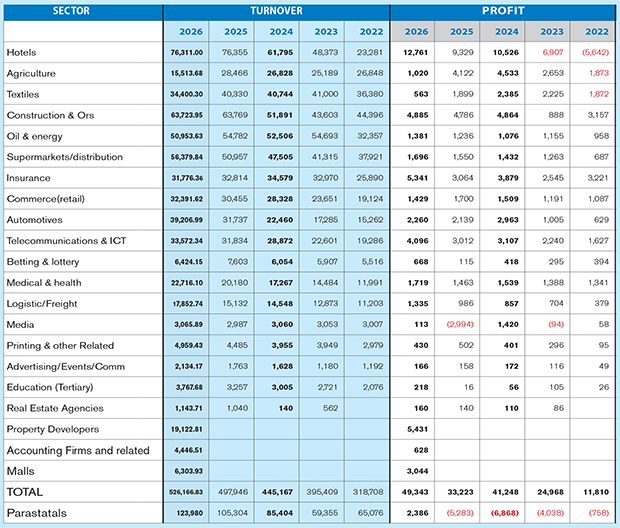
As to the Textile sector, the long slow decline is being confirmed. Turnover and profits are down, in large part because CMT, a long-time leading light of the sector, has been set aside of our sample, as it has not published official results since July 2023 and would not respond to our solicitations. After the closure of Star Knitwear and, more recently, World Knits, the prospects are not looking good. Further, our table indicates that the number of loss-making textile operations in our sample of 38 has tripled to 9 yoy. When put in perspective, if our imports do indeed show up at Rs 325 Bn in 2026 (BoM Statistical Bulletin), the expected Rs 110 Bn worth of total goods exports would become even more worrisome if textile exports keep being eroded. It may also be useful to indicate, extrapolating from the latest Analyst meeting presentation, that the sector’s leader Ciel Textile’s Rs 16.4 Bn turnover and profits are largely anchored on Indian, woven shirts operations. Trump’s tariffs have not helped. AGOA’s renewal may just about keep the ventilator working? Is anyone looking at this challenge?
The Construction & materials sector did not progress, either turnover or profit wise. Thirteen reporting companies out of our sample of 73 posted losses this year which is concerning. The leader of the pack, UBP improved its profitability, but Gamma Construction went the other way. DLB group’s very impressive results last year (Rs 838.1 million PBT. Special contracts? NSLD ?) could not be repeated this year which showed up at a surplus of Rs 97 million only, in the wake of a halving of its turnover. Larsen n Toubro showed up with the best profit of the sector, realising Rs 796.3 m on a turnover of Rs 1,303 m, after another Rs 707m last year on a T/O of Rs 1,929 m. Some have it good!
The Oil & energy sector saw an intuitively surprising drop in T/O of close to Rs 4 Bn, until we remember that the average price per barrel of oil on world markets had dropped fully 10 dollars in 2025 compared to 2024. Engen, which has since sold out to Fill- in, actually lost Rs 31 m to 31/12/2025 and Fill-in will surely look to challenge ‘upstairs’ over the coming years?
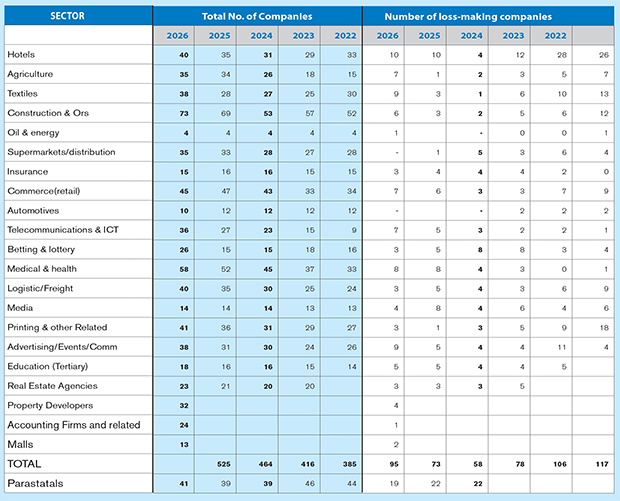
As to the Supermarket/Distribution sector, Turnovers and PBTs both ticked upwards but the sector’s profitability stayed stuck at 3 % on sales, largely pulled down by Pick n Buy’s (Winners) performance which yielded an even smaller profitability of 0.64% only, on improved sales. Is this the ‘best buy ‘in town from a consumer point of view, allowing market penetration or is more management fine tuning required? Udis, (Super U) the challenger increased its T/O by 13.6%, its profits by 19.6% and made a PBT margin on sales of 4.3%. No operation in this sample of 35 made a loss.
“Consumption is the sole end and purpose of all production.”
Adam Smith
Ed. Note : Ideally , production comes first !
There was a fair measure of positive updating of published accounts this year in the Insurance sector, compared to last, when 9 of the 16 insurers of our sample had not published up to date accounts since 2023! This number was reduced to 6 only. The Swan group reclaimed its ‘top of the pile’ position with force, turnover improving by Rs 1 billion and profits before tax more than doubling. SICOM‘s profitability remains a spectacle to behold and further doubled its profits, as did Eagle Insurance, by the way, off the back of increased premiums which will, after the latest budget, now be partly clawed back by taxes in the next financial year ….
J Kalachand remained the overall leader, profit wise and Courts /Mammouth is still the top dog of the Commerce/Retail sector T/O-wise, which is not surprising seeing the former’s still formidable after sales service and the latter’s aggressive and imaginative marketing and advertising campaigns……
In the Automotive sector, the fiscal decisions of last year’s budget had still not bitten into financial results shown in our sample of 10 companies (last year 12), which mostly shows results to June 2025. The Leal group actually improved its T/O over that period by fully Rs 2.6 billion, but profits before tax did not follow at Rs 659 million. Axess challenged strongly improving T/O by Rs 2.3 billion, but could not close the gap on the leader, except on profits which got very close to Leal’s, their respective PBT margin on sales showing up at 7.2% and 4.4%. ABC Motors improved its results very substantially. The sector as a whole registered Rs 7.5 billion more sales year on year, probably helped along by accelerated purchases in June 2025, which attempted (and managed…) to beat the new taxes announced in last year’s budget.
The story did not change in the Telecoms sector, largely dominated by Mauritius Telecom T/O wise but by Emtel in terms of yield on activities. If Mauritius Telecom improved its profits reasonably (by close to Rs 150 million on almost stable T/O), Emtel more than doubled its yearly profits to Rs 1.44 billion, setting its PBT return on sales at a very solid 35.2% compared to Mauritius Telecom’s 11.8%, a situation which was not reflected in its share price.
A word of warning on the figures spelt out for the Betting & lottery segment. There seems to have been some measure of adjustments in this year’s published figures with ‘net’ earnings replacing ‘gross’ earnings in some cases. Besides which the sector sample has widened measurably. Figures are thus not strictly comparable from one year to the next. The sectorial profit improving materially to Rs 668 million is mainly caused by the larger sample size. SIC owned Casinos are still very much in a ditch and as per an advert dated 09/09/2026 are once again up for sale, with PWC’s assistance.
“Our children will either inherit from our imprudence or from our courage”
Anon
The Logistics and Freight section had a good year, T/O progressing by 16.2% and PBT following suit with a strong 35.4% progression. Velogic, having consolidated its operations by taking over Mc Easy Freight, is ever more in the lead, accounting for 22.4% of the sector’s consolidated T/O, though its PBT on sales is not the strongest. The segment is highly diversified, our sample identifying 40 players in all, all profitable bar three exceptions.
The Health sector is this year illustrating the pains of newcomers as they seek to find their feet. Artemis Curepipe, Life Together, Royal Green and Medi Six (Premium Care) are all posting hefty losses, possibly fuelled by first year’ depreciation rates and their first priority will surely be to seek a cash positive anchor point. The new competition, as predicted, should help stabilise pricing down at lower levels. Meanwhile CIEL Healthcare consolidated its position at the very top, brushing against a Rs 7 billion T/O and improving profits yoy by 27.5%.
In a hotch potch of results in the Media sector, MBC turned in a surprising profit to June’25 , but only by selling its historical shares in Canal + which itself posted a loss of Rs 169 m, la Sentinelle lost Rs 16m to June ’26, whilst Mediacom declared a Rs 66 m profit .
Caractere Ltée is still dominating the Printing/ Packaging sector whose sample expanded from 35 to 41 companies, shows very little red ink and is progressing steadily, even expanding overseas. The talk of the town was the potential take-over of Dakri Cartons but it has not materialised this far. Circus Advertising improved both T/O and profits yoy and stayed on top of the pile in the Advertising /Events/Comm sector., though Touchpoint closed the gap somewhat, at the expense of profits. Last year’s remarks remain though. It is a pity that the Javed Vayid group did not seem to update its 31/12/2024 figures ….In the Tertiary Education ‘hub’, the University of Mauritius posted quite a swing from a Rs 111 m loss to June 2023 to a Rs 67 m surplus to June 2025. Its annual report to June 2025 was 396 pages long and looked both exhaustive and exhausting …Increased government grants (+ Rs 198 m) did the trick, though academic fees also increased substantially (+Rs 82.5m, +49% yoy). Middlesex and Charles Telfair did good business, generating meaningful profits. Polytechnics (Mtius) did not. Sotheby’s looks to have found better ways of conjuring profits than Pam Golding this year, though the latter is still the leader amongst Estate agents T/O wise. Sotheby’s also showed the largest T/O progress yoy (+ Rs 48m), followed by Colbert properties (+Rs 40m) and Barnes (+ Rs 34m).
You would expect Accountants and financial advisors to be doing their sums right, right? You would not be wrong, this new segment to our analysis is doing fine led by, in order, the local ‘big five ‘of PWC, EY, BDO, Grant Thornton and KPMG, all doing fine financially. A second new segment brought onboard is that of Property developers, all doing quite well too, though there are obvious peaks and troughs to be expected here, as particular projects need to be funded until sales can be fully realised. In this business, time is the mortal enemy and delays on planning charts play havoc on cash flows in an environment of rising costs. If the product cannot find buyers, it gets worse of course. If bankers get impatient, you die. Like in Evaco’s case, put in receivership in May 2026; the original trigger being a payment claim from Silver bank, to whom Evaco owed Rs 276 m. But then things got even worse as the behemoth project of Cap Marina faced slipping construction deadlines, rising building costs, and delivery delays for title deeds which slowed final encashments. By the time of the receivership, Evaco owed Rs 2,5 billion of direct debt to its main banker SBM, which may potentially be also heavily entangled in VEFA/GFA completion guarantees of up to Rs 2 billion more. Bluelife leads the pack here, only just, on T/O. The figures for Landscope and Alteo probably require contextualizing.
“Hope is being able to see that there is light, despite all the darkness”
Desmond Tutu
As for Shopping Malls, reflecting, no doubt, Mauritian citizens’ far reaching love affair with them; they are doing well, though IFRS requirements on revaluations probably do account for substantial parts of their apparent profitability. The country seems to be building even more of them, which certainly poses the question of eventual saturation and the gutting of inner cities of their traditional shops and stores grids.
As to Banking, nobody needs to worry about them too much for now, as they all look to be doing well, which is indeed fortunate for themselves, their depositors, the country and government’s treasury. But , lest we forget, banks need healthy customers to ensure their own health…. After the staggering repeat scenario of Silver Bank (which fortunately was quite small by the sector’s standards, though its consolidated losses, expected at some Rs 8/9 billion will be the largest ever locally, corporate-wise), who in his right mind might be rooting for a weakening sector, a more problematic portfolio, and lesser profits which would make for weaker provisioning of systemic risk? Surely not anybody wishing us away from debacles like those of Credit Suisse (2023), Lehman Bros (2008) or Metropolitan (2026)? Besides, when some dribble over billion strong profits which look oppressive to them, they should do well to remember that these are proportionate to the size of the risks taken on a balance sheet AND that today’s larger banks are earning far more overseas than locally- thus bringing in very useful (and relatively rare…) forex! Anyway, our sampled banks can hardly be labelled ‘abusive ‘with returns on balance sheet assets of between 2% and 3% for the top 10 ranked; with the exceptions of SBM Holdings (1.2%), HSBC (3.2%), Maubank (1.7%) and Bank One (0.8%). Banking is also a size game like in most sectors, until disruptive innovation challenges the established environment …. Crypto? Fintech ? I would be surprised ! Meanwhile, government is taxing banks at 35% (overseas profits at the rate of 22%!), which cannot reasonably last too long, if they are to stay competitive, especially on world markets.
Parastatals are a mixed bag. But in the current debt/ deficit situation, government simply cannot, any more, afford to tolerate the toxic mix of late financial reporting and losses piling up at taxpayers’ expense! Kudos go to FSC, MPA, MRA, RDA, CWA, CSFPSB, UoM, ICTA, CEB, Competition Commission, NPCC, MQA, MREA if only for timely reporting. A loss of Rs 407 m at MRA looks bizarre (prescribed CSG payments?). The loss of Rs 755 m at CWA looks frightening, as does that of Rs 416 m at the Waste Water Management Authority. What could possibly create a Rs 287m loss at the Mauritius Cane Industry Authority, on T/O of … Rs 114 m as at June 2023 will eventually have to be explained? Parastatals do not cover the full range of government’s potential headaches, though. Think MIC, MK, Metro, Safe City, Silver Bank, for example… Government ( Our !) finances breathe better when STC generates surpluses (+Rs 1.75 bn to June ’24, but with no updates available since…), just like CEB ( +Rs 439 m to June ’25), FSC ( +Rs 1.331 bn, june’25) , the Mauritius Ports Authority ( +Rs 630 m, June ‘25) or the SIFB (+Rs 775m to June ’24) . As a result, the number of loss-making parastatals improved slightly yoy.
“There is good in this world and it is always worth fighting for” JRR Tolkien, especially since “All it takes for the triumph of evil is for good men to do nothing”
as per an african proverb
Last year’s Foreword concluded on a rather pessimistic paragraph, underlining how unpredictable and disrupted the world had already become. This year, matters have not improved, unfortunately. Wars in Iran, in the middle east, in Ukraine, in Sudan, in Lebanon, in the West Bank and Gaza, in Myanmar, in Congo, in Ethiopia, in Yemen are peppering our lives in various ways. Internal violence is regular in Mexico, in Nigeria, in Syria and other places . Popular protests against various aspects of current living standards and challenges to governmental credibility have crystallised in France, in Greece, in India, in Italy, in Portugal, in Albania, in Russia, in Serbia, …and Mauritius , this October alone … Besides, water stress ( both droughts and floods ), a warming planet( with the further ‘hoax’ of El Nino yet to come …), AI challenges ( financial, social , democratic, fake news and otherwise), Trump’s unusually negative initiatives and Ebola; are all yet to spread their dark wings in full .
The world is on a slippery slope. And we are slipping with it …. And this will be especially so, if instead of fighting back in solidarity, we choose, instead, to bicker and scapegoat one another and insult, or migrate (where is it less challenging ?) or indeed switch off!
In these difficult times, leaders must lead better, for sure, but everyone else must also deliver on that little fleck of responsibility that he has been entrusted with!
Or we might all be walking the plank before long, having helped soap it first …
(*) YouTube l Britain’s Great Wealth Dilemma
(Completed on the 26th october 2026)
Publicité
Publicité
Les plus récents