Publicité
Portrait
Mahen “Horloger” : A lifetime spent repairing time
Par

Partager cet article
Portrait
Mahen “Horloger” : A lifetime spent repairing time
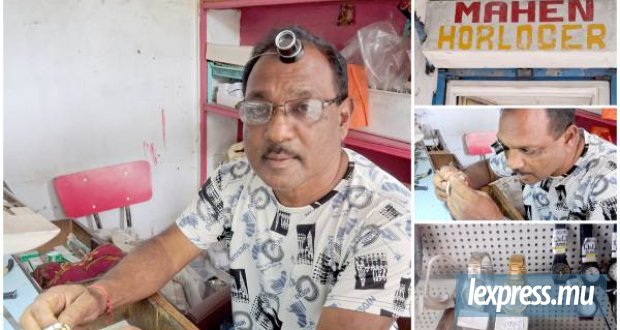
In the warm, busy streets of Rivière-du-Rempart, a craftsman continues to keep time alive
There are people whose professions are easily recognised by the tools they use, the places where they work or the services they provide. And then there are those whose identity becomes inseparable from their profession. In the village of Rivière-du-Rempart, one such person is Mahen Balgobin, affectionately and popularly known as Mahen Horloger. I met him in his modest workshop, surrounded by watches, clocks, tiny mechanical components and the instruments of a trade that demands extraordinary patience, concentration and precision. He is commonly referred to as a watchmaker, although, strictly speaking, he is a watch repairer. But perhaps the distinction matters less to his numerous customers, who know that when their watches stop working, Mahen is the person to visit.
His story is one of perseverance, professional commitment and the determination to make a living through a skill acquired with his own hands. Mahen’s educational journey began at Belle-Vue-Maurel Government School, continued at Krishnanand College in Rivière-du-Rempart and took him to Form IV at Eastern College, now known as Professor Basdeo Bissoondoyal College. Yet, at a relatively young age, he decided that the conventional classroom was not necessarily where his future lay. He wanted to learn a trade, acquire practical skills, and become independent. Rather than continue along an academic path, he made a courageous decision: to become an apprentice to Mr Koonja, a well-known watch repairer in Centre-de-Flacq.
That decision would shape the rest of his working life. Apprenticeship was not simply about learning how to open a watch, replace a damaged component or restore a mechanism to working order. It required discipline, observation, dexterity and, above all, patience. A watch is a fascinating instrument, but it is also a demanding one. Its components are often so small that the slightest mistake can affect the entire mechanism. Mahen spent two and a half years learning the trade under the guidance of his mentor. It was a period of practical education, during which he gradually developed the confidence and technical ability that would later allow him to establish himself professionally.
After completing his apprenticeship, Mahen applied for and obtained employment at a watch factory in Terre-Rouge. There, from 1984 to 1993, he worked assembling watch components imported from Europe, with the finished products destined for foreign markets. It was an important chapter in his professional development. Working in a factory exposed him to organised production processes and the assembly of watches on a larger scale. Every component had its place; every operation required accuracy. The experience strengthened his understanding of the intricate relationship between the different parts that make a watch function.
His daily routine was not an easy one. He travelled from his village of Belle-Vue-Maurel to Terre-Rouge and back, maintaining his employment while gradually developing his own clientele. But Mahen was not content to depend on his factory salary alone. During weekends, he devoted time to his personal workshop, repairing watches and clocks for customers. It was a demanding arrangement, requiring him to divide his time between factory work and his growing private activity. Yet it was also an investment in his future. He was building something of his own, one customer at a time.
Word of his competence spread beyond his immediate neighbourhood. His clientele gradually extended to places as far as Phoenix and Britannia. Such a network does not develop overnight. It is built through trust, reliability and the satisfaction of customers who return and recommend a service to others. In a profession where people entrust someone with objects that may have sentimental as well as financial value, confidence is essential. A watch may be an ordinary accessory to some, but to another person it may be a gift from a parent, a wedding present or a treasured possession carried for decades. Mahen’s workshop became a place where such objects could be given a second chance.
The trade itself has undergone considerable transformation over the years. Mahen recalls the watches of the 1970s and 1980s, when mechanical timepieces were much more common. Some operated through a key and a spring mechanism that had to be wound to keep the watch running. Once properly wound, the mechanism could keep showing the time for at least a day. These watches required an intimate understanding of their internal workings. The repairer had to examine the mechanism, identify the fault and work carefully on its many small components.
Then came automatic watches, followed by quartz technology and the various analogue watches that became increasingly common in the market. The evolution of watchmaking and watch repair brought new challenges and required practitioners to adapt. The traditional mechanical watch, with its intricate gears and springs, gave way in many instances to different technologies and mechanisms. The repairer’s knowledge could no longer remain static. Like every other profession affected by technological change, watch repair demanded continuous learning and adaptation.
Yet, despite these changes, the essential character of the work remains remarkably similar. A watch repairer must be observant, meticulous and patient. Mahen describes his work as very time-consuming, and the expression is particularly appropriate. While most people consult their watches to know what time it is, he spends hours examining the very instruments that measure it. He has to concentrate on details that others may never notice: a tiny component out of place, a mechanism that no longer responds, or a battery that needs replacing. Sometimes the problem is immediately apparent; at other times, it requires a prolonged examination. It is almost like a specialist doctor looking into the human body to identify the source of an illness. Mahen, too, has to look into the womb of a watch or clock, searching for the cause of its malfunction.
His workshop is therefore more than a commercial space. It is a place where technical knowledge, experience and human relationships meet. Customers come with their stopped watches, their clocks that have lost their rhythm and their questions about whether an old timepiece can be repaired. Some come for a new battery; others require more complicated attention. The work may appear repetitive from the outside, but every watch presents its own problem. There is no substitute for experience, and there is no shortcut to the patience required to do the job properly.
But time, as Mahen knows better than most, does not stand still. After years of dedication to his trade, he is conscious that the moment has come to pass on the torch. His son, Aman, is gradually being introduced to the profession. Still a very young man, Aman represents the possibility of continuity: the transmission of a craft from one generation to another. It is a welcome development at a time when many traditional trades are at risk of disappearing because younger generations are attracted to different professions and new career opportunities.
The father-to-son succession is more than a matter of preserving a family activity. It is also about transferring knowledge that cannot be acquired entirely from books or digital instructions. The feel of a tool in one’s hand, the ability to recognise a mechanical problem, the patience to dismantle and reassemble a tiny mechanism, and the confidence that comes from years of practice are all part of an apprenticeship. Aman will have to develop his own experience and earn the confidence of customers, but he has the advantage of learning from someone who has spent much of his life in the profession.
There will always be clocks, large and small, that need attention. There will be batteries to replace and sell, watches to examine and customers seeking advice. Technology may continue to transform the instruments through which we measure time, but the human need to repair, maintain and preserve them will not necessarily disappear. In that sense, Mahen and Aman are not merely watch repairers. They are custodians of a modest but valuable craft, keeping alive a service that has accompanied generations of Mauritian families.
During our conversation, I was particularly struck by Mahen’s reflections on time itself. What is time, I wondered, to someone who has spent so many years repairing the instruments that measure it? His answer was simple but profound: “Time is life.” Life goes on meaningfully, he explained, and time also goes on meaningfully, depending on one’s vision and mission. It is not simply the ticking of a clock or the movement of hands across a dial. Time acquires meaning through what we do with it, the purpose we give to our lives and the contribution we make to others.
Mahen also made reference to events taking place in the world today, suggesting that many of them had already been predicted in religious scriptures. He cited passages and ideas that, unfortunately, I could not fully grasp during our conversation. Nevertheless, his reflections revealed another dimension of the man behind the workshop: someone who looks beyond the technicalities of his profession and tries to understand the larger questions of human existence. His philosophy may not be expressed in elaborate academic language, but it carries the simplicity of someone who has spent years observing life, people and the passage of time.
As I left his workshop, I could not help thinking about the irony of his profession. Mahen and Aman spend their days looking closely at watches and clocks, repairing their mechanisms and restoring their ability to tell the time. They are, in a sense, time watchers. Yet, absorbed in their work, they may hardly notice time passing around them. The hands of the clock continue to move, the seasons change, customers come and go, and one generation prepares to take over from another.
Perhaps that is the real lesson of my encounter with Mahen Horloger. Time is not merely something to be measured, repaired or displayed on a dial. It is something to be lived, shared and given meaning. Mahen has spent decades helping others recover their timepieces; now he is preparing his son to carry the craft into the future. In doing so, he is passing on more than a profession. He is passing on a legacy of hard work, patience and dedication.
I wonder whether I shall return one day to his workshop in the warm and busy streets of Rivière-du-Rempart. Perhaps Aman will then be more firmly established in the trade, and Mahen will be watching proudly as the next generation takes responsibility. Until then, the clocks will keep ticking, the watches will continue to arrive for repair, and life will move forward. Time will tell.
Publicité
Publicité
Les plus récents