Publicité
Indentured heritage
From coolie to citizen: the unfinished journey of coolitude
Par

Partager cet article
Indentured heritage
From coolie to citizen: the unfinished journey of coolitude
From Mauritius to Fiji, Réunion and the Caribbean, a shared history across oceans
During my recent visit to Mauritius, I kept joking with my Mauritian friends that we were probably distant cousins.
After all, our ancestors came from similar parts of India, crossed the oceans and worked on sugar plantations. The only difference, I told them, was that their ancestors caught the earlier boats to Mauritius, while mine missed them, took a later one and ended up all the way in Fiji! We laughed. But behind that joke lies a history that connects us more than we sometimes realise.
Indian indentured labourers began arriving in Mauritius in 1834. Fiji’s first arrived in 1879, some 45 years later. Different ships, different destinations, but much the same uncertainty about what awaited them.
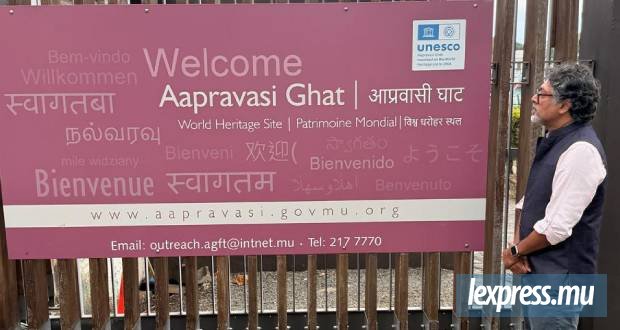
That history came alive for me at Aapravasi Ghat in Port Louis.
I had read about indenture, but seeing the reconstruction of the cramped shipboard conditions and the living quarters was something else. I tried to imagine those men and women leaving their villages, travelling for weeks across the ocean, carrying a few belongings and perhaps believing they would return home one day.
I was fortunate to be in Mauritius on 2 November, Indian Arrival Day. In Fiji, we remember our ancestors on Girmit Day, 14 May. Our dates are different, but our memories are remarkably similar.
Two paintings, two histories
During my stay, I received two gifts that touched me. The Ministry of Labour presented me with a beautiful painting of sugarcane farmers. I immediately thought of my father, who cut cane in Fiji, and my mother, who worked hard on the land. I could almost see the fields of my childhood. For others, it might be a painting of agricultural workers. For me, it was a picture of my family.
I also met Mauritian artist Nalini Treebhoobun, who generously gave me a striking drawing of Le Morne, a place associated with the resistance of enslaved people. Mauritius commemorates the abolition of slavery on 1 February.
Two paintings, two histories, and one powerful reminder: behind the wealth created by colonial plantations were ordinary people whose labour and suffering are too easily forgotten. Slavery and indenture were different systems. We should never confuse them or compete over whose ancestors suffered more. But both deserve to be remembered.
Mauritius has done something remarkable by preserving Le Morne and Aapravasi Ghat as UNESCO World Heritage Sites. They tell different stories, but both belong to the nation.
Cousins across the oceans
Mauritius is not alone in carrying this history. Fiji, Guyana, Trinidad and Tobago, Suriname, South Africa and Réunion all have their own stories of indenture.
Réunion is especially interesting. Just across the water from Mauritius, it developed under French colonial rule, receiving indentured workers from India and elsewhere. Today, their descendants form part of its rich Creole society. Our ancestors brought languages, religions, food, music and traditions. Over generations, these mixed with local cultures and created something new. Yet our countries followed very different paths. Mauritius achieved relative political stability and economic diversification. Fiji experienced coups, ethnic tensions and substantial emigration. Guyana and Trinidad and Tobago faced their own challenges of ethnic politics. Réunion became a French overseas department. Indian communities in South Africa endured apartheid.
We may be distant cousins, but our experiences of citizenship and belonging have not always been the same. Trinidad and Tobago’s Prime Minister, Kamla Persad-Bissessar, recently spoke of a little “coolie girl” becoming Prime Minister. I found that very moving.
A word once used to humiliate our ancestors was being reclaimed with pride. But the journey from coolie to citizen cannot be measured simply by how many descendants become presidents or prime ministers. It must also be measured by how ordinary people live.
That is why the Mauritian poet Khal Torabully’s idea of Coolitude matters. It is about dignity, cultural encounters and recognising the humanity that connects us.
They had no choice
Last year, while attending a conference in London, I walked through Hyde Park and came across the Animals in War Memorial. It honours the animals that served and died alongside British and Allied forces. I remember being struck by four simple words inscribed on the memorial: “They had no choice.” I found it moving. Those animals deserved remembrance. But standing at Aapravasi Ghat, I remembered that memorial and found myself asking another question.
What about the hundreds of thousands of indentured labourers who crossed oceans to work on British plantations? Many signed contracts, but how meaningful was their choice when poverty, misleading recruitment and unequal power shaped their decisions? Where is their equally prominent place in Britain’s national memory?
This is not to compare human suffering with that of animals. It is to ask why some histories receive public recognition while others remain largely forgotten. France, too, should reflect on its indentured past, particularly in Réunion.
And India? It rightly celebrates its successful diaspora. But what about the ordinary villagers who left, many never to return? Their stories deserve a greater place in Indian schools, museums and national memory. This is not about blaming today’s generations. It is about remembering those whose work helped build other people’s prosperity.
The boats that connect us
Mauritius could lead a global Coolitude network, connecting younger generations across the indentured world through their shared history. I left Mauritius with two beautiful artworks: one recalling my family’s life in Fiji’s sugarcane fields, the other Le Morne and the struggle for freedom.
Both reminded me that history lives in our families, our memories and our shared humanity. Perhaps my ancestors really did miss the earlier boat to Mauritius. But more than a century later, their descendants have found one another. And perhaps that is the real promise of Coolitude: turning a history of separation into a future of connection, dignity and shared humanity.
Publicité
Publicité
Les plus récents