Publicité
Lack of leadership affects good quality of teaching
Par

Partager cet article
Lack of leadership affects good quality of teaching

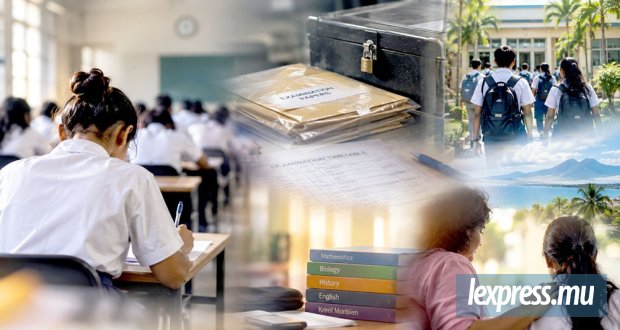
There is growing concern over the quality of performances at the School Certificate (SC) and Higher School Certificate (HSC) levels. The Mauritius Examinations Syndicate (MES) showed anxiety when it examined the detailed results of both exams at the beginning of the year: even though the pass rate is increasing, the grades obtained by pupils are falling. Experts from the Cambridge International Syndicate are expected this month to hold workshops with stakeholders of the sector including rectors and teachers to try and improve the quality of performances.
Prem Burton, a former director of the Private Secondary Schools Association (PSSA), noticed an ?alarming trend? with the informal study he has been conducting with his pupils year after year. This experienced teacher is in the habit of asking the pupils coming to him for private tuition how many written compositions they have been asked to do by their teachers and how many of them have been corrected. The answers are somewhat astonishing. Apart from a few exceptions, they hardly have five or six written compositions to write in English during the whole year. And the situation is no more encouraging for other subjects.
?Very little work is actually done at school,? comments Prem Burton. This is true for all schools including the so-called star-schools according to Prem Burton?s study. Topics are discussed is class throughout the year but no written essay is requested. Although this could easily be imputed to ?lazy teachers?, Prem Burton and Prem Saddul agree on the fact that there is an obvious ?lack of leadership?.
<B>Regular formative feedback</B>
After their training at the Mauritius Institute of Education (MIE), there is no follow-up for teachers when they become responsible for a class and ?they are left on their own?, points out the former PSSA director. There is a profusion of teachers and rectors but ?quantity does not guarantee quality?.
?At a certain time, teachers were trained and then their work had to be closely examined by their rectors and inspectors,? Prem Burton remembers. His colleague, Prem Saddul, a former director of the MIE as well as an ex-officer-in-charge of the PSSA, also thinks, ?It is high time that the role of inspectors and supervisors in our primary and secondary schools be revisited. For me inspectors and supervisors should be pedagogical advisers, facilitators and above all trainers from whom teachers expect regular formative feedback. This should be given urgent attention especially in the context of the implementation of any educational reform?.
The problem seems to be that, when teachers start working in schools, they are caught up in the system, and with no follow-up, they run out of motivation. Faizal Jeeroobarkhan from the Mauritius Institute of Education (MIE) rightly pointed out, ?When teachers go out from the MIE, we hope that they will change the system but we soon realise that the system changes them?.
?There is a lack of inspiration from the leaders,? Prem Burton maintains. If inspectors were coming to classrooms for regular visits and pointing out the strengths and weaknesses of teachers, there is indeed no doubt that the latter would be more determined to achieve success with their pupils. Today, the system only aims at making pupils pass their exams. As a result, many teachers content themselves with doing the minimum ? the more so as they know all pupils will go for private tuition after school (see inset).
<B>Rectors for pedagogical issues</B>
Rectors should also have a major role to play but how can they deal with pedagogical issues if they have to tackle administrative problems as well? For Prem Burton, there is a need to appoint managers who will deal with administrative and maintenance problems, leaving rectors free to deal with pedagogical issues. ?In fact, this is also true for the inspectorate. In the past, there were two types of inspectors who were working hand in hand for the benefit of pupils. The pedagogical inspectors were dealing with academic and teaching issues while supervisors were taking care of the infrastructure, material and equipment to make sure the school could deliver the goods,? he points out suggesting that this model should be re-introduced.
Obviously, in view of the disappointing results of the SC and HSC exams, the present system has proved inefficient. Children are the main losers in this system. A solution must be found so as to completely reform it!
 |
Learning can be fun!
When faced with the declining quality of the SC and HSC results, the MES recommends that teachers make learning more fun by using innovating teaching techniques. The interactive mathematics CD-ROM produced by the Mauritius College of the Air for HSC students is among the tools available to try and make a subject more pleasurable for pupils. It is an initiative that could be used for other subjects. But there are also other more accessible ways of helping the children open up their minds. Listening to or watching the news on radio or television are ways of learning more about one?s own country and building a critical acumen ?that could turn out to be very helpful for the GP papers for instance. Pupils also have to be urged to read more. ?How can we expect a child to speak proper English if he or she is never exposed to the language? Children have to be in touch with the right models if we want them to progress,? Prem Burton concludes.
Private tuition, the ?necessary evil?
The vicious circle of private tuition is more than ever present in schools. As not much is done in class, parents urge their children to go for private tuition. As some teachers know that their pupils are certainly taking private tuition, they do not do much in class. ?There is no doubt that private tuition is a necessary evil today because the school system does not allow the child to acquire the methodology and knowledge in class,? says Prem Burton. They can indeed help the child to obtain better results in the exams if done properly. The main problem is that, sometimes, private tuition is worse than classes in school. ?Private tuition should be the occasion to teach some methodology, encourage research and help pupils individually,? he adds. If this is not the case, then private tuition is absolute nonsense.
Publicité
Publicité
Les plus récents