Publicité
Five from Ebène winning team seek sponsors
Par

Partager cet article
Five from Ebène winning team seek sponsors
The Civic Action Teams (CAT) Convention, organized by the National Productivity and Competitiveness Council (NPCC) has become a regular annual event since 2001. On the 55 schools that registered , only 32 participated and 10 secondary schools presented their projects on a national basis.
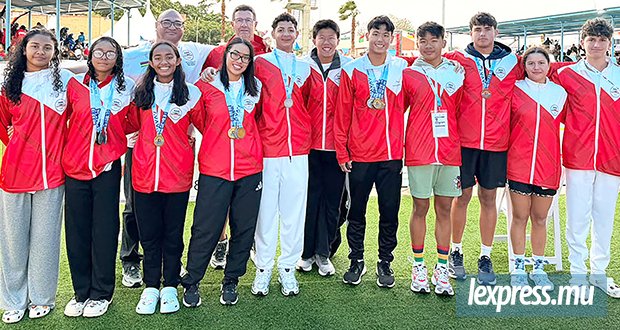
The winning school is Ebene SSS (girls). Vicky Duval, their information and communication technology (ICT)teacher, describes this victory as a reward for all the efforts and commitment the students have shown throughout the competition. She considers their victory as a great achievement on an individual level but also for the college itself. ?We are now going to Lucknow, and the trip has been financed by the NPCC for four girls who already have their tickets. However, we would like the other five students to come with us as the team-spirit is so strong. This is why we would be grateful if those five students could get sponsorship.? Let us hope that some generous donators help these deserving girls.
In fact, the ICT teacher, who also acted as facilitator for the nine girls, believes that the girls have gained a lot in terms of confidence. ?At the beginning of the competition, the girls did not feel confident at all. To be honest, I must say they even felt a kind of inferiority complex in comparison with the participants from ?star schools?. Through the competition, I tried to give them the support they needed and make them believe in themselves.?
The CAT convention has two main aims. First, to make students share experiences and, then, to export solutions from one region or sector to another. In other words, the entrants had to find a problem within their schools, analyse it, solve it and then sustain the solution.
This competition enhances the child?s development in several ways. It can be on the civic basis, as it ?empowers the citizen to act on problems in his immediate environment and it assists in developing a sense of civic responsibility?. It develops the productivity of the child in terms of action as it involves ?implementing solutions to reduce and eliminate Muda. It has a learning-by-doing approach?.
Last, but not least, it helps the child to develop a ?team approach? as each team should have 3 to 15 students. Moreover, the participants are expected to use quality tools such as brainstorming, PDCA, pareto, fishbone and circle of influence.
Ebene SSS produced indeed an unexpected and exciting project. The school found there was a lack of motivation among students, which often led them to feel downgraded. The girls reacted by setting up a laughter therapy club assuming that laughter combats stress. As a result, the name of the project was: ?Unmotivated Students?. There were nine girls in the team and Julie Yee was the leader. ?Despite the fact that I was named leader, I never really considered myself as such. Obviously, I believe I did what was expected of me, but I must admit I got great support from my team mates and Mrs. Duval. Everyone acted in a very responsible way.?
The girls of Ebene SSS felt relieved after learning they were the winners. Nevertheless, they cannot forget the stress and difficult moments they went through during the competition. One of the students, Anne-Lise Mestry, explains how she lived and benefited from this experience: ?It was really hard to cope with both studies and CAT at the same time. Sometimes, we felt like giving up, especially when we realised that there were ?star schools? in the competition. But thanks to the team spirit we developed and Mrs. Duval, we regained our motivation. Now we feel stronger and better prepared for whatever challenge comes up in our lives!?
The results were announced on 30th August at Réduit. The four other projects rewarded were: Ebene SSS (boys), Port-Louis SSS, Eden College of Rose-Hill and Royal College of Curepipe, the runner-up. The jury was composed of Maya Soonarane, from the ministry of Education, Christian Lemasson, of Manpower and Services Provider and David Lai Wai, of the University of Mauritius.
Publicité
Publicité
Les plus récents